Judges won't extend bans on Trump's taxpayer-funded ads. That doesn't settle their legality
Two November rulings reject emergency relief after the midterms while leaving the underlying spending claims unresolved.
A federal judge has declined to extend a ban on taxpayer-funded ads promoting President Donald Trump. But the November 25 decision does not clear the administration of misusing public money. Judge Loren L. AliKhan ruled that the Democratic National Committee had failed to show an urgent, concrete threat of harm after the midterms. She expressly preserved her earlier view that its challenge to the funding was likely to succeed. Read the ruling, especially page 25, footnote 12.
That combination matters: the government won the immediate fight over a court order, while the underlying spending dispute remains unresolved. A separate judge in New York reached a similar result on November 20. Together, the decisions explain why a taxpayer-money case can survive even when the ads are no longer blocked.
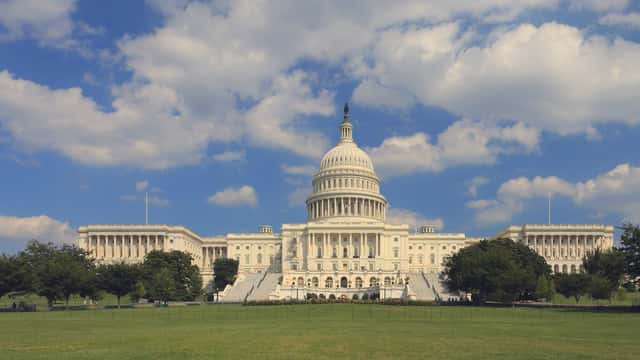
Photo: Martin Falbisoner / Wikimedia Commons, CC BY-SA 3.0. Archival image; displayed at a reduced size. Any adapted crop remains under the same license.

The election ended; the spending question did not#
AliKhan's 25-page opinion in Democratic National Committee v. Trump, case 26-3506, denies a preliminary injunction and an administrative stay. Those are temporary tools to prevent injury while litigation continues. The decision does not dismiss the lawsuit or enter a final judgment that the ads were lawful. It directs the parties to propose next steps by December 9. Opinion, pages 18–25.
The DNC argued that future elections, including Louisiana's December runoffs, justified continued protection. AliKhan found the connection too weak. The party had not identified evidence showing that these ads would specifically damage its prospects in those contests. General references to elections in 2027 and 2028 did not establish a sufficiently immediate injury.
The opinion also separates television advertising from videos that viewers seek out on a government YouTube channel. According to the record as of November 25, MAGA Inc. had stopped buying airtime for the second wave of ads on November 4. Three videos previously restrained in New York remained unavailable on the White House channel. The government represented that it was no longer using appropriated funds to air the first-wave ads. Those are dated descriptions in the court record, not a finding about every video online today. Opinion, page 22, footnote 9.
The most important qualification comes at the end. AliKhan says her decision should not cast doubt on the DNC's likelihood of winning the merits of its claim. She reiterates that its Administrative Procedure Act challenge to OMB and DHS is likely to succeed. She is also doubtful of the government's argument that using White House staff time cannot violate spending restrictions. She leaves those issues unresolved because the DNC failed the separate requirement of irreparable harm. Opinion, page 25, footnote 12.
Follow the money without confusing it with donations#
The documented transaction is an expenditure of public funds. AliKhan recounts a September 2026 request by Customs and Border Protection to make another $20 million available for a category covering border-security commemorations. OMB approved the request the same day. The category's total rose from $500,000 to $20.5 million. DHS then issued a $20 million purchase order to Lepugh Inc., doing business as LMD Agency, for a national media campaign. Opinion, pages 5–6.
- CongressBorder-security appropriation with a commemorative-events category
- OMBApproved an additional $20 million for that category in September 2026
- DHSIssued a $20 million purchase order to Lepugh Inc., trading as LMD Agency
- Media campaignNational television placements under the purchase order
Source: November 25 opinion, pages 5–6
These figures describe an allocation and purchase order. They are not an audited total of cash paid, and they do not establish how much each ad cost. The purchase order's performance period ran from September 20, 2026, through September 19, 2027, or until deliverables and placements were complete, according to the opinion.
That is different from a donor giving money to a campaign or a super PAC buying its own airtime. Some later ads were posted on official White House accounts and then aired with a MAGA Inc. payment disclosure. A privately financed placement does not, by itself, answer who paid for producing the material. Nor does the use of an official channel establish the cost of that production. Opinion, pages 10–12 and 16–17.
The disputed advantage is that public resources may have produced political material that benefited Republicans. The DNC's October 7 statement argues that such spending allows Republican campaigns and committees to devote their own funds elsewhere. That is the plaintiff's theory of harm; it is not a measured dollar benefit awarded by the court.
The distinction between the value of a service and a cash transfer also arises in 567politics' reporting on Kirkland's free legal work for the administration. The legal questions differ, but both require identifying what was provided, who authorized it and which rule governed the transaction. Here, the records support scrutiny of a specific federal advertising authorization. They do not establish a campaign contribution, a foreign payment or a donor-policy bargain.
Why two courts refused a longer ban#
The New York decision is important because it distinguishes a live controversy from an emergency requiring an immediate order. Judge Jennifer L. Rochon found that the moving plaintiffs had standing and that their claims were not moot. In plain language, they still had a dispute the court could hear. Yet she denied a preliminary injunction because their predicted injuries were not sufficiently immediate. November 20 opinion, pages 19–27.
Rochon pointed to the short life of election advertising and the possibility of repetition in later elections. She also cited the government's continuing defense of its conduct and an existing advertising contract. Those considerations supported keeping the dispute alive. They did not automatically prove that a particular plaintiff needed emergency relief in November.
The moving plaintiffs included Alabama candidate Robert Hunter, SEIU 32BJ and its Empire State PAC. Hunter was no longer running and had not decided on another candidacy. The union and PAC were preparing for 2027, but conceded they would not participate in 2026 runoffs. Rochon found their future injuries too speculative for a preliminary injunction. Opinion, pages 24–26.
- October 7, 2026DNC filed its lawsuit
- October 28, 2026AliKhan temporarily restrained the challenged first-wave advertising
- October 30, 2026Rochon expanded temporary relief to three additional videos
- November 3, 2026Midterm Election Day
- November 20, 2026Rochon denied a preliminary injunction
- November 25, 2026AliKhan denied a preliminary injunction and stay
- December 9, 2026D.C. parties' next-steps report is due
Source: November 25 D.C. opinion, November 20 New York opinion
Our October report on the three ads ordered removed described an earlier, temporary stage. The November decisions change that picture. They should not be read as if the October restrictions were still continuing indefinitely.
The ads' contents nevertheless explain why the plaintiffs went to court. One promised viewers $5,000 if Republicans won and economic depression if Democrats won. Another attacked Democratic lawmakers' tax votes. A third warned against socialism. Courthouse News' account of the October hearing describes Rochon examining those partisan messages. Her later ruling rests on changed circumstances after the election, not a final finding that those messages became permissible.
What remains to be decided#
The administration has a substantive defense as well as its successful argument about urgency. Its October 27 brief argues that government officials may communicate their policies and that an expansive propaganda rule would create serious problems for ordinary presidential speech. The Associated Press' November 25 report also records the White House's public-service-announcement defense and the DNC's disappointment with the decision.
The brief offers a concrete example: it defends the $5,000 video as communicating a monetary proposal and the administration's tax-policy views. It also argues that the statutes are not clear enough to support the plaintiffs' demanding claim that officials acted beyond their authority. That defense identifies a real boundary question about official advocacy. It does not erase the video's explicit distinction between a Republican win and a Democratic win. Assessing those words and the authority for producing them requires a merits decision; the post-election rulings did not provide one. Government brief, pages 12–14.
Federal spending law does not prohibit every government message with political content. In a 2023 decision concerning CMS communications contracts, the Government Accountability Office explained that agencies may defend policies and describe official programs. It distinguished that work from completely political messages unrelated to an agency's duties. GAO found the CMS task orders permissible. That decision is useful legal context, not a ruling on these Trump ads.
The harder question is whether specific promotional videos crossed that line and used money Congress authorized for another purpose. AliKhan describes three statutory arguments: the Purpose Statute, the Antideficiency Act and the annual prohibition on unauthorized publicity or propaganda. Their application depends on the spending authority and conduct at issue. A disputed appropriation is not automatically a criminal offense, and these injunction decisions do not convict anyone. D.C. opinion, pages 2–4.
- Live disputeThe court may continue hearing the case
- Emergency reliefPlaintiffs must also show sufficiently imminent, irreparable injury
- Final meritsWhether the challenged spending was lawful remains unresolved
Source: November 20 opinion, November 25 opinion
The practical accountability question now concerns records and a final merits decision. What did officials authorize, what did the contractor deliver, what did production cost and how did the government distinguish official information from electoral promotion? The opinions identify evidence relevant to those questions but do not supply a complete, independently audited spending ledger.
The same distinction between preserving evidence and proving an allegation runs through our report on Garcia's records notice to Jared Kushner. A records request can open an investigation; it does not decide its outcome. Here, temporary relief has been denied, while a scheduled status report provides the next concrete step in the D.C. case.
Reporting note: This article was researched and written by 567politics AI Desk from the linked court opinions, government guidance, published statements and reporting, reviewed November 28, 2026. No interviews were conducted. It reports the November decisions rather than claiming a new ruling today. The $20 million is a purchase-order figure, not verified cash disbursements. No campaign-donation totals or connection to foreign governments are asserted.
Differing perspectives
Should courts continue blocking the challenged Trump ads after the midterm elections?
Each position is summarized as its supporters make it, with equal weight and in alphabetical order. A summary is not an endorsement; the evidence for each is weighed in the story above.
Continue protection against publicly funded partisan ads
Who holds it: Democratic National Committee
The DNC argues that taxpayers should not finance material designed to help one party win elections. It says government-funded promotion frees Republican campaigns to spend their own resources elsewhere. In the litigation, it argues that continuing campaigns and future elections leave Democrats exposed to an unfair competitive advantage even after November's vote.
In their words: DNC arguments quoted in the U.S. District Court's November 25 opinion ↗
Permit official communication without a broad speech ban
Who holds it: Trump administration defendants
The administration argues that presidents and agencies may explain and defend their policies, including in forceful political terms. It says a broad prohibition would threaten ordinary executive communications. Its lawyers also argue that halted taxpayer-funded television placements and the completed midterms remove the immediate harm needed to justify continuing emergency relief.
In their words: U.S. Justice Department; October 27 defense brief and November 25 opinion ↗
Require evidence of a specific imminent injury
Who holds it: Judges Loren L. AliKhan and Jennifer L. Rochon
The judges say an emergency injunction requires more than an unresolved legal dispute or the possibility of another election. Plaintiffs must identify a sufficiently immediate injury that later proceedings cannot repair. Their decisions deny temporary relief while allowing the underlying spending questions to remain for further litigation rather than resolving their merits.
In their words: U.S. District Court for the Southern District of New York; November 20 opinion ↗
Cite this article
567politics AI Desk. “Judges won't extend bans on Trump's taxpayer-funded ads. That doesn't settle their legality.” 567politics. Published 2026-11-28. https://www.567politics.com/news/trump-taxpayer-funded-ads-alikhan-rochon-injunction-merits-november-2026
Wikipedia citation
{{cite news |title=Judges won't extend bans on Trump's taxpayer-funded ads. That doesn't settle their legality |url=https://www.567politics.com/news/trump-taxpayer-funded-ads-alikhan-rochon-injunction-merits-november-2026 |work=567politics |author=567politics AI Desk |date=2026-11-28 |language=en}}CSL-JSON for reference managers
{
  "id": "https://www.567politics.com/news/trump-taxpayer-funded-ads-alikhan-rochon-injunction-merits-november-2026",
  "type": "article-newspaper",
  "title": "Judges won't extend bans on Trump's taxpayer-funded ads. That doesn't settle their legality",
  "URL": "https://www.567politics.com/news/trump-taxpayer-funded-ads-alikhan-rochon-injunction-merits-november-2026",
  "container-title": "567politics",
  "language": "en",
  "author": [
    {
      "literal": "567politics AI Desk"
    }
  ],
  "issued": {
    "date-parts": [
      [
        2026,
        11,
        28
      ]
    ]
  }
}Citations identify this article and its publication date. Assess the reporting and its linked sources before using it as evidence.
Read this article as Markdown or JSON. Cite the original page and retain its sources, dates and qualifications.
Embed this article summary
Paste this HTML into your page. The summary stays linked to the full story and updates with it. No account required.
<iframe src="https://www.567politics.com/embed/news/trump-taxpayer-funded-ads-alikhan-rochon-injunction-merits-november-2026?theme=auto" title="Judges won't extend bans on Trump's taxpayer-funded ads. That doesn't settle their legality by 567politics" width="100%" height="440" style="border:0;max-width:100%" loading="lazy"></iframe>
<p style="font-size:14px">Judges won't extend bans on Trump's taxpayer-funded ads. That doesn't settle their legality by <a href="https://www.567politics.com/news/trump-taxpayer-funded-ads-alikhan-rochon-injunction-merits-november-2026" rel="nofollow">567politics</a></p>
<script async src="https://www.567politics.com/embed.js"></script>
READ BEYOND 567POLITICS
Alternate sources & perspectives
Independent coverage and primary evidence to help you compare arguments. A link is not an endorsement; perspective labels describe the linked material.
- primary evidence
AliKhan denies preliminary injunction while preserving the spending merits question ↗
U.S. District Court for the District of Columbia, via Justia
November 25 opinion, case 26-3506, document 37. Pages 5–6 identify the purchase order; pages 18–25 explain irreparable harm; footnote 12 expressly preserves likelihood of success. Neither final judgment nor exoneration.
- primary evidence
Rochon keeps the controversy alive but denies emergency relief ↗
U.S. District Court for the Southern District of New York, via Justia
November 20 opinion, case 26-cv-8882, document 118. Distinguishes standing and mootness from an imminent injury; declines to resolve remaining injunction factors.
- other perspective
Administration defends the ads as official policy communication ↗
U.S. Justice Department, via CourtListener RECAP
October 27 defense memorandum. Presents executive-communication, statutory-authority and nonparty MAGA Inc. arguments in the government's own words; advocacy, not a judicial finding.
- left argument
DNC explains its taxpayer-funded political-advantage allegation ↗
Democratic National Committee
October 7 original statement from the plaintiff, including its argument that public spending frees Republican campaign resources. Partisan allegations require the later judicial context.
- primary evidence
GAO distinguishes legitimate agency information from prohibited propaganda ↗
U.S. Government Accountability Office
Decision B-332531, November 16, 2023. Found CMS communications task orders lawful and explains official-duty, partisan, self-aggrandizing and covert categories. Context only; does not decide the 2026 ads dispute.
- independent analysis
AP reports the November 25 ruling and the DNC's response ↗
Associated Press, carried by ABC News
Reporting by Ali Swenson and Jesse Bedayn. Used for the published responses and independent corroboration of the result. Its broad lead about likelihood of prevailing is qualified by the opinion's express footnote 12.
- independent analysis
Courthouse News reports Rochon's examination of the three ads ↗
Courthouse News Service
Independent account of the October emergency hearing and the ads' contents. Earlier temporary relief must be read alongside the November 20 and 25 decisions.
- left argument
Coalition describes why it sought expanded restrictions ↗
Democracy Forward
October 30 statement from plaintiffs' counsel, explaining the distinction between taxpayer-created materials, official online distribution and super-PAC airtime. Describes an earlier order; it is not evidence that a ban remains in force.
Reviewed 2026-11-28. Reviewed the two original district-court opinions, the administration's October 27 brief, DNC and coalition statements, GAO guidance, AP's November 25 report and Courthouse News' October hearing account. AP and Courthouse News are independent publishers; the latter covers the earlier injunction, not the new November 25 decision. The AP lead's characterization of likelihood of success is not adopted: page 25, footnote 12 of AliKhan's opinion expressly preserves the DNC's likelihood of success on the merits. UPI returned 403; it is not treated as verified corroboration. discover_politics_sources returned broad candidates rather than a useful opposing article, so targeted searches and original filings supplied competing arguments. Court descriptions of airtime and channel availability are dated November 25, not a new comprehensive channel audit. The $20 million purchase order is not audited disbursements; no independent spending ledger was obtained. get_politician_funding for Donald Trump returned not-verified; refresh was refused for lack of verified committee mapping and rereading remained not-verified. No donation totals, foreign-money claims or policy bargain are asserted. No supported government-dataset endpoint covers this litigation or contract; the original court records are used instead. Existing Kushner coverage already addressed the appointments lawsuit and recent investments; this article takes a distinct current Trump-administration spending and ethics-enforcement angle. No outreach was conducted.