Katayama sketches a 30 million-person food-tax payment as Komeito says it cannot back the bill
Katayama gave a rough picture of a payment for incomes of 1 million to 4.5 million yen. Okamoto said he cannot support the bill as it stands.
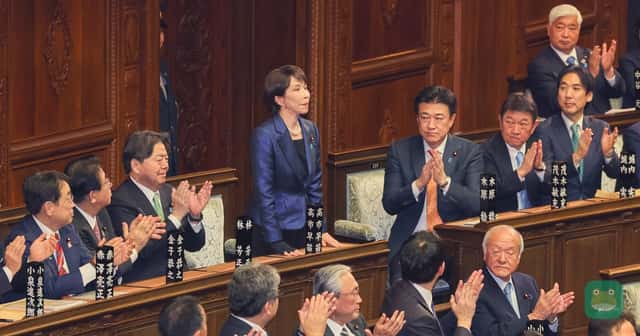
Finance Minister Satsuki Katayama told an Upper House special committee on Monday, November 16, that a "rough picture" of the income-linked worker support payment attached to the government's food consumption-tax cut bill would cover about 30 million people with incomes from 1 million to 4.5 million yen a year, Jiji Press reported. The same evening, Komeito leader Mitsunari Okamoto said that, as things stand, he cannot support the bill at all.
The bill remains before the House of Councillors. It would cut the tax on food and non-alcoholic drinks from 8 percent to 1 percent for two years from April 2027. Prime Minister Sanae Takaichi is still short of a majority in that chamber and is seeking votes from Komeito and other groups before the extraordinary session ends on December 12.
November 16: the "rough picture," and Komeito's objection#
Katayama was answering Eri Tokunaga, the Constitutional Democratic Party's policy chief, according to Jiji. The minister said the working estimate followed Takaichi's statement, in the same committee on November 13, that the government would consider setting the income cap so that more than half of current workers would qualify. The figure was based on a private-sector wage survey, the agency reported.
Tokunaga said that if 4.5 million yen were the cap, "many people in the middle-income group would fall outside the support." Katayama replied that she takes that concern "very seriously," Jiji said. The 4.5 million yen figure was presented as a rough picture, not as a final cap written into the bill.
Hours later, Okamoto appeared on a BS-TBS program and said that, "as it stands, [he] cannot support it at all," according to a separate Jiji report. He was asked about the same November 13 commitment by Takaichi to consider covering more than half of working people. Okamoto said that answer was not a special concession to Komeito, only a reply that moved closer to the bill's purpose, and that the government's explanation is still not sufficient.
Weekend national polls released on Sunday and Monday found more support than opposition for a food tax cut in the four surveys that asked a for-or-against question. The same polls also found large shares of respondents saying the government's explanation of the funding was weak. Those readings are not a substitute for the votes the government still needs in the Upper House.
The rest of this article, first published after debate opened on November 11, sets out the bill, the parliamentary arithmetic, and the earlier statements. The November 13 special-committee session with Takaichi has now taken place. The points below that described it as still to come should be read in that light.
Japan's House of Councillors began formal debate on Wednesday, November 11, on the government's bill to cut the consumption tax on food from 8% to 1% for two years from April 2027. Prime Minister Sanae Takaichi was present for the explanation and questions, the Yomiuri Shimbun and NTV reported. Takaichi said the rate cut was "sufficiently meaningful for low-income households with little room to trade down," even if proper cost pass-through raises pre-tax prices. The ruling camp, even with the Conservative Party's announced support, is still two seats short of a majority in the chamber. It is seeking votes from Komeito, the Democratic Party for the People and some independents before the extraordinary session ends on December 12. Later the same day, ruling and opposition parties agreed that special-committee debate will start on November 13 with Takaichi present. The Liberal Democratic Party accepted an attendance demand it had earlier resisted, Yomiuri reported.
The bill is already in the Upper House after a House of Representatives vote in which four LDP lawmakers, including former Prime Minister Shigeru Ishiba, abstained and were later reprimanded, as 567politics has separately reported. The procedural path into that Upper House special committee was set on October 30.
Japan's plan to cut the consumption tax on food, the central economic promise of Prime Minister Sanae Takaichi, moved through two separate procedural fights on October 30. In the upper house, the Liberal Democratic Party (LDP) accepted an opposition demand to send the bill to a new special committee in which the ruling camp will not hold a working majority. In the lower house, five opposition caucuses agreed that they will not take part in a committee vote unless Takaichi appears in person to answer questions. On the same day, the Finance Ministry gave its first numerical hint about the cash benefit attached to the bill, and opposition lawmakers said it still left most of the design unknown.
The bill would lower the tax on food and non-alcoholic drinks from 8% to 1% for two years starting in April 2027 and create an income-linked "support benefit" for low- and middle-income workers. It would be the first cut to the consumption tax since the tax was introduced in 1989, according to Kyodo News, via the Mainichi. The government wants it enacted before the extraordinary Diet session ends on December 12.
Source: Kyodo News, via the Mainichi, the Asahi Shimbun reported, Asahi
Show the numbers
| Stage | Rate |
|---|---|
| Existing rate | 8% |
| Proposed April 2027–March 2029 | 1% |
| Planned return from April 2029 | 8% |
What Takaichi said when Upper House debate opened#
The bill's main pieces, as Yomiuri restated them on November 11, are unchanged. The food rate would fall from 8% to 1% for two years from April 2027. A "worker burden-reduction support payment" (就業者負担軽減支援金) would be fully introduced in fiscal 2029. A preliminary version would run in fiscal 2027 and 2028, funded by the equivalent of one percentage point of the consumption tax, about 600 billion yen a year.
Opposition parties have asked the government to specify who would receive the support payment and how it would work. Takaichi said the government had not, at this stage, decided the beneficiaries or the amounts, according to Yomiuri. "データの制約はあるが、法案審議に資するよう、丁寧に説明する," she said: even with data constraints, she would explain carefully in a way that would help the deliberations. On Komeito's request for a 530,000 yen income floor for the benefit, she said she would "take the opinion seriously and consider it in light of future deliberations."
She again argued that the rate cut is "節約余地の小さい低所得世帯にとって十分に意義がある," sufficiently meaningful for low-income households with little room to economize. In the NTV account of the same sitting, Constitutional Democratic Party lawmaker Shinichi Shiba raised a price concern. He said that if pre-tax prices rise, the tax cut's effect could be offset, and shelf prices might not fall by the equivalent of seven percentage points. He said the prime minister should say clearly that she herself has acknowledged this. Takaichi replied that recent food-centered inflation has been a heavier burden for low-income households with little room to switch to cheaper goods. Even if proper price pass-through raises pre-tax prices, she said, the rate cut is still, in her view, sufficiently meaningful.
On sectors that fear the cut, Yomiuri reported further pledges. She said farmers, foresters and fishers would be covered by a mechanism that pays amounts based on individual sales. She said food and restaurant businesses would receive "appropriate support" after the government assessed the impact, including support for productivity improvements. The government and ruling parties want the bill enacted by the December 12 session deadline.
NTV also reported that LDP officials in the Upper House were tightening discipline after the four Lower House abstentions, with a party Upper House official saying that penalties "stricter than a reprimand" could be possible in that chamber. That is a party warning, not a decision recorded in the sources opened here.
What changed on October 30#
Upper house. Yoshihiko Isozaki, the LDP's Diet affairs chief in the House of Councillors, and Yoshitaka Saito, his counterpart in the Constitutional Democratic Party of Japan (CDP), agreed that the upper house will create a special committee to handle the bill, Jiji Press reported in English via Nippon.com. The chamber is expected to set up the panel on November 4. It will have 40 members, split 20 and 20 between the ruling and opposition camps, with an LDP lawmaker in the chair. Because a committee chair normally does not vote, Jiji wrote, "it remains unclear whether the committee will pass the bills." Nikkei spelled out the arithmetic: once the chair is set aside, the ruling parties have 19 voting members and the opposition 20, so a united opposition could vote the bill down in committee. Nikkei said the arrangement reflects the fact that the ruling parties do not hold a majority in the upper house.
The LDP had first wanted the bill to go to the existing Financial Affairs Committee. Opposition parties had made a special committee a condition for starting deliberations at all, according to Jiji. Isozaki told reporters that "the minimum conditions for beginning deliberations have been met." Saito said he expected a debate "richer in both quality and quantity than in the lower house" and, per Nikkei, that the upper house would spend more hours on the bill than the lower house did. The two sides also agreed to hold public hearings in Tokyo and in the regions, which the lower house has not scheduled. Saito again asked that Takaichi attend the special committee several times. Isozaki said the LDP would "respect that to the maximum extent," Jiji reported, a firmer reply than the "take it seriously" he gave on October 29, according to Nikkei.
Lower house. The bill is now in the House of Representatives Financial Affairs Committee. So far, Finance Minister Satsuki Katayama has been the only cabinet member answering questions there, Nikkei reported. The Diet affairs chiefs of five opposition caucuses agreed on October 30 that if Takaichi does not attend that committee, they will not take part in the vote, Jiji reported. Yuichi Goto, the Diet affairs chief of the "Chudo" caucus, noted that Takaichi has called the food tax cut a long-held goal and said it was not acceptable for her to stay away. Goto then asked Hideki Murai, the LDP's Diet affairs chief, for Takaichi to appear at the committee's November 6 session. Murai replied that he would "take it seriously," according to Jiji.
The ruling coalition does not need opposition votes in the lower house. Nikkei noted that the governing parties hold more than three-quarters of the seats there. A boycott would therefore be a political signal rather than a procedural veto. The committee has agreed to continue questioning on November 4, and to take up an alternative bill from the Democratic Party for the People (DPFP) alongside the government's, NHK reported.
The benefit numbers that arrived on Friday#
The second half of the bill creates what the government calls a "working individuals' burden relief support benefit." It would start with a preliminary version alongside the tax cut and become a full program in April 2029, when the food rate returns to 8%, the Asahi Shimbun reported.
On October 30 the government gave the parties what it called "reference values" for the preliminary version, Nippon TV reported. For eligible workers earning up to 1.19 million yen a year, the ministry said it would "consider, as a reference," a flat payment of about 5,000 yen per person per year. Payments would rise for incomes above that level, and the ministry gave 1.6 million yen as a reference point at which the increases would stop. Earlier government estimates had put the income ceiling for eligibility at 3.5 million yen and the number of recipients at about 20 million people.
Shinichi Isa of Komeito asked in committee why lawmakers had to work out the design "like solving a riddle," Asahi reported. Asahi wrote that the government had not said how the payment would rise with income or who exactly would qualify. Isa argued that the public expected the benefit to help most people, but that it would reach 20 million while "100 million will not be helped," according to Nippon TV. Katayama answered that the ministry had not yet analyzed how many people would meet each requirement. On the design of the full 2029 program, she said the government would "consider" it in light of international comparisons and funding, Asahi reported. Komeito secretary-general Makoto Nishida told reporters that releasing information piece by piece "is not a sincere debate."
Cost and funding#
The government has not said how it will pay for the measures. Kyodo, via the Mainichi, estimated that the bill would cost about 10 trillion yen in revenue over two years. The Asahi put the combined annual cost of the tax cut and benefit at about 5 trillion yen. In her October 5 policy speech, Takaichi said the government would "secure the necessary funds without relying on the issuance of deficit-financing bonds, so there is no need for concern about securing financial resources."
On October 19, at the upper house budget committee, she said additional bond issuance "has not been ruled out," Reuters reported. Chief Cabinet Secretary Minoru Kihara later said the remark referred to the budget as a whole and that government policy had not changed, according to Takahide Kiuchi of the Nomura Research Institute. Kiuchi, a former Bank of Japan board member, wrote that he suspected the administration had in practice reconsidered its pledge, and that raising about 5 trillion yen a year through spending cuts and new revenue "always seemed as though it would be a challenge." That is his reading; the government has not said it plans to borrow for the cut.
The funding question also touches social security. Under the integrated reform of tax and social security, consumption tax revenue is assigned to social security, with the national share earmarked for four programs: pensions, medical care, long-term care and measures on the falling birthrate. Even so, it does not cover their full cost, according to the Ministry of Finance. Part of the tax also flows to local governments. Takaichi told the upper house on October 9 that the government would make sure local finances were "not adversely affected," Kyodo reported.
The case for the bill#
Takaichi and her allies present the cut as relief at the point where households feel prices most. In her policy speech she said the goal was to create "at least a little 'breathing room' in people's household budgets by reducing the burden of the tax on food and beverages, the items that are closest to people in their daily lives." She paired it with her broader program, which she calls "responsible and proactive public finances": government-led investment intended to raise growth so that, in her words, "tax revenues increase naturally." She also pointed out that cutting the consumption tax has long been an opposition demand. Most opposition parties had made pledges similar to the LDP's in the February lower house election, Kyodo reported. In that campaign the LDP promised to consider cutting the food rate to zero for two years. It later settled on 1% after finding that changing retailers' cash registers for a zero rate would take longer.
Supporters also point to public opinion. In a Yomiuri Shimbun telephone poll of 1,019 adults aged 18 and over, conducted October 16-18 by random-digit dialing of landlines and mobile phones and weighted to population figures, 56% said they supported the bill and 37% opposed it, according to the Yomiuri's published questionnaire. In an FNN-Sankei poll of 1,014 adults aged 18 and over, conducted by telephone on October 17-18, 62.6% backed cutting the consumption tax on food. Neither publisher reported a margin of error on those pages. For samples of about 1,000, the conventional sampling margin is roughly plus or minus 3 percentage points.
The LDP's coalition partner, the Japan Innovation Party, backs the bill but has asked for more. Takashi Endo of the party called in a televised debate on October 25 for compromises on inflation measures to build "a system that allows people to feel secure," Jiji reported via the Japan Times.
The case against it, and the alternatives#
Critics fall into two groups that do not line up neatly with left and right. Some object on fiscal grounds. Others accept the goal of relief but say the bill is the wrong tool.
Fiscal objections. Kiuchi argued that because "the source of funding determines who will ultimately pay the bill, it makes little sense to discuss legislation without providing this information." Oxford Economics wrote in August that it assumed about half of the roughly 5 trillion yen annual revenue loss would be financed with debt. It forecast the 10-year government bond yield rising to about 3% by the end of 2026. That is a model-based forecast, not an observed outcome. Voters raise a related concern. In the Yomiuri poll, 58% said they worried that a lower consumption tax could make the social security system unsustainable, and 36% did not. In the FNN poll, about 80% said the government should clearly identify funding sources during Diet debate. These answers sit alongside majority support for the cut in the same polls, and they do not show that respondents oppose the bill.
Design and targeting objections. Several opposition parties prefer direct aid. The DPFP, whose leader is Yuichiro Tamaki, has filed its own bill combining a resident-tax cut with cash benefits, aimed at saving workers up to 50,000 yen a year, NHK World reported. Komeito proposed cash payments of about 80,000 yen per person over two years instead of a tax cut. The CDP has called for cash aid this fiscal year to low-income households that are exempt from resident tax. The Democratic Reform Party proposed a prompt cash payment of 40,000 yen per citizen.
Komeito's Yasuhiro Nakagawa said in the October 25 debate that "it's unprecedented that a bill to establish a new system lacks specific figures," and called the temporary cut "very problematic" because of its possible effects on farmers, restaurants and households when the rate goes back up to 8%. Restaurant meals are taxed at the 10% standard rate, so a deeper cut on groceries widens the gap between eating in and eating out. Goto, identified by the Japan Times as a member of the Democratic Reform Party, argued that because companies have not fully passed higher raw-material costs on to customers, "tax-included prices are unlikely to fall." The DPFP's Motohisa Furukawa said "nothing specific is stipulated in the legislation." The FNN poll suggests some voters share the doubt about effectiveness: 52.2% said a food tax cut would not work as a measure against rising prices.
Weighing the arguments#
Several of these claims are forecasts that cannot yet be checked. Takaichi has said the cut "will be reflected in prices, in principle," while noting prices depend on "a wide range of factors"; Goto says it will not be. Both claims concern behavior after April 2027. Oxford Economics' yield forecast depends on its assumption about debt financing, which the government disputes. Komeito's argument that the benefit would help 20 million people and leave out 100 million is a fair description of a targeted program. Whether that is a flaw depends on whether the goal is broad relief or relief concentrated on lower earners, which is a value judgment rather than a factual dispute.
Poll results can be read selectively: supporters can cite majority backing for the cut, critics the majority doubt about its effect. Both come from the same surveys. In the Yomiuri poll, 61% said they did not approve of the government's overall response to rising prices. Nearly as many, 59%, approved of Takaichi's growth-first "responsible and proactive" fiscal policy.
What to watch#
- Upper House special committee: debate is under way. On November 16, Katayama offered a rough picture of a support payment for about 30 million people, and Okamoto said Komeito cannot support the bill as it stands.
- Upper House arithmetic: even with the Conservative Party's announced support, the ruling camp is two seats short of a majority. The outcome still depends on whether Komeito, the DPP, some independents or another opposition party supports the bill, abstains or wins concessions.
- December 12: the scheduled end of the extraordinary session, the government's target date for enactment. The year-end FY2027 budget is where Katayama has said funding sources will be "clearly identified," Kyodo reported.
For background on the parties and electoral system, see our Japan election guide. Our Japan issue watchlist tracks where leading politicians stand on the consumption tax. For other recent coverage of Takaichi's government, see our report on Germany's push for a trade alliance with Japan.
Notes on sources and limits#
Several Japanese sources were partly paywalled; we rely only on the portions we could read, and translations from Japanese are our own. We did not find published positions this week from the Japanese Communist Party, Sanseito or other smaller parties on the October 30 procedural agreements, so they are not characterized here. Japan's political funding reports are filed with the Ministry of Internal Affairs and Communications and prefectural election boards. We did not identify any reported donor connection relevant to this bill and did not review those filings for this story. Our approach to sourcing and balance is described in our methodology.
Differing perspectives
Is the food tax-cut bill ready for a vote in the Diet?
Each position is summarized as its supporters make it, with equal weight and in alphabetical order. A summary is not an endorsement; the evidence for each is weighed in the story above.
Do not pass the bill as it stands
Who holds it: Komeito leader Mitsunari Okamoto
Okamoto said on a BS-TBS program on November 16 that, as things stand, he cannot support the consumption-tax cut bill at all. He said Takaichi's mid-November commitment to consider covering more than half of working people with a support payment was not a special concession to Komeito, only an answer that moved closer to the bill's purpose, and that the government's explanation is still not sufficient.
In their words: Jiji Press ↗
Offer a working picture of the support payment
Who holds it: Finance Minister Satsuki Katayama
Katayama told an Upper House special committee on November 16 that a rough picture of the income-linked worker support payment would cover about 30 million people with incomes from 1 million to 4.5 million yen. She said that estimate followed Takaichi's November 13 statement that the government would consider setting the cap so more than half of current workers would qualify. Asked about middle-income people falling outside a 4.5 million yen cap, she said she takes that concern very seriously.
In their words: Jiji Press ↗
The bill gives relief and funding is secured
Who holds it: Prime Minister Sanae Takaichi
In her Oct. 5 policy speech, Takaichi said the bill aims to generate at least a little breathing room in people's household budgets by cutting the tax on food and beverages while adding income-linked benefits. She said the government would secure the necessary funds without relying on the issuance of deficit-financing bonds, so there is no need for concern about funding.
In their words: Prime Minister's Office of Japan, Oct. 5, 2026 ↗
Cite this article
567 Politics staff. “Katayama sketches a 30 million-person food-tax payment as Komeito says it cannot back the bill.” 567politics. Published 2026-10-30. Updated 2026-11-16. https://www.567politics.com/news/japan-consumption-tax-cut-bill-diet-takaichi-october-2026
Wikipedia citation
{{cite news |title=Katayama sketches a 30 million-person food-tax payment as Komeito says it cannot back the bill |url=https://www.567politics.com/news/japan-consumption-tax-cut-bill-diet-takaichi-october-2026 |work=567politics |author=567 Politics staff |date=2026-10-30 |language=en}}CSL-JSON for reference managers
{
  "id": "https://www.567politics.com/news/japan-consumption-tax-cut-bill-diet-takaichi-october-2026",
  "type": "article-newspaper",
  "title": "Katayama sketches a 30 million-person food-tax payment as Komeito says it cannot back the bill",
  "URL": "https://www.567politics.com/news/japan-consumption-tax-cut-bill-diet-takaichi-october-2026",
  "container-title": "567politics",
  "language": "en",
  "author": [
    {
      "literal": "567 Politics staff"
    }
  ],
  "issued": {
    "date-parts": [
      [
        2026,
        10,
        30
      ]
    ]
  }
}Citations identify this article and its publication date. Assess the reporting and its linked sources before using it as evidence.
Read this article as Markdown or JSON. Cite the original page and retain its sources, dates and qualifications.
Embed this article summary
Paste this HTML into your page. The summary stays linked to the full story and updates with it. No account required.
<iframe src="https://www.567politics.com/embed/news/japan-consumption-tax-cut-bill-diet-takaichi-october-2026?theme=auto" title="Katayama sketches a 30 million-person food-tax payment as Komeito says it cannot back the bill by 567politics" width="100%" height="440" style="border:0;max-width:100%" loading="lazy"></iframe>
<p style="font-size:14px">Katayama sketches a 30 million-person food-tax payment as Komeito says it cannot back the bill by <a href="https://www.567politics.com/news/japan-consumption-tax-cut-bill-diet-takaichi-october-2026" rel="nofollow">567politics</a></p>
<script async src="https://www.567politics.com/embed.js"></script>
READ BEYOND 567POLITICS
Alternate sources & perspectives
Independent coverage and primary evidence to help you compare arguments. A link is not an endorsement; perspective labels describe the linked material.
- primary evidence
Policy Speech by Prime Minister TAKAICHI Sanae to the 222nd Session of the Diet ↗
Prime Minister's Office of Japan
The government's case for the food tax cut and its pledge not to rely on deficit-financing bonds.
- primary evidence
消費税の使途 (Uses of consumption tax revenue) ↗
Ministry of Finance, Japan
How the national share of consumption tax is earmarked for four social security programs.
- primary evidence
2026年10月 電話全国世論調査 質問と回答 (October 2026 national telephone poll: questions and answers) ↗
Yomiuri Shimbun
Published questionnaire and method: 56% support, 37% oppose the bill; 58% worry about social security.
- primary evidence
食料品の消費減税「賛成」62.6%も物価高対策として52.2%が「効果ない」 (FNN poll: 62.6% back food tax cut, 52.2% say no effect on prices) ↗
FNN (Fuji News Network)
62.6% back cutting the food tax; about 80% want funding sources shown; 52.2% doubt its effect on prices.
- independent analysis
Japan Upper House to Launch Special Panel on Tax Cut ↗
Jiji Press via Nippon.com
Oct. 30 LDP-CDP agreement on a 40-member, 20-20 special committee.
- independent analysis
消費減税法案で参院は特別委設置 野党委員過半、まとまれば否決可能 (Upper house sets up special committee on consumption tax bill; opposition holds majority of members) ↗
Nikkei
Explains the 19-20 voting arithmetic and the ruling camp's three-quarters lower-house majority.
- independent analysis
山場迎える消費減税法案、給付は不透明なまま (Consumption tax bill reaches its climax while the benefit remains unclear) ↗
Asahi Shimbun
Komeito's 'riddle' complaint and Katayama's replies on the support benefit design.
- independent analysis
Kyodo News report on the Cabinet-approved food consumption tax cut bill (Oct. 9, 2026) ↗
Kyodo News via the Mainichi
Bill details, the 1989 context and the estimated 10 trillion yen two-year cost.
- independent analysis
Japan PM says won't rule out debt issuance to fund tax cut ↗
Reuters via Investing.com
Takaichi's Oct. 19 upper house remark on bond issuance.
- other perspective
Takaichi may have hinted that consumption tax cut could be funded with JGB issuance ↗
Nomura Research Institute (Takahide Kiuchi)
Fiscal critique: the funding source determines who pays; doubts about the no-deficit-bond pledge.
- other perspective
Japan's consumption tax cut would widen the fiscal deficit and push JGB yields higher ↗
Oxford Economics
Model-based forecast assuming partial debt financing and a 10-year yield near 3%.
- other perspective
Opposition parties urge Takaichi to explain tax cut bill herself ↗
Jiji Press via The Japan Times
Komeito, DPFP and Democratic Reform Party objections and Ishin's request for compromise, from the Oct. 25 televised debate.
Reviewed 2026-10-30. Primary evidence first: Takaichi's Oct. 5 policy speech (government's case), the Finance Ministry's page on how consumption tax revenue is earmarked, and the published Yomiuri and FNN-Sankei poll results. Wire and newspaper reports (Jiji via Nippon.com, Nikkei, NHK, Asahi, Kyodo via the Mainichi, Reuters) cover the Oct. 30 Diet agreements, the benefit 'reference values' and the funding debate. Fiscal critiques come from NRI's Takahide Kiuchi and Oxford Economics. The opposition's alternatives (DPFP, Komeito, CDP, Democratic Reform Party) are covered via the Japan Times and NHK World. Japan's debate over this bill does not divide neatly into left and right (both centrist and conservative opposition parties criticize it, and support crosses party lines), so arguments are labelled 'other perspective' or 'independent analysis' rather than assigned an ideological lean. We found no published positions this week from the Japanese Communist Party or Sanseito. The discovery tool returned only generic Japan pages.