Israel's final count: 53 seats for Netanyahu's bloc, 48 for Eisenkot's, as officials reject fraud claims
Arab-led lists won 19 seats. A Shin Bet inquiry into suspected foreign funding is open; election officials and police report no evidence of systematic fraud.
Israel's Central Elections Committee released the final count of the October 27 Knesset election early on Friday, October 30, Israel time. It confirmed what the partial tally had suggested: neither Prime Minister Benjamin Netanyahu's governing bloc nor the opposition bloc led by Gadi Eisenkot holds the 61 seats needed for a majority in the 120-seat parliament. Netanyahu's coalition parties won 53 seats, the four-party opposition bloc won 48, and the two Arab-led lists won 19 between them, according to the committee's figures as reported by Israel National News and AFP via The Straits Times.
The count arrived alongside a fight over the election's legitimacy. Netanyahu's Likud party says the result was "stolen" through foreign-funded vote-buying in Arab communities. The committee's chairman has asked the Shin Bet security agency to investigate suspected foreign funding, Qatar has denied any role, and election officials say they see no basis for claims of systematic fraud.
Our earlier report on the partial count, which showed 54, 49 and 17 seats with about 84.5% of votes counted, covered election night. This report covers the completed count and the dispute that followed it.
The final numbers#
The committee's final results, as reported by Israel National News, give Likud 27 seats, Eisenkot's Yashar 21 and Together, led by Naftali Bennett, 12. The Joint List won 11 seats. The Democrats and Ra'am won eight each. Yisrael Beytenu, Otzma Yehudit and United Torah Judaism won seven each, and Shas and the Religious Zionist Party six each. No other list crossed the threshold.
The outgoing coalition (Likud, Otzma Yehudit, United Torah Judaism, Shas and the Religious Zionist Party) adds up to 53. The opposition bloc (Yashar, Together, the Democrats and Yisrael Beytenu) adds up to 48. The Joint List and Ra'am together hold 19.
According to the same report, turnout was 77.9%. The committee counted 5,716,665 ballots, of which 5,690,778 were valid and 25,887 invalid. The electoral threshold, 3.25% of valid votes, came to 184,947 votes.
CBS News reported that the right-wing bloc's share of seats fell from 68 to 53. CBS reported that the Arab-led lists' 19 seats are a record for them, and the Jewish Telegraphic Agency reported that Arab turnout nearly doubled from the previous election. Arab citizens make up about a fifth of Israel's population, CBS noted.
Source: Israel National News, citing the Central Elections Committee
Show the numbers
| List | Seats |
|---|---|
| Likud | 27 |
| Yashar (Eisenkot) | 21 |
| Together (Bennett) | 12 |
| Joint List | 11 |
| The Democrats | 8 |
| Ra'am | 8 |
| Yisrael Beytenu | 7 |
| Otzma Yehudit | 7 |
| United Torah Judaism | 7 |
| Shas | 6 |
| Religious Zionist Party | 6 |
Certification and the timetable to November 4#
The results are not yet certified. The committee said it will keep reviewing polling-station results over the coming days, including correcting typing and transcription errors and examining inquiries from the public and party lists. Subject to "minor adjustments," it will present the results to President Isaac Herzog on Wednesday, November 4, Israel National News reported. Herzog then consults party leaders before choosing who gets the first chance to form a government.
If no leader can assemble a majority, Israel would hold another election, and Netanyahu would remain caretaker prime minister until a new government is formed, CBS reported.
The committee's own results site did not load for this report; Israel National News, AFP and CBS give the same bloc totals from its statement.
The allegations, and what is known about them#
Three separate matters are in play, and Likud's statements often run them together.
1. The Shin Bet inquiry into suspected foreign funding#
In a letter dated Wednesday, October 28, and made public on Thursday, committee chairman Justice Noam Sohlberg asked Shin Bet director David Zini to investigate. "Serious suspicions have been brought to my attention regarding improper influence on the elections through foreign funding by outside actors operating against Israeli interests," he wrote, according to JTA. "I cannot attest to the nature of these suspicions," he added, but said the involvement of foreign entities created "an obligation to investigate them thoroughly." He asked for findings within a week, ahead of the deadline for election appeals.
The letter named no country and no party. Israeli media have reported that the inquiry concerns possible money from Qatar and Turkey intended to raise turnout in Arab communities, The Jerusalem Post reported. The Post noted that encouraging people to vote is not, by itself, evidence of election bribery.
The Shin Bet issued its own caution on Thursday. Its investigation "has not yet been completed," and "any statements concerning the substance or nature of the suspicions under investigation do not reflect the agency's position," it said, as quoted by JTA. The agency added that its intelligence came from its own operations and "did not come from any political party or political entity on either side of the political spectrum." It said an inquiry of this kind "does not cast aspersions or place blame on an entire sector that went out to vote democratically and legally," CBS reported.
On Friday, acting committee director-general Dean Livne said in a statement on the chairman's behalf that the intelligence was "highly classified" and had been shown, with Sohlberg's approval, to Netanyahu, opposition leader Yair Lapid and Eisenkot. "Reports published throughout the day are entirely unfounded," he said, according to Israel National News. He added that the investigation "will not affect the final results submitted to the President" and "does not concern any particular sector."
The Jerusalem Post reported that the inquiry began before election day, when Zini publicly called the vote secure; Ynet reported that committee officials are asking why the agency did not act earlier.
2. A separate police bribery case#
Police are separately investigating suspected payments for votes involving Ra'am ballot slips. Three residents of southern Israel were arrested on election day and four more men on Thursday, and the case was transferred to the Lahav 433 national fraud unit, the Jerusalem Post reported. Police said searches had found cash and Ra'am ballot slips. Their statement did not identify any link between that case and the suspected foreign funding.
3. Likud's broader claim that the election was "stolen"#
Likud's claim goes much further than either investigation. "Israel's elections have been stolen," the party said on Thursday, describing "an attack on democracy aimed at leading to a foreign takeover of the Knesset, the Islamization of Israel, and the overthrow of the right-wing government," according to CBS. In a statement posted on Netanyahu's X account, Likud called what it named the "Ra'amgate affair" an "earthquake," JTA reported. The party says it has submitted hundreds of testimonies and recordings to police, the Shin Bet and the committee, and a Likud lawyer told the Jerusalem Post the party intends to seek invalidation of results at polling stations where it suspects irregularities.
Officials who have reviewed the matter have rejected that broader claim so far. On Thursday, Livne said "the elections to the Knesset were conducted lawfully" and that "to the best of our knowledge there is no basis for claims of systematic harm to the integrity of the elections," JTA reported. Police said election day saw relatively few integrity incidents and that they had no investigative or intelligence support for the allegations Likud put to them, according to the Jerusalem Post.
What is established: an inquiry into suspected foreign funding is open; a separate bribery case has produced seven arrests; and the election authority and police say they have seen no evidence of systematic fraud. What is not established: whether any foreign money reached Israeli voters or parties, who sent or received it, and whether it changed any seat. The legal threshold: under Section 86 of the Knesset Elections Law, as summarized by the Jerusalem Post, a court can annul results only on appeal, filed within 14 days of publication, and a central test is whether an irregularity could have affected the outcome.
Qatar's response#
Qatar's foreign ministry rejected the allegations outright. "We categorically deny allegations that Qatar has interfered in Israeli elections or funded any activities intended to influence their outcome," spokesman Majed al-Ansari said, as quoted by CBS and JTA. He called the claims "ridiculous and dangerous" and said Qatar "should not be used as a scapegoat for the political failures of certain Israeli politicians."
How the camps are responding#
Netanyahu's coalition and the right#
Likud's argument is that foreign money, routed to Arab communities, inflated turnout enough to deny the right its majority, and that a government relying on the Arab-led lists would therefore lack legitimacy. On Thursday the party urged other Zionist parties not to cooperate with Ra'am or the Joint List to elect a new Knesset speaker or form a government, the Jerusalem Post reported. Knesset Speaker Amir Ohana of Likud called the allegations the most serious in Israel's democratic history, and National Security Minister Itamar Ben-Gvir called for the arrest of Arab party leaders suspected of involvement, JTA reported.
The strongest version of this argument does not depend on the "stolen" framing. Foreign funding of an election campaign would be a serious offense whatever its effect, and the election chairman himself called the suspicions serious enough to order an inquiry. Yoav Limor, a columnist for the right-of-center daily Israel Hayom, argued that the suspicions "demand a thorough investigation that produces clear conclusions" and asked how any funds moved, through bank accounts, money changers or cash. He also faulted Likud for its silence over earlier reports of Qatari payments to Netanyahu aides, and called Qatar "a malign state."
Eisenkot's opposition bloc#
Eisenkot has welcomed an investigation while accusing Netanyahu of using it to undermine the result. "It is too early to determine what happened, or if anything happened at all," he said, according to the BBC. "What is already clear is that Likud and Netanyahu have embarked on an orchestrated and organized campaign to delegitimize the election results," he said, as quoted by JTA. In a social media post reported by CBS, he accused Netanyahu of an "improper influence operation" aimed at "delaying the publication of the election results on time."
Democrats leader Yair Golan said genuine suspicions must be investigated but accused Netanyahu of trying to delegitimize voters' choice, especially that of Arab citizens, the Jerusalem Post reported. On X, as quoted by NBC News, he wrote: "We must no longer accept Netanyahu's racist division between Jewish votes and Arab votes."
The strongest version of this argument is that an unproven allegation is being used to rule out a set of elected lawmakers before investigators report. The officials closest to the evidence, at the election committee, police and Shin Bet, have each cautioned against treating the inquiry as a finding.
The Arab-led parties#
Ra'am leader Mansour Abbas denied any connection. "Ra'am has no connection whatsoever to the affair in question or to any other such affairs," he said, pledging to cooperate with law enforcement, JTA reported. Addressing Netanyahu, he added: "There will be nothing, because there is nothing." Balad chairman Sami Abu Shehadeh, whose party ran on the Joint List, called the accusations a "racist blood libel," according to the Jerusalem Post.
Researchers quoted by JTA offered an alternative explanation for the turnout. Rami Zeedan, a scholar of Arab political participation in Israel, said he observed extensive grassroots mobilization during fieldwork this summer and called the turnout a "genuine and highly visible effort" to replace the government. These are expert observations, not a measurement of how much organic mobilization contributed; that question is unresolved until the inquiry reports.
The president#
Herzog, who will choose who gets the first mandate, called for a thorough investigation while warning, "we must not tarnish an entire community that sought to exercise its right to vote," JTA reported.
Reasoning check#
Two inferences deserve scrutiny. The first moves from "Arab turnout rose sharply" to "the rise was bought." A large rise in turnout is consistent with both organized mobilization and illicit funding, and turnout alone cannot separate the two; that is the question the inquiry is meant to answer. The second moves from "an investigation has been opened" to "the allegation is true," or, in the other direction, from "officials have seen no systematic fraud" to "nothing improper happened." Neither step follows. An open inquiry is not a finding, and the absence of systematic fraud does not rule out a narrower offense. So far, the count stands, a targeted inquiry is open, and no public evidence shows any seat was affected.
Paths to a government#
The arithmetic leaves three broad options, which the BBC laid out. One is a unity arrangement between Likud and some opposition parties. A second is Netanyahu peeling off enough opposition lawmakers to reach 61. A third is an Eisenkot-led government that relies on the Arab-led lists, either inside the coalition or supporting it from outside. Eisenkot and all but one member of his bloc ruled out depending on the Arab parties before the vote, the BBC reported. CBS reported that the heads of both Arab-led lists have said they would help oust Netanyahu.
CBS noted that once sworn in, the opposition bloc and Arab-led lists together will hold a Knesset majority, even before any government exists, which is why Likud's appeal on the speakership matters.
Netanyahu, whom Donald Trump endorsed before the vote according to CBS, remains prime minister in a caretaker role until a government is formed.
Context: contested results elsewhere this month#
Other countries have seen results contested this month. In Brazil, Flávio Bolsonaro dropped an annulment bid after the runoff. In Serbia, the election commission confirmed the Student List's majority while President Aleksandar Vučić warned against the incoming government. Those cases are not evidence about Israel's, but each shows certification proceeding amid political challenges.
Open questions#
- What the Shin Bet finds, and whether the committee publishes it before the appeal window closes.
- Whether Likud files a court appeal, and against which polling stations.
- Whom Herzog picks after consultations that begin once he receives the results on November 4.
- Whether the opposition and Arab-led lists cooperate on the Knesset speakership once the new Knesset is sworn in.
About this report#
This AI-assisted report was prepared on October 30, 2026. Final results are as released by Israel's Central Elections Committee and reproduced by Israel National News and AFP; the committee's results site did not load for this report. Statements are attributed to the outlets that published them, including CBS News, NBC News, the BBC, JTA, The Jerusalem Post, Ynet and Israel Hayom. No representative poll on the allegations with full methodology was available, so this report does not describe public opinion. U.S. Federal Election Commission data does not apply to the Israeli politicians discussed; Israel's own party-finance oversight was not reviewed because this report makes no claim about any named politician's funding. Our approach is described in the 567politics methodology.
Photo note#
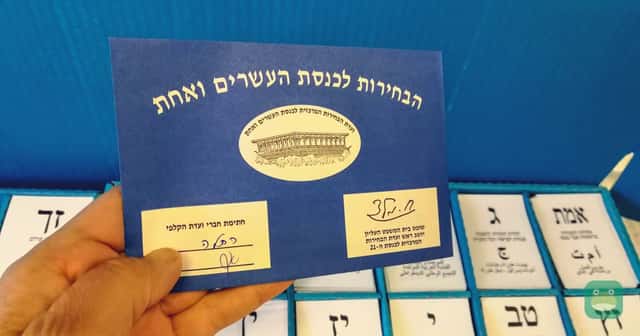
File image of a ballot envelope and party ballot slips from Israel's April 2019 Knesset election, not from the 2026 vote. Photo: Laliv g, original file, CC BY-SA 4.0. Cropped for publication.

Differing perspectives
How should Israel respond to the allegations of foreign funding in its election?
Each position is summarized as its supporters make it, with equal weight and in alphabetical order. A summary is not an endorsement; the evidence for each is weighed in the story above.
Investigate the claims and respect the results
Who holds it: Gadi Eisenkot of Yashar and Sami Abu Shehadeh of the Joint List
Gadi Eisenkot says "it is too early to determine what happened, or if anything happened at all." He says Likud and Netanyahu have embarked on "an orchestrated and organized campaign to delegitimize the election results." Sami Abu Shehadeh of the Joint List says the losing side is "constructing a racist blood libel" and calling on the security agencies to overturn the result.
In their words: BBC News, Oct. 30, 2026 ↗
Treat the funding claims as an attack on the election
Who holds it: Likud and Prime Minister Benjamin Netanyahu
Likud said in a statement that "Israel's elections have been stolen." It described "an attack on democracy aimed at leading to a foreign takeover of the Knesset, the Islamization of Israel, and the overthrow of the right-wing government." Netanyahu and Likud allege that Arab-majority parties were helped by foreign funding that amounted to vote-buying.
In their words: CBS News, Oct. 30, 2026 ↗
Cite this article
567politics News Desk. “Israel's final count: 53 seats for Netanyahu's bloc, 48 for Eisenkot's, as officials reject fraud claims.” 567politics. Published 2026-10-30. Updated 2026-11-02. https://www.567politics.com/news/israel-final-count-53-48-19-allegations-october-2026
Wikipedia citation
{{cite news |title=Israel's final count: 53 seats for Netanyahu's bloc, 48 for Eisenkot's, as officials reject fraud claims |url=https://www.567politics.com/news/israel-final-count-53-48-19-allegations-october-2026 |work=567politics |author=567politics News Desk |date=2026-10-30 |language=en}}CSL-JSON for reference managers
{
  "id": "https://www.567politics.com/news/israel-final-count-53-48-19-allegations-october-2026",
  "type": "article-newspaper",
  "title": "Israel's final count: 53 seats for Netanyahu's bloc, 48 for Eisenkot's, as officials reject fraud claims",
  "URL": "https://www.567politics.com/news/israel-final-count-53-48-19-allegations-october-2026",
  "container-title": "567politics",
  "language": "en",
  "author": [
    {
      "literal": "567politics News Desk"
    }
  ],
  "issued": {
    "date-parts": [
      [
        2026,
        10,
        30
      ]
    ]
  }
}Citations identify this article and its publication date. Assess the reporting and its linked sources before using it as evidence.
Read this article as Markdown or JSON. Cite the original page and retain its sources, dates and qualifications.
Embed this article summary
Paste this HTML into your page. The summary stays linked to the full story and updates with it. No account required.
<iframe src="https://www.567politics.com/embed/news/israel-final-count-53-48-19-allegations-october-2026?theme=auto" title="Israel's final count: 53 seats for Netanyahu's bloc, 48 for Eisenkot's, as officials reject fraud claims by 567politics" width="100%" height="440" style="border:0;max-width:100%" loading="lazy"></iframe>
<p style="font-size:14px">Israel's final count: 53 seats for Netanyahu's bloc, 48 for Eisenkot's, as officials reject fraud claims by <a href="https://www.567politics.com/news/israel-final-count-53-48-19-allegations-october-2026" rel="nofollow">567politics</a></p>
<script async src="https://www.567politics.com/embed.js"></script>
READ BEYOND 567POLITICS
Alternate sources & perspectives
Independent coverage and primary evidence to help you compare arguments. A link is not an endorsement; perspective labels describe the linked material.
- independent analysis
Final election results released: Full seat distribution and political bloc breakdown ↗
Israel National News
Reproduces the Central Elections Committee's final party seat totals, turnout, valid and invalid ballot counts, threshold, the Nov. 4 handover date, and acting director-general Dean Livne's statement on the Shin Bet inquiry. Used here in place of the committee's own results site, which did not load.
- independent analysis
Netanyahu bloc finishes in lead but short of majority: Official results ↗
The Straits Times (AFP)
Wire report on the committee's final results, confirming the 53-48-19 bloc split, Likud as the largest party, the Shin Bet's caution and the timeline to the president.
- independent analysis
Israel probes suspected Qatari, Turkish funding to boost Arab turnout ↗
The Jerusalem Post
Separates the Shin Bet foreign-funding inquiry, the police bribery case and Likud's legal challenges, and summarizes Section 86 of the Knesset Elections Law on election appeals.
- independent analysis
What next as Netanyahu's party claims Israel's election was stolen? ↗
CBS News
Quotes Likud's 'stolen' statement, the Shin Bet and committee responses, Qatar's denial and Eisenkot's reply, and explains the caretaker and coalition rules.
- independent analysis
Israeli officials reject Netanyahu's claim of a 'stolen' election ↗
Jewish Telegraphic Agency
Quotes Sohlberg's letter, Livne's statements, the Shin Bet, Likud, Ra'am, Joint List figures, Herzog, and researchers who argue the Arab turnout rise reflected grassroots mobilization.
- independent analysis
Israeli opposition accuses Netanyahu of trying to 'delegitimise' election ↗
BBC News
Reports the allegations and responses, including Eisenkot's 'too early to determine' remark and Balad's 'racist blood libel' reply, and lays out three possible routes to a government.
- independent analysis
Israel's final election results show neither Netanyahu nor rival can immediately form a government ↗
NBC News
Final-results report with statements from the election committee, Mansour Abbas and Democrats leader Yair Golan.
- other perspective
Qatar denies meddling in Israeli election: 'If it were true, Qatar would own all of Israel' ↗
Ynet
Israeli outlet's account of Qatar's response, the committee chairman's request, briefings given to Netanyahu and Eisenkot, and questions inside the committee about when the Shin Bet knew.
- other perspective
Qatar election interference allegations raise troubling questions about Shin Bet's failures ↗
Israel Hayom
Opinion column by Yoav Limor in a right-of-center daily arguing the suspicions require a thorough, conclusive investigation and questioning the Shin Bet's performance, while faulting both political camps.
Reviewed 2026-10-30. discover_politics_sources returned only generic Israel pages (Wikipedia, Britannica, outlet homepages), so these sources were found by direct search and each was opened and checked on October 30, 2026. The Central Elections Committee's results site (votes26.bechirot.gov.il) and The Times of Israel did not load for this review, so committee figures are cited through outlets that reproduced its statement. No standalone opinion piece making Likud's 'stolen election' case, or a left-wing or Arab-party opinion essay, was verified for this list; those positions are represented through party statements quoted in the news reports above. Findings of the Shin Bet inquiry had not been published as of this review.