Germany sets 2030 AI targets at Berlin Digital Summit but names no budget
Merz says Germany must get faster at building and using AI. A task force plan sets adoption goals for firms and agencies but commits no new money.
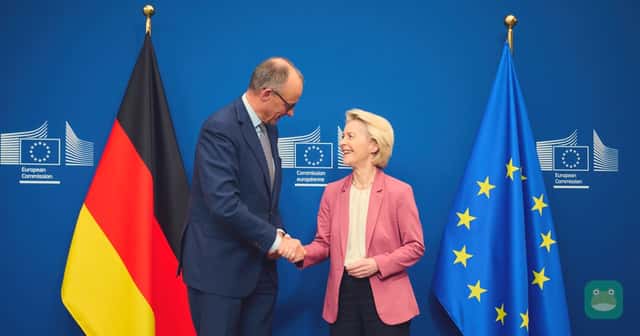
Germany's government presented a plan on Monday to make the country what it calls an "AI nation" by 2030. Chancellor Friedrich Merz told the federal Digital Summit in Berlin that Germany must get much faster at building and using digital tools. The plan sets targets for business and government use of artificial intelligence. It does not say how much money will be spent.
The summit runs on November 2 and 3 at the Wilhelm-Hallen in Berlin's Reinickendorf district. That is according to the Federal Ministry for Digital Affairs and State Modernization, known by its German initials BMDS. This year's motto is "Shaping AI: safe, sovereign, competitive." Merz and Digital Minister Karsten Wildberger, a member of Merz's Christian Democratic Union (CDU), held a press conference on the first afternoon.
What the chancellor said#
Merz framed the plan as a matter of keeping pace. The public broadcaster ARD's tagesschau quoted him. "We can, and I think we must, become much faster and better in Germany and in Europe at developing digital technologies and really using them," he said. He added: "We must, we want to become front-runners." He warned that refusing the technology would lead to decline.
Merz said technology policy should be "in line with our values and security interests," tagesschau reported. Tagesschau said the government wants to cut its dependence on the United States and China and to work more closely with France and Canada.
Wildberger spoke before the summit opened. "There is value creation there, there is growth there, there are jobs there," he told ARD, according to the Frankfurter Allgemeine Zeitung. He said regulation needs "more room for innovation." He described sovereignty as having a choice of suppliers. He added that Germany still wants to live "in a world that also lives from partnerships."
At the summit itself, Wildberger said "we are still too slow" and "we underestimate what is coming," the tech outlet heise reported. He also said: "We cannot regulate every detail in advance."
Where the plan came from#
The plan is the final report of an AI task force. The National Security Council set up the task force in the summer, with the digital ministry in charge, tagesschau reported. The energy and utilities trade outlet ZfK reported that the group first met on July 2 under State Secretary Markus Richter. Politico Europe described the goal as making Germany a "sovereign AI nation" by 2030. The coalition agreement between the CDU, its Bavarian sister party the CSU, and the Social Democrats (SPD) had already used the phrase "AI nation," the FAZ noted.
The report warns that time is short. "The window to narrow this gap is closing soon," it says, according to tagesschau and the FAZ. It calls the next 12 to 18 months decisive.
The report backs a two-track approach, tagesschau said. In the short term, Germany would focus on AI models for industry. In the longer term, it would fund research into future models, such as "physical AI" used in machines and robots.
The 2030 targets#
The report sets several numeric goals for 2030. Tagesschau, the FAZ and ZfK all reported the same core figures:
| Goal for 2030 | Target |
|---|---|
| Large companies using AI | at least 80% |
| Small and midsize firms using AI | 55% |
| Federal agencies with an AI tool for core tasks | 90% |
| Share of economic output based on AI | more than 10% |
The plan also aims to triple the number of AI startups, the outlets reported. Politico said it targets a 300% rise in data center capacity compared with 2025.
ZfK reported that the report picks 18 measures from an inventory of about 440 ideas. It groups them under six headings: society, security, application, infrastructure, frontier AI and talent. One measure would cap the time from application to start of operation for a data center at two and a half years. Politico reported that the state would act as a "strategic anchor customer" for AI products.
Wildberger said the government wants to be judged against the targets, ZfK reported. The outlet said the targets are indicative rather than binding. A group of state secretaries is to check progress every quarter. The 16 federal states, which run much of the public sector, are not bound by the plan.
How far Germany has to go#
Official data give a sense of the starting point. In 2025, 26% of German companies with at least 10 employees used at least one AI technology, according to the Federal Statistical Office (Destatis). Use rose with company size.
Source: Destatis
Show the numbers
| Company size | Share using AI |
|---|---|
| All (10+ employees) | 26% |
| 10 to 49 employees | 23% |
| 50 to 249 employees | 36% |
| 250+ employees | 57% |
Destatis counts 57% of the largest firms as AI users, against the 80% goal. Small firms stood at 23% and midsize firms at 36%. Destatis does not publish a single combined figure for small and midsize firms, and the task force report may define these groups in its own way. So the gap to the 55% goal can't be measured exactly from this table.
The report also compares spending. ZfK said it cites private AI investment of about $286 billion in the United States in 2025, against $3.9 billion in Germany. It also cites Chinese plans for about $295 billion in state spending on AI data centers. ZfK reported that the report quotes a model from the Institute for Employment Research (IAB) that projects 0.8 percentage points of extra annual growth from AI.
No price tag yet#
The plan does not commit new money. Politico reported that the measures "neither constitute funding decisions nor prejudge" future budgets. ZfK's headline called it "18 measures without a price tag." ZfK also noted that the report gives no estimate of how much electricity new data centers would need.
The digital ministry has about 600 staff, heise reported. Some civil society groups at the summit said the ministry works mainly as a ministry for the digital economy, according to heise.
What business groups want#
Business leaders at the summit backed faster AI use, though not all were upbeat about the race. Siemens chief executive Roland Busch said the race for general-purpose AI models is largely lost, heise reported.
The digital industry association Bitkom released a survey on the summit's first day. It asked companies where they would prefer their AI to come from.
Source: Bitkom
Show the numbers
| Origin | 2025 | 2026 |
|---|---|---|
| Germany | – | 96% |
| France | 38% | 46% |
| Other EU countries | 40% | 43% |
| United States | 51% | 41% |
| China | 18% | 12% |
Bitkom said 96% of firms would prefer AI from German providers. But 64% said they would not accept trade-offs for it, such as a higher price or fewer features. Preference for US providers fell from 51% to 41% over the year. Preference for French providers rose from 38% to 46%.
The survey was run by Bitkom Research for Bitkom, a lobby group for the tech sector. It reached 603 companies with 20 or more employees in Germany by phone. Fieldwork ran in calendar weeks 28 to 33 of 2026, roughly early July to mid-August. Bitkom says the sample is representative of the whole economy. The main question was: "From which countries or regions would you prefer to use AI?" Bitkom did not publish a margin of error. A second Bitkom phone survey of 602 firms fed into the release, which said 97% of firms want more public investment in key technologies.
"Germany and Europe must not only be users of AI, we must also become providers," Bitkom president Ralf Wintergerst said in the release. He called for enough computing power, access to data, regulation "that supports innovation" and a state that itself uses German and European AI.
Critics in the Bundestag#
Opposition parties had their say before and during the summit. Rebecca Lenhard of the Greens said that "at the end of the Digital Summit there must be concrete agreements and a clear road map," the Süddeutsche Zeitung's policy newsletter SZ Dossier reported. She also called for AI companies to face liability for their products, the newsletter said.
Sonja Lemke of the Left party raised other concerns, according to SZ Dossier. She pointed to the power, water and land used by data centers. She also cited working conditions for people who label training data, and payment for the data used to train models. She said the summit's focus showed it "serves profit interests alone."
The Alternative for Germany (AfD), the largest opposition party, co-led by Alice Weidel, did not issue a summit statement that 567 Politics could find. In June the AfD parliamentary group tabled two AI motions. Its digital policy spokesman, Ruben Rupp, said then that government action on AI had been "paralyzing," according to a group press release. He called for cutting red tape, "especially" from the EU, cheaper energy and more venture capital. His colleague Robin Jünger proposed an "AI Airbus," a cooperative European project under German leadership to build large language models and computing capacity.
Digital rights advocates questioned whether "sovereignty" goals will change buying habits. Markus Beckedahl of the Center for Digital Rights and Democracy told ZDFheute that dependence on large tech firms has grown. "There is always a pragmatic reason to stay with the Big Tech monopolists after all," he said.
The European context#
ZDFheute reported that about 1,000 people attended. Guests included the chief executives of the French AI firm Mistral and the Canadian firm Cohere, as well as Canada's digital minister. French President Emmanuel Macron attended last year's summit, which focused on European digital sovereignty.
The EU's AI rules form the backdrop. ZDFheute noted that the EU's "digital omnibus" package delayed some duties under the AI Act, partly under German pressure. Roberto Viola, who heads the European Commission's digital department, said at the summit that innovation is shy when regulation is present, heise reported. ZDFheute also cited a European Parliament study that puts EU payments to US tech firms at about 264 billion euros a year.
Germany's push to work with partners echoes recent trade moves. Merz has sought closer ties with Japan and Singapore this fall. Our Germany guide and German policy watchlist give wider political context.
The summit's second day#
The summit continues on Tuesday. The open questions are the ones the report itself leaves aside: how much the federal budget will commit, how the states will take part, and how new data centers will get power. Wildberger's targets give opponents and supporters a public yardstick to check between now and 2030.
This story relies on news reports of the task force paper, because 567 Politics could not open the full report. Figures attributed to the report come from those reports. For how we handle sources and balance, see our editorial standards and methodology.
Differing perspectives
Is Germany's 2030 AI plan the right way to close the gap with the United States and China?
Each position is summarized as its supporters make it, with equal weight and in alphabetical order. A summary is not an endorsement; the evidence for each is weighed in the story above.
Binding plan and liability
Who holds it: The Greens, including Rebecca Lenhard
Lenhard says that at the end of the summit there must be concrete agreements and a clear road map. She also argues that AI companies should be held liable for their products. In this view, broad targets are not enough without firm commitments and clear responsibility for harms caused by AI systems.
In their words: SZ Dossier ↗
Build German AI providers
Who holds it: Bitkom, the digital industry association
Bitkom argues that Germany and Europe must become AI providers, not just users. It says companies want sovereign AI but such offers must compete on their merits wherever the supplier is based. It calls for more computing power, access to data, regulation that supports innovation, and a state that leads by using German and European AI itself.
In their words: Bitkom ↗
Count resource and labor costs
Who holds it: The Left, including Sonja Lemke (Bundestag speech, Sept. 25, 2026)
Lemke argues that a European AI push would repeat the problems seen in the US: heavy land, power and water use by data centers and uncompensated use of creative work. She says creators and data workers must be paid for work that went into AI systems, and calls for stronger labor law and strict AI regulation.
In their words: Fraktion Die Linke im Bundestag ↗
Deregulate and back an AI Airbus
Who holds it: AfD parliamentary group (June 2026 motions)
The AfD group argues that government action on AI has been too slow. Its digital spokesman Ruben Rupp calls for cutting red tape, especially from the EU, cheaper energy and more venture capital. Robin Jünger proposes a European AI Airbus under German leadership to build large language models, computing capacity and data infrastructure.
In their words: AfD-Fraktion im Bundestag ↗
Speed up adoption now
Who holds it: Chancellor Friedrich Merz and the CDU-led government
Merz argues that Germany and Europe must become much faster at developing and using digital technologies and aim to lead, warning that refusing AI would mean decline. The government says the next 12 to 18 months are decisive. It wants industry-focused models, research into future AI, closer work with France and Canada, and technology policy in line with German values and security interests.
In their words: tagesschau ↗
Cite this article
567politics News Desk. “Germany sets 2030 AI targets at Berlin Digital Summit but names no budget.” 567politics. Published 2026-11-02. https://www.567politics.com/news/germany-ai-roadmap-digital-summit-merz-sovereignty-2030-november-2026
Wikipedia citation
{{cite news |title=Germany sets 2030 AI targets at Berlin Digital Summit but names no budget |url=https://www.567politics.com/news/germany-ai-roadmap-digital-summit-merz-sovereignty-2030-november-2026 |work=567politics |author=567politics News Desk |date=2026-11-02 |language=en}}CSL-JSON for reference managers
{
  "id": "https://www.567politics.com/news/germany-ai-roadmap-digital-summit-merz-sovereignty-2030-november-2026",
  "type": "article-newspaper",
  "title": "Germany sets 2030 AI targets at Berlin Digital Summit but names no budget",
  "URL": "https://www.567politics.com/news/germany-ai-roadmap-digital-summit-merz-sovereignty-2030-november-2026",
  "container-title": "567politics",
  "language": "en",
  "author": [
    {
      "literal": "567politics News Desk"
    }
  ],
  "issued": {
    "date-parts": [
      [
        2026,
        11,
        2
      ]
    ]
  }
}Citations identify this article and its publication date. Assess the reporting and its linked sources before using it as evidence.
Read this article as Markdown or JSON. Cite the original page and retain its sources, dates and qualifications.
Embed this article summary
Paste this HTML into your page. The summary stays linked to the full story and updates with it. No account required.
<iframe src="https://www.567politics.com/embed/news/germany-ai-roadmap-digital-summit-merz-sovereignty-2030-november-2026?theme=auto" title="Germany sets 2030 AI targets at Berlin Digital Summit but names no budget by 567politics" width="100%" height="440" style="border:0;max-width:100%" loading="lazy"></iframe>
<p style="font-size:14px">Germany sets 2030 AI targets at Berlin Digital Summit but names no budget by <a href="https://www.567politics.com/news/germany-ai-roadmap-digital-summit-merz-sovereignty-2030-november-2026" rel="nofollow">567politics</a></p>
<script async src="https://www.567politics.com/embed.js"></script>
READ BEYOND 567POLITICS
Alternate sources & perspectives
Independent coverage and primary evidence to help you compare arguments. A link is not an endorsement; perspective labels describe the linked material.
- primary evidence
Unternehmen mit Nutzung von Technologien der kuenstlichen Intelligenz nach Beschaeftigtengroessenklassen ↗
Destatis (Federal Statistical Office)
Official 2025 figures on AI use by company size.
- primary evidence
Digital-Gipfel 2026: Presse-Bereich ↗
Federal Ministry for Digital Affairs and State Modernization
Official summit dates, venue, motto and press conference recordings.
- independent analysis
Merz und Wildberger auf dem Digitalgipfel ↗
tagesschau (ARD)
Merz quotes and the main 2030 targets in the task force report.
- independent analysis
Berlin to unveil blueprint to catch up on AI ↗
Politico Europe
Report details including the no-funding caveat and data center goal.
- independent analysis
KI-Nation 2030: 18 Massnahmen ohne Preisschild ↗
ZfK
Measures, investment comparisons and monitoring setup.
- independent analysis
KI-Taskforce: Deutschland bleiben noch anderthalb Jahre ↗
Frankfurter Allgemeine Zeitung
Wildberger interview remarks and report targets.
- independent analysis
Digitalgipfel: Minister und Industrie hoffen auf KI ↗
heise online
Summit remarks from Wildberger, Siemens and the European Commission.
- independent analysis
Digitalgipfel der Bundesregierung ↗
ZDFheute
Attendance, EU AI Act context and digital rights criticism.
- independent analysis
Digitalwende: Der Digitalgipfel startet ↗
SZ Dossier
Reactions from Green, Left and CDU lawmakers.
- other perspective
Zum Digital-Gipfel: Fast alle Unternehmen wollen KI aus Deutschland ↗
Bitkom
Industry association survey and policy demands.
- left argument
Gute KI-Regulierung statt Weltuntergangsphantasien ↗
Fraktion Die Linke im Bundestag
Sonja Lemke speech on AI regulation, labor and environmental costs.
- right argument
Mit Kuenstlicher Intelligenz aus Deutschland an die Weltspitze ↗
AfD-Fraktion im Bundestag
AfD motions calling for deregulation and a European AI Airbus.
Reviewed 2026-11-02. Sources opened by 567 Politics on November 2, 2026. The full AI task force report was not available to us, so its figures come from news reports (tagesschau, FAZ, Politico Europe, ZfK). The AfD view comes from a June 2026 parliamentary group release because we found no AfD reaction to the summit. The Left view comes from a September 2026 Bundestag speech. Automated source discovery returned only general reference pages about Germany, so these sources were chosen by hand.