Starmer and Reeves make the case for closer EU ties as Burnham heads toward Brussels summit
The former prime minister urged a European security framework and the former chancellor backed rejoining. Badenoch and Farage say Brexit should stay settled.
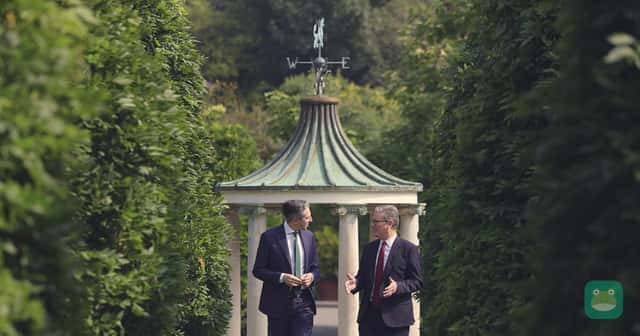
Two senior figures from Labour's last government have used the weekend to argue that Britain should move closer to Europe. Former Prime Minister Keir Starmer told a Dublin audience on Friday, October 30, that Europe needs "a common security framework as much as a common market," with Britain "central to that project." On Sunday, November 1, former Chancellor Rachel Reeves went further. She wrote that she believes "Britain's future lies in the European Union."
Both interventions land three weeks before a UK-EU summit in Brussels on November 20. Prime Minister Andy Burnham will push options there for a reset of relations. The Conservatives and Reform UK say there is no case, and no mandate, for reopening the Brexit settlement. This report sets out what each side has said, what the government has and has not promised, and what recent polling shows.
What Starmer said in Dublin#
Starmer spoke at a dinner of the British Irish Chamber of Commerce in Dublin City Hall, where he received honorary life membership, BBC News NI reported. The Guardian called it his first significant political intervention since leaving No 10 in July.
His central claim was that the change in America's role is lasting. "Europe has twice been caught asleep, failing to anticipate and prepare for predictable events," he said. The first time, he said, was "when Russia's attack on Ukraine exposed longstanding European weaknesses on defense and security." The second was "when President Trump made clear, once and for all, that the US will no longer bankroll our European security. We have to catch up."
He added: "This is about responding to a permanent change of affairs, not an aberration of the Trump presidency. Things will not go back to the way they were before."
Starmer did not call for a break with Washington. "That doesn't mean the US relationship is no longer important," he said. "On the contrary, the military, security and intelligence alliance is far too strong for that. But it does mean enabling Europe to take on far more responsibility for its own defense and security."
He said more defense spending was "part of that, but the challenge goes far beyond that," according to the Irish Times. He then set out the case for a British role. "The EU is changing to respond to that, but it cannot be the EU alone when Europe's periphery is core to its defense," he said. "Britain must be central to that project. We are one of two nuclear powers. We are a leading Nato member. We have a viable next-generation fighter jet program."
The Guardian also reported that he said Brexit had done "deep damage" to the UK economy. He said he wanted to be "more ambitious," including "closer economic cooperation [and] closer security cooperation."
The Irish setting#
Starmer spent several days in Dublin. He met business leaders and Taoiseach Micheál Martin, the Irish Times reported. The paper said he is credited with a key role in repairing relations between London and Dublin, in part by setting up an annual UK-Ireland summit. It also reported that Starmer "is mentioned as being interested in becoming Nato's next head." We have not seen Starmer confirm that interest.
"Ireland and the UK stand side by side in the coalition of the willing with Ukraine," Starmer said. He hoped "Britain's relationship with its friends and allies can and should be strengthened by this urgent and common security project."
What Reeves wrote#
Reeves made her case in the Sunday Times, the BBC reported. It was her first major intervention since leaving the Treasury. "No-one in the Treasury ever doubted where my instincts were," she wrote. "I do believe Britain's future lies in the European Union." She said Brexit had made the country "poorer, weaker and less secure."
She did not call for an immediate application. She said supporters of rejoining must "make the argument, demonstrate tangible benefits and to get the next steps right." For the November 20 summit, she said she hoped for confirmation of a youth mobility scheme. She also hoped for "progress towards entry" into Security Action for Europe (SAFE).
SAFE is an EU program to fund rearmament after Russia's full-scale invasion of Ukraine. A UK-EU defense pact agreed last May let UK-based defense firms take part in SAFE-funded projects, the BBC reported. Full entry would go further.
What Burnham's government has promised#
Burnham's own position has drawn the most scrutiny. In his first Labour conference speech as prime minister, on September 29, he promised to set out options on ties with Brussels around the time of the summit, the Independent reported. He later said this could include an option to go "all the way" and rejoin if that is what public opinion favored. He did not rule out a rejoin pledge in Labour's next manifesto.
Late in October, he suggested he could call a referendum on a return to EU freedom of movement. Downing Street then appeared to step back from that, the BBC reported. "The prime minister isn't proposing a return to freedom of movement or any option," his deputy spokeswoman said. "He is crucially not leaning either way and that will be for the British public to decide." Burnham has also said he "can't see myself ever recommending anything that would involve joining the euro or Schengen."
At Prime Minister's Questions on Wednesday, October 28, Burnham said there was "no confusion at all" about his stance, according to the BBC. "The red lines in our manifesto, including on freedom of movement, will stay in place firmly for the whole of this Parliament," he told MPs. Labour's 2024 manifesto ruled out free movement, single market membership and a customs union.
The BBC said Burnham will push options in Brussels on youth mobility, food and drink, energy and cooperation on illegal migration. In a letter to Cabinet ministers, he asked them to be "aligned and disciplined." He wrote that it "will not be appropriate for ministers individually to advocate for specific options." Any "fundamental change" would be "for the public to decide and a matter for the next Parliament," he wrote. The next general election is due by 2029.
Defense Secretary Wes Streeting was in Paris this week for a meeting of European defense ministers. He said they were "united and unwavering" in support for Ukraine, the Guardian reported.
The case against#
The Conservatives and Reform UK both oppose a return to free movement. Both say the Brexit question should stay closed.
Conservative leader Kemi Badenoch responded to Reeves on BBC One's Sunday with Laura Kuenssberg. She said she "can't even believe we are reopening" the debate. "This is not something that is needed in order to cut welfare, in order to spend money on defense," she said. "We are having yet another Westminster bubble argument about the EU when it is time for us to actually start using the opportunities, fix mistakes that have been made and go into the future." She added: "I do not want to indulge Andy Burnham's fantasies about redoing the referendum because he doesn't have a plan for what to do today."
At PMQs, Badenoch accused Burnham of failing to "respect" the 2016 vote. She recalled the years after the referendum: "We do not want to go through that again - the country was paralyzed. It was miserable, regardless of which side of the debate you were on." Burnham replied that she was "speaking the truth" about that period. He blamed "a harder Brexit than what was promised" for low growth and weak control of migration.
Reform UK leader Nigel Farage has argued that closer ties would hand power away from Parliament. "To even consider rejoining the single market, the customs union, let alone the European Union itself, is the opposite of devolution," he said in Doncaster, the Independent reported. He called it "a massive transfer of huge powers up to an authority, whereby there's nothing Parliament could do to change any of it." Told that most voters back rejoining, he suggested they would change their minds once they knew the costs. He said Burnham had "made a very big political mistake."
Farage has called a return to free movement "a total betrayal of Brexit Britain," the BBC reported. Looking to the summit, he said Burnham "must not sign up to anything there without at least putting those minor changes to a general election."
Badenoch has also argued that most people who voted for Brexit did so because they did not want free movement. The Liberal Democrats take the other side on that point. They argue that freedom of movement would help economic growth, the BBC reported.
The case for#
The pro-Europe argument now comes in two strands. One is about security. Starmer's case rests on the view that America's retreat from funding European defense is permanent. If so, he argues, Europe needs "a common security framework" with Britain at its center, alongside the US alliance. Reeves's hope for SAFE entry fits that strand.
The other strand is economic. Reeves argues that Brexit has made the country "poorer." Burnham argues that the current deal has brought low growth and less control of migration, citing the loss of a returns agreement for people who cross the Channel in small boats. Both say they want a public debate first. Reeves says the benefits must be shown, and Burnham says any big change needs a mandate.
Critics answer each strand. Badenoch says EU ties are not needed to fund defense. Farage says deeper ties would cost Parliament control. Badenoch also points to the turmoil of the years after 2016.
What the polls show#
The most recent detailed poll we found is a YouGov survey for The Times, published October 8. YouGov surveyed 2,312 adults aged 18 and over in Great Britain online on October 4 and 5, 2026. YouGov's article does not state a margin of error. For a sample of this size, a simple random sample would give about plus or minus 2 points. Online panel polls are not true random samples, so that figure is only a guide.
Asked how they would vote in a referendum on rejoining, 52 percent said rejoin and 27 percent said stay out. Another 15 percent were unsure and 7 percent said they would not vote. Among 2016 Leave voters, 22 percent said they would now vote to rejoin. Among 2024 Conservative voters, 28 percent would rejoin, as would 9 percent of Reform UK voters.
YouGov also asked what should happen if a government negotiated a deal to rejoin. Sixty-four percent said there should be a referendum first. Twenty-three percent said the government should be able to decide without one. A referendum was the preferred option in every voting group YouGov reported. That includes 54 percent of those who would vote to rejoin.
Both sides can use these numbers. Supporters of closer ties point to the 25-point lead for rejoining. Opponents can point to the strong demand for a new vote and to Farage's view that support would fall once costs were debated. The poll did not test specific options such as a customs union, single market membership or youth mobility.
What comes next#
The UK-EU summit in Brussels on November 20 is the next test. Burnham has said he hopes it will lead to "some important, concrete steps." Reeves has named youth mobility and SAFE as her markers of success. Farage has said Burnham should sign nothing without an election.
After the summit, Burnham says he will set out next steps "to consider the UK's long-term relationship with the EU as part of our 10-year plan." Other countries are also testing new forms of partnership with Brussels. Canada's recent summit with the EU produced a contested "associate membership" label.
For more background on British politics, see our United Kingdom issues page.
Differing perspectives
Should Britain seek closer ties with the European Union?
Each position is summarized as its supporters make it, with equal weight and in alphabetical order. A summary is not an endorsement; the evidence for each is weighed in the story above.
Can't even believe we are reopening it
Who holds it: Kemi Badenoch, Conservative Party leader
On BBC One's Sunday with Laura Kuenssberg, Badenoch said she "can't even believe we are reopening" the Brexit debate. She said: "This is not something that is needed in order to cut welfare, in order to spend money on defence." She called it "yet another Westminster bubble argument about the EU" and said: "I do not want to indulge Andy Burnham's fantasies about redoing the referendum."
In their words: BBC News, Nov. 1, 2026 ↗
The UK must be at the heart of a stronger Europe
Who holds it: Keir Starmer, former prime minister
Speaking in Dublin on Oct. 30, Starmer said: "A stronger Europe is vital and the UK must be at the heart of it." He said the US shift is "a permanent change of affairs, not an aberration of the Trump presidency." He called for "a common security framework as much as a common market" and said Brexit had done "deep damage" to the UK economy.
In their words: The Guardian, Oct. 31, 2026 ↗
Cite this article
567 Politics staff. “Starmer and Reeves make the case for closer EU ties as Burnham heads toward Brussels summit.” 567politics. Published 2026-11-01. Updated 2026-11-02. https://www.567politics.com/news/starmer-dublin-speech-europe-security-burnham-eu-november-2026
Wikipedia citation
{{cite news |title=Starmer and Reeves make the case for closer EU ties as Burnham heads toward Brussels summit |url=https://www.567politics.com/news/starmer-dublin-speech-europe-security-burnham-eu-november-2026 |work=567politics |author=567 Politics staff |date=2026-11-01 |language=en}}CSL-JSON for reference managers
{
  "id": "https://www.567politics.com/news/starmer-dublin-speech-europe-security-burnham-eu-november-2026",
  "type": "article-newspaper",
  "title": "Starmer and Reeves make the case for closer EU ties as Burnham heads toward Brussels summit",
  "URL": "https://www.567politics.com/news/starmer-dublin-speech-europe-security-burnham-eu-november-2026",
  "container-title": "567politics",
  "language": "en",
  "author": [
    {
      "literal": "567 Politics staff"
    }
  ],
  "issued": {
    "date-parts": [
      [
        2026,
        11,
        1
      ]
    ]
  }
}Citations identify this article and its publication date. Assess the reporting and its linked sources before using it as evidence.
Read this article as Markdown or JSON. Cite the original page and retain its sources, dates and qualifications.
Embed this article summary
Paste this HTML into your page. The summary stays linked to the full story and updates with it. No account required.
<iframe src="https://www.567politics.com/embed/news/starmer-dublin-speech-europe-security-burnham-eu-november-2026?theme=auto" title="Starmer and Reeves make the case for closer EU ties as Burnham heads toward Brussels summit by 567politics" width="100%" height="440" style="border:0;max-width:100%" loading="lazy"></iframe>
<p style="font-size:14px">Starmer and Reeves make the case for closer EU ties as Burnham heads toward Brussels summit by <a href="https://www.567politics.com/news/starmer-dublin-speech-europe-security-burnham-eu-november-2026" rel="nofollow">567politics</a></p>
<script async src="https://www.567politics.com/embed.js"></script>
READ BEYOND 567POLITICS
Alternate sources & perspectives
Independent coverage and primary evidence to help you compare arguments. A link is not an endorsement; perspective labels describe the linked material.
- primary evidence
If the government decides to rejoin EU, Britons say there should be a referendum ↗
YouGov
Poll for The Times: 52% rejoin vs 27% stay out; 64% want a referendum before any rejoin deal.
- left argument
Starmer says UK must get closer to Europe as US relationship changes ↗
The Guardian
Report built around Starmer's case for a common European security framework and closer economic ties.
- independent analysis
Europe 'must be ready' to face security threats, warns Keir Starmer in Dublin ↗
The Irish Times
Extended speech extracts and Irish context, including Starmer's meetings with the Taoiseach.
- independent analysis
Sir Keir Starmer: Europe can't rely on US to 'bankroll' defence, Dublin event told ↗
BBC News NI
Speech coverage and background on Starmer's relationship with Trump.
- independent analysis
Reeves says UK's future should be inside the EU ↗
BBC News
Reeves's Sunday Times argument for rejoining and Badenoch's response on BBC One.
- right argument
Burnham 'opening door to Reform' by reigniting Brexit debate, Farage says ↗
The Independent (PA)
Farage's case that closer EU ties would transfer power away from Parliament.
- independent analysis
Burnham insists 'no confusion at all' over his position on the EU ↗
BBC News
PMQs exchange with Badenoch, manifesto red lines and Burnham's letter to ministers before the Nov 20 summit.
- independent analysis
No 10 appears to backtrack on PM's freedom of movement referendum suggestion ↗
BBC News
Downing Street clarification on free movement; Conservative, Reform and Liberal Democrat positions.
Reviewed 2026-11-01. Reviewed November 1, 2026. Automated discovery returned only unrelated commercial and adult pages, so sources were chosen by hand from reporting the article cites. Primary evidence is the YouGov/Times poll (n=2,312 GB adults, online, Oct 4-5, 2026; no margin of error published). Left and right arguments are news reports built around one side's case (Starmer's speech; Farage's Doncaster remarks) rather than op-eds; Reeves's Sunday Times article is paywalled, so it is cited through BBC reporting. We found no Conservative or Reform reaction specifically to Starmer's Dublin speech.