Spain's top court closes Puigdemont's case 6 days before the vote, and Feijóo vows to repeal the amnesty
The Supreme Court applied the 2024 amnesty to the former Catalan leader after higher courts overruled it, putting the law back at the center of the Nov. 29 election.

Carles Puigdemont no longer faces any criminal charge in Spain. On Monday, Nov. 23, the Criminal Chamber of Spain's Supreme Court closed the last open case from Catalonia's 2017 independence push, applying the 2024 amnesty law to the former Catalan president and two of his former ministers.
Crowds at Barcelona's Arc de Triomf on Aug. 8, 2024, the day Puigdemont briefly reappeared in Catalonia while still facing an arrest warrant. Photo: Danielmoreno4774, Wikimedia Commons, CC BY 4.0.

The ruling landed six days before the Nov. 29 general election, in which Puigdemont's party could again hold the votes a prime minister needs. Within hours, PP candidate Alberto Núñez Feijóo said he would repeal the amnesty law if elected, Vox leader Santiago Abascal called it the last link in a chain of "infamy," and Junts called it a final victory over what it calls state repression. Quotations below are translated from Spanish and Catalan by 567 Politics.
What the Supreme Court decided#
The court's press office announced that the chamber declared "the extinction of the eventual criminal liability by amnesty" of Puigdemont and former regional ministers Antoni Comín and Lluís Puig. It also ordered a sobreseimiento libre, a final dismissal that cannot be reopened on the same facts. The chamber confirmed the order closing the investigation that the investigating judge, Pablo Llarena, issued on Nov. 3.
The written order is dated Nov. 20 and was notified Monday, Estrella Digital reported after reviewing it. Five judges signed it: Andrés Martínez Arrieta, who presided, Manuel Marchena, who wrote it, Julián Sánchez Melgar, Antonio del Moral and Javier Hernández. The notified text contains no dissent, according to the same report.
The three men were never tried. They had been charged in absentia with embezzlement of public funds. Because the court dismissed the case under the article of Spain's criminal procedure law used when defendants are exempt from liability, not the article used when the facts are not a crime, the order speaks of "eventual" liability. An amnesty extinguishes liability; it does not declare that what happened in 2017 was lawful.
The order leaves one door open. It preserves the civil and accounting liability that Article 8 of the amnesty law sends to the Court of Audit, where the question of public money spent on the 2017 referendum is still pending, Estrella Digital reported.

The seat of Spain's Supreme Court in Madrid. Photo: Luis García (Zaqarbal), Wikimedia Commons, CC BY-SA 3.0.

Why the court changed course#
The Supreme Court did not reach this result on its own. Since July 2024 it had held that embezzlement in the independence case fell outside the amnesty, reasoning that the accused had obtained a "personal benefit of a patrimonial nature," one of the law's own exceptions.
Two higher courts undid that reading. On July 16, 2026, the Court of Justice of the European Union ruled that diverting public funds to pay for the Oct. 1, 2017 referendum did not affect the EU's financial interests, El País reported. That had been one of the Supreme Court's reasons for refusing the amnesty. Then, on Oct. 6, Spain's Constitutional Court ruled 7 to 5, on an appeal by former minister Dolors Bassa, that the Supreme Court should have applied the amnesty to those convicted or charged with embezzlement. The Constitutional Court's judgment, No. 67/2026, was published in the official gazette on Nov. 12.
Source: Estrella Digital, El País
Show the numbers
| Side | Judges |
|---|---|
| Majority | 7 |
| Dissent | 5 |
After that ruling, the Supreme Court lifted Puigdemont's arrest warrant on Oct. 6 and applied the amnesty to the leaders already convicted of embezzlement: Oriol Junqueras, Raül Romeva, Jordi Turull and Bassa. Three of the judges who signed Monday's order had criticized the Constitutional Court in that earlier decision, accusing it of "unnecessary grandiloquence" and of invading the Supreme Court's jurisdiction, El País reported. Monday's order does not repeat that criticism. It applies Articles 1 and 8 of Organic Law 1/2024 and the Constitutional Court's doctrine.
Vox was the only party that tried to keep the case open#
Every other party in the case wanted it closed. The public prosecutor, the State Attorney's office and the three defense teams all asked for dismissal. Vox, which acted as acusación popular, a citizen prosecutor role Spanish law allows, asked the court to keep the charges and suspend the case until the EU court answers a separate question referred by Catalonia's High Court. As a fallback, Vox asked the Supreme Court to send its own question to Luxembourg.
The judges rejected both requests. A reading of the EU court's July 16 judgment "does not show the doubts the citizen prosecutor raises, without any argument to support the claim," the chamber wrote, according to El País, adding that a new EU ruling was not needed. Vox "limits itself to suggesting the advisability without any argument at all," the order said, as quoted by Europa Press.
Estrella Digital noted that the government appoints the heads of both the prosecutor's office and the State Attorney's office, the two public bodies that asked for dismissal alongside the defense.
- Catalonia holds the independence referendum courts had banned
- Supreme Court case opens as Puigdemont leaves for Belgium
- Puigdemont, Comín and Puig formally charged
- Supreme Court rules embezzlement falls outside the amnesty
- EU Court of Justice rules on the amnesty law
- Constitutional Court rules 7-5 for amnesty on embezzlement; arrest warrant lifted
- Judge Llarena closes the investigation
- Supreme Court notifies the final dismissal
- Spain votes in a general election
Source: El País, Estrella Digital, Poder Judicial
How the parties reacted#
The ruling put the amnesty back at the center of the campaign's final week, and each camp read it differently.
Junts. Puigdemont answered on X within minutes by recommending a poem by the Mallorcan writer Jaume C. Pons Alorda, "El necessari naixement de contrincants" ("The necessary birth of opponents"). The poem thanks the speaker's "dearest enemies" and ends with a vulgar line, El Mundo reported. He was expected to appear in Belgium to explain his plans, according to Estrella Digital. Earlier, he had ruled out returning to Spain before the vote, El País reported.
Junts secretary general Jordi Turull called the decision "definitive, this victory of the independence movement over the repression of the state" and "a very clear victory over the far right, because Vox was citizen prosecutor in the trial," laSexta reported. He added that "the conflict with the state remains." ERC leader Oriol Junqueras called it "wonderful" and "what is fair."
PP. Feijóo, interviewed on Antena 3 the same morning, said: "Am I going to repeal the amnesty law? Yes," calling it "a political commitment," Estrella Digital reported. He said he did not believe Prime Minister Pedro Sánchez's promise to refuse a Catalan self-determination referendum, because Sánchez had once said he would not pass an amnesty either. "This is about Spain being Spain again and about those who do not believe in our country not deciding here," Feijóo said.
Vox. At a rally in Palencia, Abascal said the amnesty for Puigdemont "is the last part of the chain of that infamy," called Sánchez a "traitor" and described the law as a betrayal of those who "defended constitutional legality in Catalonia," Europa Press reported.
PSOE and the government. 567 Politics found no new statement from Sánchez or the PSOE on Monday's order by publication time. The day before, on the program Salvados, Sánchez said he "did not do the amnesty for Mr. Puigdemont, but as the culmination of a process of normalizing coexistence in Catalan society," and said he would "of course" not agree to a referendum with Junts, El Nacional reported. In October, Justice Minister Félix Bolaños said "Catalan society has won" and that Puigdemont "could return today if he wanted," La Vanguardia reported.
What repeal would and would not change#
Feijóo's pledge would not reopen Puigdemont's case. Spain's Constitution, in Article 9.3, bars retroactive punitive measures, and a final dismissal has the force of res judicata, Estrella Digital noted in its analysis. What has been amnestied would stay amnestied. Repeal would mainly stop the law from applying to cases still pending and send a political message.
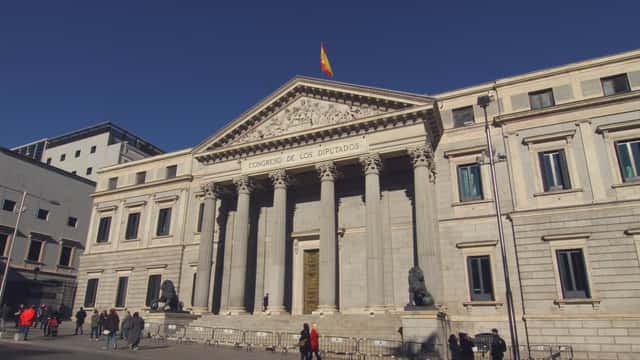
Spain's Congress of Deputies, which approved the amnesty law in 2024. The chamber elected on Nov. 29 will decide whether to keep it. Photo: Vickybol, Wikimedia Commons, CC BY-SA 3.0.

The PP has opposed the law since Congress approved it in May 2024 as the price of Junts's votes for Sánchez's November 2023 investiture. In 2023 the PP won the most seats, 137, but Feijóo could not assemble a majority. The same arithmetic shapes this election: a PP government would need Vox or abstentions, while a PSOE government would likely again need Junts and other regional parties. Feijóo has said he prefers to govern alone and listed the red lines he sets for any deal with Vox. Junts has its own demands, including defending the use of Catalan in Congress, which the PP program would reverse.
The chart below places Spain's main parties on 567 Politics' dated editorial estimates of economic and social positions. It shows positions, not vote shares, and it does not measure where parties stand on Catalonia's status, the issue that divides Junts from the PP and Vox most sharply.
What voters are being asked#
No representative poll on the amnesty taken after Monday's ruling was available by publication time, so this story does not describe what Spaniards think of the decision. Spain's ban on publishing new polls began after Monday, the last legal day. The final surveys split sharply on who will win: the state-run CIS put the PSOE ahead, while private pollsters gave the PP and Vox a majority together.
Several facts remain open. Puigdemont has not said when he will return to Spain, or whether he plans to run in a future Catalan election, now that no criminal charge blocks him. The Court of Audit case on the referendum's cost is unresolved. Catalonia's High Court still has its own question pending before the EU court, which Vox wanted the Supreme Court to wait for. And the next Congress will decide whether the amnesty law stays on the books, though not whether Monday's dismissal stands.
Puigdemont, Comín and Puig were never convicted of any crime and keep the presumption of innocence.
Differing perspectives
Should Spain keep the amnesty law that closed the case against Carles Puigdemont?
Each position is summarized as its supporters make it, with equal weight and in alphabetical order. A summary is not an endorsement; the evidence for each is weighed in the story above.
Keep the amnesty as a tool for coexistence
Who holds it: Prime Minister Pedro Sánchez, the PSOE and Justice Minister Félix Bolaños
Sánchez says he did not pass the amnesty for Puigdemont but to complete a process of normalizing coexistence in Catalonia. He argues that independence parties now talk about regional financing and commuter trains rather than a referendum, and that many officials were trapped in court cases only an amnesty could resolve. He says he will not agree to a self-determination referendum with Junts.
In their words: El Nacional (Sánchez interview on Salvados) ↗
Repeal the amnesty law
Who holds it: PP leader Alberto Núñez Feijóo and the Partido Popular
Feijóo says he will repeal the amnesty law if he wins, calling it a political commitment even though the cases it closed cannot be reopened. He links the law to Sánchez's 2023 investiture with Junts's votes and argues Sánchez cannot be trusted to refuse a referendum, since he once said he would not pass an amnesty. He says Spain should not be governed by those who do not believe in it.
In their words: Estrella Digital (Feijóo interview on Antena 3) ↗
Treat the amnesty as a betrayal and keep prosecuting
Who holds it: Vox leader Santiago Abascal and Vox, citizen prosecutor in the case
Abascal calls the amnesty for Puigdemont the last link in a chain of infamy and a betrayal of those who defended constitutional legality in Catalonia. Vox argues Puigdemont fled Spanish justice and spent years deciding who governs Spain. In court, Vox asked judges to keep the charges and wait for, or request, a European Court of Justice ruling on amnesty for embezzlement.
In their words: Europa Press ↗
Welcome the amnesty and keep pressing for independence
Who holds it: Junts secretary general Jordi Turull and Junts
Turull calls the ruling a definitive victory of the independence movement over state repression and over Vox, which sought prison terms. He says the amnesty covered everyone because Puigdemont insisted on negotiating as an equal. Junts argues the underlying conflict with the Spanish state remains unresolved and says it will keep working for Catalan independence.
In their words: laSexta ↗
Cite this article
567 Politics staff. “Spain's top court closes Puigdemont's case 6 days before the vote, and Feijóo vows to repeal the amnesty.” 567politics. Published 2026-11-23. https://www.567politics.com/news/spain-supreme-court-puigdemont-amnesty-case-closed-feijoo-repeal-vox-junts-november-2026
Wikipedia citation
{{cite news |title=Spain's top court closes Puigdemont's case 6 days before the vote, and Feijóo vows to repeal the amnesty |url=https://www.567politics.com/news/spain-supreme-court-puigdemont-amnesty-case-closed-feijoo-repeal-vox-junts-november-2026 |work=567politics |author=567 Politics staff |date=2026-11-23 |language=en}}CSL-JSON for reference managers
{
  "id": "https://www.567politics.com/news/spain-supreme-court-puigdemont-amnesty-case-closed-feijoo-repeal-vox-junts-november-2026",
  "type": "article-newspaper",
  "title": "Spain's top court closes Puigdemont's case 6 days before the vote, and Feijóo vows to repeal the amnesty",
  "URL": "https://www.567politics.com/news/spain-supreme-court-puigdemont-amnesty-case-closed-feijoo-repeal-vox-junts-november-2026",
  "container-title": "567politics",
  "language": "en",
  "author": [
    {
      "literal": "567 Politics staff"
    }
  ],
  "issued": {
    "date-parts": [
      [
        2026,
        11,
        23
      ]
    ]
  }
}Citations identify this article and its publication date. Assess the reporting and its linked sources before using it as evidence.
Read this article as Markdown or JSON. Cite the original page and retain its sources, dates and qualifications.
Embed this article summary
Paste this HTML into your page. The summary stays linked to the full story and updates with it. No account required.
<iframe src="https://www.567politics.com/embed/news/spain-supreme-court-puigdemont-amnesty-case-closed-feijoo-repeal-vox-junts-november-2026?theme=auto" title="Spain's top court closes Puigdemont's case 6 days before the vote, and Feijóo vows to repeal the amnesty by 567politics" width="100%" height="440" style="border:0;max-width:100%" loading="lazy"></iframe>
<p style="font-size:14px">Spain's top court closes Puigdemont's case 6 days before the vote, and Feijóo vows to repeal the amnesty by <a href="https://www.567politics.com/news/spain-supreme-court-puigdemont-amnesty-case-closed-feijoo-repeal-vox-junts-november-2026" rel="nofollow">567politics</a></p>
<script async src="https://www.567politics.com/embed.js"></script>
READ BEYOND 567POLITICS
Alternate sources & perspectives
Independent coverage and primary evidence to help you compare arguments. A link is not an endorsement; perspective labels describe the linked material.
- primary evidence
El Tribunal Supremo declara extinguida la responsabilidad penal de Carles Puigdemont por la amnistía en la causa del 'procés' ↗
Consejo General del Poder Judicial (Supreme Court press office)
Official announcement of the Criminal Chamber order confirming Judge Llarena's Nov. 3 closure and the final dismissal.
- independent analysis
El Supremo aplica la amnistía a Puigdemont y cierra la causa del 'procés' ↗
El País
Quotes the order's rejection of Vox's EU-court request and traces the EU and Constitutional Court rulings that forced the change.
- independent analysis
El Supremo amnistía a Puigdemont, Comín y Puig y archiva el 'procés' ↗
Estrella Digital
Reviews the Nov. 20 order: signing judges, Article 637.3 basis, the 7-5 Constitutional Court vote and the pending Court of Audit case.
- independent analysis
El Supremo amnistía a Puigdemont y cierra la causa del 'procés' casi una década después ↗
Europa Press
Wire account quoting the order's language on Vox's request.
- right argument
Feijóo, el día que el Supremo archiva la causa de Puigdemont: '¿Voy a derogar la ley de amnistía? Sí' ↗
Estrella Digital
PP: Feijóo's Antena 3 pledge to repeal the law, plus why repeal would not reopen closed cases.
- right argument
Abascal recrimina a Sánchez la 'infamia' de la amnistía a Puigdemont y le llama 'traidor' ↗
Europa Press
Vox: Abascal's Palencia rally remarks calling the amnesty a betrayal.
- other perspective
Turull celebra la amnistía a Puigdemont contra 'la represión del Estado' ↗
laSexta
Junts: secretary general Jordi Turull calls it a victory and says the conflict with the state continues.
- independent analysis
Puigdemont celebra la amnistía con un poema ↗
El Mundo
Describes Puigdemont's X reaction quoting Jaume C. Pons Alorda's poem, in a critical frame.
- left argument
Sánchez reivindica el éxito de la amnistía para 'normalizar la convivencia' ↗
El Nacional
PSOE: Sánchez on Salvados, Nov. 22, says the amnesty served Catalan coexistence and rules out a referendum deal.
- left argument
El Gobierno reivindica la amnistía: 'Puigdemont podría regresar hoy si quisiera' ↗
La Vanguardia
Government: Justice Minister Bolaños, Oct. 7, says Catalan society has won.
Reviewed 2026-11-23. Hand-picked because discover_politics_sources returned only unrelated clothing-brand results. The full text of the Supreme Court order was not published by the court at review time; its contents are taken from the court's press release and from El País, Estrella Digital and Europa Press, which reviewed it. No new PSOE or government statement on the Nov. 23 order was found by publication, so the government's position comes from Sánchez's Nov. 22 interview and Bolaños's October remarks. No representative poll on the ruling was available.