Sánchez wants 2 billion euros from Spain's 100-million fortunes. About 125 people would pay
The PSOE's late campaign pledge names no rate or base, Spain already taxes these fortunes twice, and Frente Amplio says Sánchez copied its plan.
Six days before Spain's Nov. 29 general election, Prime Minister Pedro Sánchez has promised a new tax on people whose fortunes exceed 100 million euros. His party says it would raise about 2 billion euros a year for subsidized housing, pensions and a new child-rearing benefit. The proposal names no rate, no tax base and no answer to whether it would replace or sit on top of the wealth taxes Spain already charges.
Those details decide whether the number holds. Spain's most recent wealth-tax statistics count roughly 125 people who declared more than 100 million euros in taxable assets. Raising 2 billion euros from that group would mean collecting, on average, more than 15 million euros extra from each of them every year. Quotations below are translated from Spanish by 567 Politics.
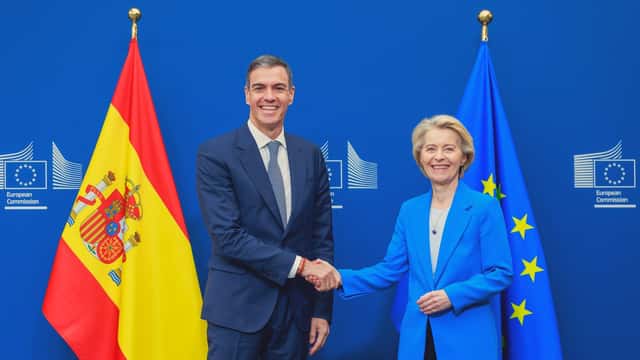
Pedro Sánchez, left, with European Commission President Ursula von der Leyen in Brussels on May 28, 2025. Photo: European Union, Wikimedia Commons, CC BY 4.0.

What Sánchez proposed#
Sánchez announced the tax on Monday, Nov. 23, in a video on X in which he flips a coin and says that if it lands heads "the ultra-rich pay, and if it lands tails, too." In the accompanying post he wrote: "Although we have reduced income inequality to historic lows, the richest 0.1% concentrates more than 10% of wealth. And its share has kept growing since 2010." He did not cite a source for that figure in the post.
A PSOE statement reported by El Independiente put expected revenue at about 2 billion euros a year. It said the tax "will not affect the middle classes, savers or small and medium-sized business owners," and that the party would "close the routes that allow the ultra-rich to reduce their tax bill, without exemptions or rebates to dodge the tax." It also said Spain should start applying at home the global minimum tax on large fortunes that the party backs in Europe.
The measure was not spelled out in the PSOE's 500-pledge program. El País reported that the program only said, in point 457, that the party would "promote the creation of a global minimum tax on large fortunes." The program does include other levies aimed at high earners: a top personal income tax rate of 35% on capital income above 300,000 euros, a tax on luxury travel such as private jets and megayachts, and a levy on large owners whose homes are not rented at affordable prices.

Finance Minister Arcadi España on the steps of the Council of Ministers building in Madrid in March 2026. Photo: Pool Moncloa/Fernando Calvo, Wikimedia Commons, La Moncloa attribution license.

Finance Minister Arcadi España, who is also a PSOE candidate in Valencia, defended the idea in Alicante alongside an extension of Spain's temporary bank levy, which the cabinet is due to approve on Tuesday. He called both "two instruments to strengthen progressivity." According to Expansión, he added: "If you don't agree with these taxes, as the People's Party and Vox don't, it means you don't agree with having enough resources to fund health care, education or social policies."
A government source told El País that the tax would be "compatible with the large-fortunes tax" and would aim at assets "that currently fall outside traditional taxes." The source spoke anonymously because the measure is a campaign proposal, not a government bill. The paper also noted that earmarking a tax's revenue for specific spending, as Sánchez described, fits awkwardly in Spanish tax law.
What the claim about the top 0.1% does and does not show#
Sánchez's inequality claim combines two different measures. Income inequality and wealth concentration can move in opposite directions, so a record-low income gap does not contradict growing wealth concentration. But the PSOE did not publish the dataset behind the "more than 10%" share or the trend "since 2010," and 567 Politics could not match the exact figures to an official Spanish series before publication. Wealth-tax filings, discussed below, cannot settle it either, because they leave out exempt assets and two regions.
Spain already taxes these fortunes twice#
People with more than 100 million euros in Spain already face two wealth taxes. The first is the regional wealth tax, the Impuesto sobre el Patrimonio, which is ceded to the regions; several have cut it with partial or full rebates.
The second is the Temporary Solidarity Tax on Large Fortunes, created by Article 3 of Law 38/2022 in December 2022. It applies to net assets above 3 million euros, after a 700,000-euro exemption. Rates rise from 1.7% to 2.1% and then to 3.5% on taxable wealth above about 10.7 million euros. Taxpayers can deduct whatever they paid in regional wealth tax, and the combined bill for both wealth taxes plus income tax is capped at 60% of the taxpayer's income tax base. Despite its name, the tax has no end date: the consolidated text extends it until wealth taxation is reviewed as part of the reform of regional financing.
Applied to round numbers, the statutory scale shows why the 100-million line matters. The headline rate has almost stopped rising by 50 million euros, so a fortune of 100 million and one of 200 million face nearly the same share.
Source: Law 38/2022, Article 3, BOE, Capitol
Show the numbers
| Net wealth (euros) | Percent of wealth |
|---|---|
| 5 million | 0.44 |
| 10 million | 1.23 |
| 50 million | 3.01 |
| 100 million | 3.25 |
| 200 million | 3.38 |
The solidarity tax was designed as a backstop: it mainly collects from wealthy residents of regions that cut their own wealth tax. Its revenue shows how the design works. It brought in 623 million euros in its first year, then 37 million in 2024 and 19 million in 2025, El Independiente reported, citing Tax Agency figures. The Tax Agency's 2024 annual revenue report attributes the drop to regional changes to the wealth tax, which meant that "most of the revenue that this tax had generated in 2023" went to those regions instead of the central government.
Source: El Independiente, citing Tax Agency data, Tax Agency 2024 revenue report
Show the numbers
| Year | Million euros |
|---|---|
| 2023 | 623 |
| 2024 | 37 |
| 2025 | 19 |
The regional and state wealth taxes together raised 2,154 million euros in 2024, according to the same El Independiente analysis of Tax Agency data. The PSOE's 2 billion euro target, in other words, roughly equals what all of Spain's wealth taxes now collect from more than 200,000 filers.
How many people would pay#
No official count of people worth more than 100 million euros exists, because wealth-tax data measure taxable assets, not market wealth. Two recent official tables come close. ABC reported that Finance Ministry wealth-tax statistics show 123 filers with more than 100 million euros in 2022, together holding more than 29 billion euros. El Independiente cited the Tax Administration Report for 2023, which shows about 130 filers above 100 million euros out of 228,575.
Both counts leave things out. They exclude the Basque Country and Navarre, which run their own tax systems. They also exclude assets that are exempt from the wealth tax, the most important being shares in qualifying family businesses. A founder whose stake in a family company is exempt can appear in a far lower bracket, or not at all. That exemption is the kind of "route" the PSOE says it wants to close, but the party has not said whether its new tax would count those shares.
That matters for the arithmetic. If the base is only the roughly 125 declared fortunes, raising 2 billion euros would require an average of about 15 million euros more from each of them. Capitol's analysis noted that it could not check the 2 billion euro estimate against any official source and called it "an estimate by the government about an idea, not a calculation about a law." If the tax reached exempt family-business stakes, the base would be far larger, and so would the number of companies affected.
The left says it was there first#

The chamber of Spain's Congress of Deputies, which would have to pass any new tax. Photo: Barcex, Wikimedia Commons, CC BY-SA 3.0.

Sánchez's main rival on the left accused him of copying. Frente Amplio, the coalition led by Ada Colau, already proposed a permanent state tax of 3% a year on net wealth above 50 million euros, modeled on French economist Gabriel Zucman's plan, plus a minimum 2% rate on fortunes above 1 million euros. The coalition says its whole tax package would raise 10 billion euros a year. Its program also includes the 10-million-euro cap on inheritances that the right calls confiscatory.
"If this were a battle between writers, we would accuse him of plagiarism," said Antonio Maíllo, leader of United Left, part of Frente Amplio, according to Europa Press. He welcomed the proposal but predicted that "the left will vote for the original and not the copy," and urged Sánchez to approve a universal child-rearing benefit in cabinet the next day if he meant it. Toni Valero, a Frente Amplio candidate in Madrid, said Sánchez had "finally remembered" six days before the election "that there are ultra-rich people in this country."
Spain's two largest unions were supportive but cautious. Unai Sordo, head of CCOO, called it "important" that those who have most "contribute more," but said in remarks reported by El País that improving Spain's tax take requires "a comprehensive reform, not a campaign idea."
The right warns about flight and cost#
The People's Party has not published a detailed reply, but its program points the other way. Under the heading "Spaniards will pay less tax," the PP's 2026 program promises lower income tax for middle and low earners, families, the self-employed and young people, and says it will "eliminate the taxes that hold back investment." Measure 185 says no government will force a region to raise taxes and that regions "may lower them as much as they want." The program does not name the solidarity tax, but that tax was created precisely to limit the effect of regional wealth-tax cuts.
Reported remarks by PP candidate Alberto Núñez Feijóo on Monday focused on other pledges, including a new euthanasia law and repeal of the amnesty law. Vox leader Santiago Abascal called Sánchez "a scoundrel who dresses up as Robin Hood," RTVE reported.
The economic case against came mostly from analysts and right-leaning media. El Español quoted tax experts who called a rate high enough to raise 2 billion euros from so few people "confiscatory," and cited an Ifo Institute estimate that each euro raised by a wealth tax costs 1.7 euros in other revenue as people and capital move. That estimate comes from studies of other countries' wealth taxes. No published model applies it to a proposal that does not yet have a rate or base, so it cannot be treated as a forecast of this tax.
A new tax would need the next Congress#
- Law 38/2022 creates the solidarity tax on net wealth above 3 million euros
- First collection brings in 623 million euros
- Royal Decree-law 8/2023 keeps the tax until wealth taxation is reviewed
- Collection falls to 37 million euros as regions restore their own wealth tax
- Collection falls to 19 million euros
- Sánchez proposes a new tax on fortunes above 100 million euros
- General election chooses the Congress that would vote on it
Source: Law 38/2022, BOE, El Independiente, Europa Press
A campaign pledge is not a law. Under Article 133 of Spain's Constitution, only a law can create a tax, and Article 134.7 bars the annual budget law from creating one. A new tax would need a bill passed by the Congress elected on Nov. 29, where the final polls disagree sharply about who will hold a majority.
The chart below shows 567 Politics' dated editorial estimates of where Spain's main parties sit on economic and social questions. It shows positions, not vote shares or likely coalitions.
If the PSOE leads the next government, it would most likely need Frente Amplio and regional parties, which would push for a broader tax. A government of the PP, alone or with Vox, has promised to cut taxes instead. Several questions remain open: the rate, whether exempt family businesses would be counted, whether the tax would replace the solidarity tax, how earmarking would work, and how a 2 billion euro estimate was produced. The PSOE had not published the calculation behind its estimate by publication time.
Differing perspectives
Should Spain create a new tax on personal fortunes above 100 million euros?
Each position is summarized as its supporters make it, with equal weight and in alphabetical order. A summary is not an endorsement; the evidence for each is weighed in the story above.
Create the tax on fortunes above 100 million
Who holds it: Prime Minister Pedro Sánchez, the PSOE and Finance Minister Arcadi España
Sánchez argues that while income inequality has fallen, the richest 0.1% hold more than 10% of Spain's wealth and their share keeps rising. The PSOE says many large fortunes pay proportionally less than working families by using exemptions and rebates, and that a tax limited to fortunes above 100 million euros would close those routes without touching the middle class, savers or small businesses. It estimates about 2 billion euros a year for subsidized housing, pensions and a child-rearing benefit.
In their words: Europa Press (Sánchez video and PSOE statement) ↗
Cut taxes and let regions lower them
Who holds it: The People's Party and its candidate Alberto Núñez Feijóo
The PP argues that Spaniards already pay too much and promises lower income tax for middle and low earners, families, the self-employed and young people. Its program pledges to eliminate taxes that hold back investment, to treat all forms of saving equally, and to let regions cut their own and ceded taxes as much as they want. It says fighting tax fraud, not new levies, should fund relief for those who comply.
In their words: Partido Popular, 2026 election program ↗
Tax far more wealth, starting at 1 million
Who holds it: Frente Amplio, the coalition led by Ada Colau, including United Left's Antonio Maíllo
Frente Amplio argues that a 100-million threshold is a late and limited copy of its own plan. It proposes a permanent state tax of 3% a year on net wealth above 50 million euros and a minimum 2% rate on fortunes above 1 million, which it says, with its other measures, would raise 10 billion euros a year. Its leaders say the government could approve a universal child-rearing benefit now rather than promise it during a campaign.
In their words: Europa Press (Frente Amplio statements) ↗
Cite this article
567 Politics staff. “Sánchez wants 2 billion euros from Spain's 100-million fortunes. About 125 people would pay.” 567politics. Published 2026-11-24. https://www.567politics.com/news/spain-sanchez-ultrarich-tax-100-million-fortunes-2-billion-solidarity-tax-frente-amplio-pp-november-2026
Wikipedia citation
{{cite news |title=Sánchez wants 2 billion euros from Spain's 100-million fortunes. About 125 people would pay |url=https://www.567politics.com/news/spain-sanchez-ultrarich-tax-100-million-fortunes-2-billion-solidarity-tax-frente-amplio-pp-november-2026 |work=567politics |author=567 Politics staff |date=2026-11-24 |language=en}}CSL-JSON for reference managers
{
  "id": "https://www.567politics.com/news/spain-sanchez-ultrarich-tax-100-million-fortunes-2-billion-solidarity-tax-frente-amplio-pp-november-2026",
  "type": "article-newspaper",
  "title": "Sánchez wants 2 billion euros from Spain's 100-million fortunes. About 125 people would pay",
  "URL": "https://www.567politics.com/news/spain-sanchez-ultrarich-tax-100-million-fortunes-2-billion-solidarity-tax-frente-amplio-pp-november-2026",
  "container-title": "567politics",
  "language": "en",
  "author": [
    {
      "literal": "567 Politics staff"
    }
  ],
  "issued": {
    "date-parts": [
      [
        2026,
        11,
        24
      ]
    ]
  }
}Citations identify this article and its publication date. Assess the reporting and its linked sources before using it as evidence.
Read this article as Markdown or JSON. Cite the original page and retain its sources, dates and qualifications.
Embed this article summary
Paste this HTML into your page. The summary stays linked to the full story and updates with it. No account required.
<iframe src="https://www.567politics.com/embed/news/spain-sanchez-ultrarich-tax-100-million-fortunes-2-billion-solidarity-tax-frente-amplio-pp-november-2026?theme=auto" title="Sánchez wants 2 billion euros from Spain's 100-million fortunes. About 125 people would pay by 567politics" width="100%" height="440" style="border:0;max-width:100%" loading="lazy"></iframe>
<p style="font-size:14px">Sánchez wants 2 billion euros from Spain's 100-million fortunes. About 125 people would pay by <a href="https://www.567politics.com/news/spain-sanchez-ultrarich-tax-100-million-fortunes-2-billion-solidarity-tax-frente-amplio-pp-november-2026" rel="nofollow">567politics</a></p>
<script async src="https://www.567politics.com/embed.js"></script>
READ BEYOND 567POLITICS
Alternate sources & perspectives
Independent coverage and primary evidence to help you compare arguments. A link is not an endorsement; perspective labels describe the linked material.
- primary evidence
Ley 38/2022, Article 3: Impuesto Temporal de Solidaridad de las Grandes Fortunas (consolidated text) ↗
Boletín Oficial del Estado
The statute that sets the current solidarity tax: 3 million euro threshold, 700,000 euro exemption, rates up to 3.5% and the 60% combined cap.
- primary evidence
Informe Anual de Recaudación Tributaria 2024 ↗
Agencia Tributaria
Explains that solidarity-tax revenue fell in 2024 because regional wealth-tax changes moved most of it to regional treasuries.
- left argument
Sánchez anuncia un nuevo impuesto a ultrarricos que recaudará 2.000 millones para vivienda, pensiones y crianza ↗
Europa Press
Carries Sánchez's video remarks and the PSOE statement on exemptions, beneficiaries and the 2 billion euro estimate.
- independent analysis
Sánchez propone un impuesto para "ultrarricos" con fortunas superiores a 100 millones de euros ↗
El País
Notes the measure was not in the PSOE program, compares it with Frente Amplio's Zucman tax and quotes CCOO and UGT leaders.
- independent analysis
Qué cambiaría el impuesto a fortunas de 100 millones de Sánchez ↗
Capitol
Applies the current solidarity-tax scale to sample fortunes and sets out the constitutional route a new tax would need.
- independent analysis
El impuesto a los ultrarricos de Sánchez apunta a 130 contribuyentes ↗
El Independiente
Uses Finance Ministry data to estimate about 130 filers above 100 million euros and reports solidarity-tax revenue for 2023 to 2025.
- independent analysis
El impuesto a los «ultrarricos» a partir de 100 millones de Pedro Sánchez afectaría a 123 personas en España ↗
ABC
Reports 2022 wealth-tax statistics showing 123 filers above 100 million euros and explains what those figures exclude.
- left argument
Frente Amplio acusa a Sánchez de plagiar con una "mala copia" su propuesta de impuesto a los ultrarricos ↗
Europa Press
Antonio Maíllo and Toni Valero argue the proposal copies and falls short of Frente Amplio's broader wealth tax.
- right argument
Programa electoral PP 2026: Reconstrucción nacional ↗
Partido Popular
Measures 177 to 185 set out the PP's tax-cutting agenda, including eliminating taxes that hold back investment and regional freedom to lower taxes.
- right argument
El impuesto a los ultrarricos de Sánchez: afectaría a unas 100 personas y se perdería el doble de los 2.000M recaudados por fuga de capitales ↗
El Español
Quotes tax experts who call the needed rate confiscatory and cites Ifo Institute estimates of revenue losses from wealth taxes.
- other perspective
Último lunes de campaña: Sánchez anuncia un impuesto a los ultrarricos y Feijóo, una nueva ley de eutanasia ↗
RTVE
Public broadcaster's campaign summary, including Abascal's reaction and Frente Amplio's accusation of copying.
- independent analysis
Pedro Sánchez anuncia un nuevo impuesto a ultrarricos para financiar vivienda protegida, blindar las pensiones y crear una prestación por crianza ↗
Expansión
Reports Finance Minister Arcadi España's defense of the tax and the planned extension of the bank levy.
Reviewed 2026-11-23. Hand-picked because discover_politics_sources returned unrelated results (biographies and US physician listings). The PSOE had published no rate, base or revenue model by review time, so the 2 billion euro figure is the party's own estimate. No PP press statement specifically answering the proposal was found; the PP position is taken from its 2026 program. Counts of fortunes above 100 million come from wealth-tax statistics as reported by ABC and El Independiente, which exclude exempt assets and the Basque Country and Navarre. No representative poll on the proposal was available.