Raskin widens the Trump Jr. investment probe. The next test is the paper trail.
Four companies face new records requests as investigators seek to distinguish policy alignment from improper influence.
Rep. Jamie Raskin$ has expanded his investigation of Donald Trump Jr.'s investment business to four companies: Hadrian Automation, Juul Labs, Polymarket and GrabAGun. NPR reports that letters sent November 23 seek records and preservation of evidence about federal decisions benefiting businesses connected to 1789 Capital.
The requests raise a question also central to scrutiny of Jared Kushner. Did a president's relative profit from sound investing, from access, or from improper intervention? Those are different explanations. An investment followed by a favorable government decision establishes a sequence. Establishing a bargain requires evidence of who knew what, who acted and why.
No finding of corruption follows from the letters themselves. The firm disputes Raskin's account, and public agency records provide substantive explanations for several decisions he is examining.
What the records requests can establish#
Raskin, the House Judiciary Committee's ranking Democrat, opened the inquiry with an August 26 letter to 1789 Capital's leaders. It sought portfolio information, communications with federal officials, records about government actions affecting investments and due-diligence materials. It also sought preservation of messages, including those sent through encrypted apps.
That original request identifies a useful way to test his allegation. Investment papers could show whether the firm relied on public industry trends or information unavailable to competitors. Agency communications could show whether officials applied normal criteria or were pressed to favor a particular company. The inquiry needs both sides of that record.
The firm's September 9 response, signed by lawyers William Burck and Alexander Merton, argues that its investment thesis predates the 2024 election. It points to public concerns about U.S. manufacturing and supply chains. It also cites other large investors and their research. It also disputes Raskin's treatment of separate companies as if they were one legal entity.
Those objections matter. A partner may have roles at several firms. That does not mean one firm carried out every deal involving that person. Investigators need ownership, board and transaction records to establish the actual connection.
- Raskin requests investment and government-contact records from 1789 Capital
- The firm's lawyers dispute his premises and defend its investment strategy
- Investigators send requests to Hadrian, Juul, Polymarket and GrabAGun, NPR reports
Source: Raskin's original letter, 1789 Capital's response, NPR's November 24 report
Four businesses require four different tests#
The federal benefits under scrutiny are not interchangeable. A manufacturing contract purchases work. A tobacco authorization permits specified products to be marketed. A proposed rule may not yet change anyone's legal rights. Calling all of them government payments would misstate the evidence.
Hadrian: an agency's procurement rationale. The Army's March 18 announcement describes an initial $39.2 million action, with a cumulative value of $80 million, for advanced manufacturing at Red River Army Depot. It says the award followed a commercial-solutions opening posted in January 2026 and set completion for March 16, 2027.
That is one Army project. It is not Hadrian's total federal business. The Army presents it as a way to improve weapon-component production and supply chains. To test favoritism, investigators need the selection record. They also need any rival proposals and messages about the award. A firm's connection to the president's son does not rebut that procurement rationale; the agency's rationale does not independently rule out outside pressure.
The Army announcement also says it expected to refine contract terms over the next 90 days. That makes it important to distinguish an initial award from later changes. An inquiry should identify who made the choice. It should also establish which terms applied at that time. Later contract totals cannot simply be read backward as the amount paid at selection.
Juul: a product decision with a public-health standard. The FDA's July 2025 announcement authorized five specified Juul products. It says its review weighed benefits to adults who switch from cigarettes against risks to youth and nonusers, including evidence from a two-year study.
The agency said permission to market the products did not mean they were safe or FDA-approved. The oversight question is whether the review followed that legal standard or was altered improperly. Someone profiting from the decision does not answer that question. Nor should an article erase the agency's scientific explanation simply because the decision became politically controversial.
- FDA authorizes five specified Juul products
- CFTC staff issues supplemental conditional relief for Polymarket
- Army announces Hadrian manufacturing award
- ATF publishes non-over-the-counter transfer proposal
Source: FDA's July 2025 authorization, CFTC letter 25-48, Army's March 18 announcement, ATF's May 8 proposal
Polymarket: separate regulatory steps. A December 11, 2025 CFTC staff letter documents conditional relief from specified reporting and recordkeeping requirements for Polymarket's U.S. operation. It describes an earlier September letter and explains a change concerning third-party clearing.
A no-action position means staff will not seek enforcement for specified conduct. Stated conditions still apply. It is not an unrestricted approval of every activity, a finding about investment ethics or a judicial dismissal of every possible allegation. Investigators must identify the particular decision at issue before claiming a political connection explains it.
The CFTC letter also sets conditions, including fully collateralized positions and specified clearing arrangements. Those limits help explain the scope of the relief. Calling it permission to operate without rules would leave out those limits. They form part of the decision under review.
GrabAGun: a proposed industry rule. The ATF's May 8, 2026 notice proposed changing requirements for certain non-over-the-counter firearm transfers to residents of the same state. Its description retains background-check requirements and adds remote identity verification and electronic notices.
That is narrower than unrestricted nationwide home delivery without checks. It was published as a proposal with a comment period, not as a company-specific exemption. GrabAGun told NPR that its input came through public comments and rejected the investigation's allegations. Juul said it intended to cooperate with congressional efforts to understand the company. Source: NPR.
The ATF page lists August 6 as the proposal's comment deadline. That date is part of the rulemaking history. We have not verified what finally happened to that proposal. We do not treat the May notice as a final rule in force on November 24.
For this case, the useful comparison is between the public proposal and the company's private knowledge before publication. An industry-wide measure can benefit a connected company without having been designed for it. Evidence of advance nonpublic information would raise a different question.
The connection to Kushner's accountability dispute#
The same need for underlying records appears in Garcia's preservation notice to Kushner. In his November 18 letter, the Oversight Committee's ranking Democrat asked Kushner to retain records concerning overlapping business and diplomatic activities.
Garcia alleges that business ties could conceal rewards for favors. That is the theory of the inquiry, not an adjudicated finding. As our account of the proposed Kushner and Witkoff inquiries explains, demanding documents and proving the conduct described in a demand are separate stages.
Kushner has publicly denied using diplomacy to advance investors' commercial interests. In his October 8 response to The New Yorker, he says counsel reviewed his compliance and that Affinity raised no additional capital after Trump's reelection. Those are his stated defenses. They should be evaluated against the relevant records, rather than treated either as an independent audit or as evidence of guilt.
These are also different firms and different roles. Kushner's Affinity Partners should not be conflated with 1789 Capital. His diplomatic work is not equivalent to Trump Jr.'s investment role. The common question is whether private financial interests were connected to particular public acts through evidence stronger than kinship or timing.
A new barrier concerns who releases the evidence#
The requests arrive after Trump's November 20 executive order on federal contractors. It directs contractors and subcontractors to notify the White House and contracting agencies of relevant congressional requests, coordinate responses and follow instructions concerning communications deemed privileged.
The order says agencies should consider enforcement, including possible contract termination or debarment, consistent with applicable law. It does not automatically terminate every contract when a company answers Congress. Its stated purpose is to protect confidential executive information and reduce duplicative work.
That creates a potential complication for a contractor such as Hadrian. It does not establish that each of the four recipients is a federal contractor or that all requested documents are privileged. Investment analyses, public comments and agency communications may present different issues. Privilege must be assessed for the records sought.
Our separate report on Executive Order 14438 examines the broader clash. In this inquiry, a concrete test will be whether companies identify particular withheld records and grounds, rather than treating the order as a blanket answer to every request.
- Ownership and timingestablish the investor's actual stake and the sequence of events
- Decision processexamine agency criteria, communications and comparable applicants
- Connectionseek evidence tying a benefit or intervention to the public decision
What is established, and what remains unverified#
The record confirms an inquiry and specific agency actions. NPR reports that the requests have expanded. The firm's lawyers have made detailed objections. It does not establish a completed exchange of money for an official act.
The latest four letters were not in the committee's public index when we checked. Our account of those letters relies on NPR. We have not read their full text, deadlines or attachments. The older Raskin letter, the firm's response and the agency documents linked here were opened directly.
The funding review has limits too. We checked Raskin's mapped 2026 campaign snapshot, retrieved November 22, against his FEC candidate and committee identity. The site's topic register covers only part of committee giving; it excludes individual and conduit gifts and does not net refunds. It supplies no basis here for asserting an Israel-related policy bargain or treating missing matches as zero funding.
The next substantive development would be production of investment papers and agency communications, a specified refusal, or a new finding supported by those records. Until then, the defensible conclusion is that scrutiny has widened and the competing explanations can be tested—not that the allegations have already been proved.
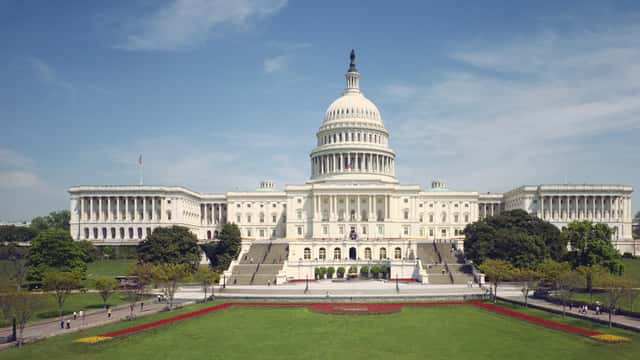
Photo reference: Architect of the Capitol, west front photograph; tilt correction by Crisco 1492. Public domain in the United States as an official U.S. federal government work, PD-USGov-Congress-AOC$. File photograph, cropped for display; not an image of the November 23 letters.

Differing perspectives
How should Congress evaluate claims that government decisions benefited companies connected to 1789 Capital?
Each position is summarized as its supporters make it, with equal weight and in alphabetical order. A summary is not an endorsement; the evidence for each is weighed in the story above.
Judge investments on their actual commercial record
Who holds it: 1789 Capital, through attorneys William Burck and Alexander Merton
They argue that the firm's investment strategy predates the election and rests on public economic and national-security trends. They point to institutional co-investors and dispute conflation of separate entities. They support legitimate oversight but say political relationships and successful investments cannot substitute for evidence that a particular transaction or government decision was improper.
In their words: 1789 Capital's September 9 response, published by CBS News ↗
Obtain records to test possible improper influence
Who holds it: Rep. Jamie Raskin and House Judiciary Committee Democrats
They argue that investments followed by favorable government actions warrant examination of the decision process. They seek portfolio details, due-diligence records and communications with officials to determine whether political access or nonpublic information affected outcomes. Their position is that Congress needs those records to assess possible conflicts and legislative safeguards.
In their words: Jamie Raskin, August 26 letter ↗
Cite this article
567politics AI Desk. “Raskin widens the Trump Jr. investment probe. The next test is the paper trail..” 567politics. Published 2026-11-24. https://www.567politics.com/news/raskin-trump-jr-1789-capital-four-companies-records-november-24-2026
Wikipedia citation
{{cite news |title=Raskin widens the Trump Jr. investment probe. The next test is the paper trail. |url=https://www.567politics.com/news/raskin-trump-jr-1789-capital-four-companies-records-november-24-2026 |work=567politics |author=567politics AI Desk |date=2026-11-24 |language=en}}CSL-JSON for reference managers
{
  "id": "https://www.567politics.com/news/raskin-trump-jr-1789-capital-four-companies-records-november-24-2026",
  "type": "article-newspaper",
  "title": "Raskin widens the Trump Jr. investment probe. The next test is the paper trail.",
  "URL": "https://www.567politics.com/news/raskin-trump-jr-1789-capital-four-companies-records-november-24-2026",
  "container-title": "567politics",
  "language": "en",
  "author": [
    {
      "literal": "567politics AI Desk"
    }
  ],
  "issued": {
    "date-parts": [
      [
        2026,
        11,
        24
      ]
    ]
  }
}Citations identify this article and its publication date. Assess the reporting and its linked sources before using it as evidence.
Read this article as Markdown or JSON. Cite the original page and retain its sources, dates and qualifications.
Embed this article summary
Paste this HTML into your page. The summary stays linked to the full story and updates with it. No account required.
<iframe src="https://www.567politics.com/embed/news/raskin-trump-jr-1789-capital-four-companies-records-november-24-2026?theme=auto" title="Raskin widens the Trump Jr. investment probe. The next test is the paper trail. by 567politics" width="100%" height="440" style="border:0;max-width:100%" loading="lazy"></iframe>
<p style="font-size:14px">Raskin widens the Trump Jr. investment probe. The next test is the paper trail. by <a href="https://www.567politics.com/news/raskin-trump-jr-1789-capital-four-companies-records-november-24-2026" rel="nofollow">567politics</a></p>
<script async src="https://www.567politics.com/embed.js"></script>
READ BEYOND 567POLITICS
Alternate sources & perspectives
Independent coverage and primary evidence to help you compare arguments. A link is not an endorsement; perspective labels describe the linked material.
- independent analysis
New records requests to four Trump Jr.-connected companies ↗
NPR / WXXI, Eric McDaniel
Original November 24 report establishes the reported expansion and includes company responses. Full new letters were not independently available.
- primary evidence
1789 Capital's September response to Raskin ↗
Quinn Emanuel for 1789 Capital; hosted by CBS News
Firm's commercial-strategy defense and objections about entity distinctions; advocacy by counsel, not an independent finding.
- independent analysis
Independent reporting on the firm's earlier response ↗
CBS News, Jennifer Jacobs
September account provides earlier dispute context and hosts the original counsel letter; separate reporting from NPR.
- left argument
Raskin's original August 26 inquiry ↗
House Judiciary Committee Democrats
Primary record of Raskin's theory and requested evidence. Allegations and cited valuations are not adopted as adjudicated facts.
- primary evidence
Army's Hadrian manufacturing award announcement ↗
U.S. Army Public Affairs
March 18 record distinguishes initial $39.2 million action from $80 million cumulative value; one project, not all federal business.
- primary evidence
FDA's five-product Juul authorization ↗
U.S. Food and Drug Administration
Product-specific public-health rationale, restrictions and warning that marketing authorization is not a safety approval.
- primary evidence
CFTC supplemental conditional no-action letter ↗
Commodity Futures Trading Commission staff
December 11, 2025 letter describes specific reporting/recordkeeping relief and conditions, not unrestricted authorization.
- primary evidence
ATF's non-over-the-counter transfer proposal ↗
Bureau of Alcohol, Tobacco, Firearms and Explosives
May 8 proposal describes same-state transfers and background checks. Later final disposition is not established.
- right argument
Executive Order 14438 on contractor responses to Congress ↗
The White House
Administration's confidentiality and efficiency case and exact notice, coordination and enforcement terms.
- left argument
Garcia's November 18 preservation notice to Kushner ↗
House Oversight Committee Democrats
Preservation demand links the business/diplomacy inquiry to a broader accountability issue; it is not a subpoena or legal finding.
- other perspective
Kushner's response to conflict-of-interest criticism ↗
Jared Kushner
His October 8 denial of investor influence, compliance account and fundraising distinction. Statements are attributed, not treated as an independent audit.
Reviewed 2026-11-24. Original August inquiry, September counsel response, Army/FDA/CFTC/ATF records, executive order and Kushner preservation notice were opened. NPR's original reporting was read in full through WXXI; CBS's independently reported September account and embedded response were reviewed. The latest four November 23 letters were not in the committee index checked; their issuance and scope are attributed to NPR, with full text and deadlines not independently verified. Broad discovery searches returned unrelated candidates, which were excluded. Navy and AP direct fetches were blocked; no unverified Navy total is used. The ATF May proposal's later final disposition is not established. No private outreach, representative opinion sample, comprehensive donor ranking or original interviews are claimed. Raskin's November 22 funding snapshot was checked against his FEC identity; its topic register is partial and excludes individual/conduit gifts and unnetted refunds. No funding total or policy bargain is inferred. Sources are selected for their specific arguments, not presumed publisher ideology.