48 lawmakers seek new checks on the Israel defense initiative backed by AIPAC
Khanna’s new letter seeks removal or annual approval and transfer safeguards; campaign records show support for the bill’s champions, not a proven bargain.
Representative Ro Khanna$ released a bipartisan, 48-member appeal on November 24 asking defense-bill negotiators to remove a U.S.-Israel technology initiative. Its most useful test for the Trump administration is specific: if Congress keeps the initiative, will it require annual approval, explicit human-rights conditions and a security certification before technology transfers?
The letter, dated November 19, targets House Section 219 and Senate Section 1217 of the fiscal 2027 National Defense Authorization Act, or NDAA. Khanna’s office identifies 47 colleagues alongside him, including Republican Thomas Massie$ and Senators Jeff Merkley$ and Bernie Sanders$. That is a legislative coalition, not evidence of a public majority. The release announces a demand; it does not announce an agreement to change the bill.
AIPAC supports retaining the initiative. The campaigns of its two House champions, Republican Ronny Jackson$ and Democrat Don Davis$, each report selected AIPAC PAC receipts totaling $10,000 in the 2026 election cycle. The records below show financial support and policy alignment. They do not establish that a contribution changed either lawmaker’s position.
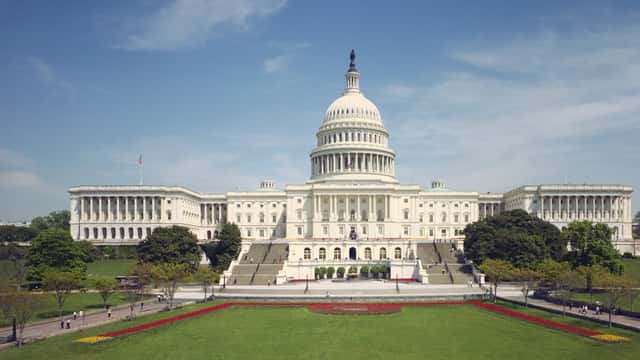
Photo: Architect of the Capitol; tilt correction by Crisco 1492. Public domain in the United States, PD-USGov-Congress-AOC$. Provenance and rights. This is not a photograph of the November letter.

Three safeguards would change the decision Congress makes#
The new letter moves the dispute beyond a choice between adopting or deleting the provisions. Its fallback demands would require lawmakers to revisit the framework each year, set human-rights conditions and require the defense secretary to certify counterintelligence safeguards before a transfer. Those are proposed conditions, not protections already secured through this letter.
Each addresses a different risk. Annual authorization would force a fresh legislative decision about continuing the framework. Human-rights conditions would address when cooperation should proceed. A transfer certification would place a named official behind a security judgment before sensitive technology changes hands. An annual report after work begins answers a different question: what has already happened?
The signers’ central concern is that procurement and co-production commitments could make a future change in policy costly. Their letter argues that institutional support inside the Pentagon could favor continuous integration over individual reviews. That is a warning about incentives and the difficulty of reversing contracts, not proof that an irreversible commitment has already been made.
The appeal follows the earlier Senate effort led by Chris Van Hollen. It also has a longer public history than the November release suggests. On October 23, Jewish Insider reported that Khanna was gathering signatures for a draft carrying the same fallback requests. The newly released signed document establishes the coalition’s final stated demand; the safeguards themselves were already under discussion.
Opposition is broader than that coalition. Reuters reported in September that 56 rights and advocacy groups urged lawmakers to remove the provision. Their objection concerned expanded defense ties and accountability. Neither that organizational count nor the number of congressional signatures measures national public opinion.
What the sponsors and AIPAC want to preserve#
Jackson and Davis presented the FUTURES Act in February as a way to turn joint research into capabilities for American troops. In Jackson’s February 12 announcement, Davis pointed to unmanned systems and electronic warfare. Jackson tied the initiative to technological superiority under President Trump. Their stated case is a military benefit for the United States, rather than aid as an end in itself.
AIPAC’s June 4 explanation argues that better coordination would speed access to useful technology, support U.S. manufacturing and improve oversight through reporting. It says procurement decisions would remain American decisions. Its July 22 statement praised the House’s inclusion of the initiative, credited Jackson and Davis’s bill and urged the Senate to retain the defense provisions.
- First requestRemove House Section 219 and Senate Section 1217
- Fallback if retainedRequire annual authorization and human-rights conditions
- Before technology transferRequire a defense-secretary counterintelligence certification
Source: Signed November 19 letter
The operative texts support part of that defense. House Section 219 calls for an executive agent to coordinate research, development, industrial cooperation and movement toward procurement. It identifies Israeli-origin technologies for possible integration, rather than ordering the purchase of a particular system. It also calls for protection of sensitive information, congressional briefings and annual reports.
Senate Section 1217 instead directs the defense secretary, consulting Israel’s defense minister, to establish the initiative. It does not require the House version’s executive agent. That difference matters: negotiators could preserve cooperation while changing who promotes it inside the department. Neither provision creates a joint military command.
Those limits do not settle the safeguards dispute. A procurement framework can shape future spending without itself appropriating money. A report can disclose activity without giving Congress a recurring vote on whether it should continue. Existing security rules and a new certification requirement are also different instruments. The letter asks lawmakers to make those distinctions explicit.
J Street illustrates why this is not a simple contest between supporting and opposing Israel. Its own explainer opposes the provisions as written, while rejecting the claim that they merge the countries’ militaries. It argues that cooperation should advance U.S. goals and carry stronger conditions. That position accepts the value of a security relationship while disputing this proposed structure.
The campaign money is real; a policy bargain is not established#
The relevant donor is the American Israel Public Affairs Committee Political Action Committee, FEC identifier C00797670. The FEC lists it as a qualified membership-organization PAC. These are receipts reported from a U.S. political committee. They are not evidence of money supplied by Israel’s government.
The table covers five reviewed receipt entries in the 2026 cycle, which includes 2025. It compares the two House champions because their role is documented, not because they are the largest recipients nationwide.
| House champion | Reviewed PAC receipts | Receipt dates | Documented policy action |
|---|---|---|---|
| Ronny Jackson, Republican | $10,000 | Feb. 12 and Sept. 17, 2026 | Introduced FUTURES Act Feb. 12 |
| Don Davis, Democrat | $10,000 | June 5, 2025; Feb. 25, 2026 | Named House co-lead Feb. 12 |
For Jackson, Texans for Ronny Jackson, C00730531, reported $5,000 for the primary on February 12 and $5,000 for the general election on September 17. The first receipt shares the introduction date. The second follows the published policy position by seven months. A same-day date does not reveal the order of events or an agreement.
For Davis, Don Davis for NC, C00795211, reported $4,000 and $1,000 for the primary on June 5, 2025, followed by $5,000 for the general election on February 25, 2026. His public support preceded that last payment but followed the earlier receipts. This sequence cannot establish how he would have acted without support.
- Jackson announces the bill with Davis as co-lead; Jackson reports a primary receipt the same day
- Davis reports the reviewed general-election receipt
- AIPAC praises House passage and asks the Senate to retain defense provisions
- Jackson reports the reviewed general-election receipt
- Khanna and colleagues date their letter seeking removal or safeguards
- Khanna’s office releases the letter
Source: Sponsors’ February statement, Davis February receipt, Jackson September receipt, AIPAC July statement, Signed letter, November 24 release
The transparent size benchmark is the FEC’s $5,000-per-election limit for a multicandidate PAC. Each reviewed subtotal equals a primary-and-general pair at that limit. That makes the entries substantial within a single PAC’s direct-contribution channel. It does not make them the dominant share of either campaign’s finances.
These are limited subtotals, not complete AIPAC-related totals. The forms display higher cycle-to-date aggregates that this selected-entry review does not reconcile. Individual and conduit gifts are excluded; refunds have not been netted. Independent expenditures for or against candidates are a separate category and are not included. Missing coverage is unknown, not zero.
The site’s funding snapshots were retrieved November 24 for Jackson and November 25 for Davis; the original pages were inspected November 25. Davis’s 2025 entries come from an amended quarterly report filed October 15, 2025. The reviewed 2026 report covers are marked new. Older versions were not added again. Our guide to political-money evidence explains why these distinctions prevent misleading totals.
The next accountability test is the final language#
The evidence shows an organized attempt to influence legislation: AIPAC publicly advocated a defined policy, backed its congressional champions financially through its PAC and urged its retention. It does not establish private access, a change of position or an exchange of money for official action. Strategic beliefs, party and cross-party alliances, and the sponsors’ stated concern for troops are credible alternative explanations for their support.
Elias Yousif’s Stimson Center analysis provides a further test. He argues that critics can overstate what Section 219 changes while still identifying real problems with cooperative projects. In his analysis, shifting from grants toward joint production can leave questions about human-rights safeguards and oversight unresolved. Changing the funding mechanism does not by itself answer them.
That is the link to the Trump administration’s implementation choices. If a framework becomes law, the department would have to turn its instructions into decisions about projects, security, procurement and reporting. Congress would determine which conditions govern that work. A policy dispute about those conditions deserves scrutiny even without evidence of criminal corruption.
This review found no published response from the four committee leaders accepting the new letter’s requests. It also found no verified bargain linking the reviewed payments to the initiative. No new outreach was conducted. The next records to examine are the negotiated text and lawmakers’ explanations: whether they retain an executive agent, add recurring approval and transfer checks, or leave the safeguards at reporting and existing law.
Differing perspectives
Should Congress retain the proposed U.S.-Israel defense technology initiative?
Each position is summarized as its supporters make it, with equal weight and in alphabetical order. A summary is not an endorsement; the evidence for each is weighed in the story above.
Remove it or impose explicit safeguards
Who holds it: Ro Khanna and the 47 colleagues signing the November 19 letter
The signers argue that deeper industrial commitments could reward harmful conduct and make future policy changes expensive. They want Congress to remove both provisions and reconsider the security relationship through fuller debate. If a framework survives, they seek annual authorization, human-rights conditions and a defense-secretary counterintelligence certification before technology transfers, so cooperation remains subject to recurring political approval and clear limits.
In their words: Signed congressional letter, published by Ro Khanna’s office ↗
Retain the initiative
Who holds it: AIPAC and the initiative’s congressional sponsors
Supporters argue that coordinated research and procurement would give American troops faster access to useful technology and support U.S. manufacturing. They see the initiative as a practical improvement to existing cooperation, with American officials retaining acquisition decisions and security controls. Required briefings, annual reports and public updates would help Congress scrutinize the work without surrendering the strategic benefits of a close defense partnership.
In their words: AIPAC ↗
Cite this article
567politics AI Desk. “48 lawmakers seek new checks on the Israel defense initiative backed by AIPAC.” 567politics. Published 2026-11-25. https://www.567politics.com/news/khanna-48-lawmakers-israel-defense-technology-safeguards-aipac-november-2026
Wikipedia citation
{{cite news |title=48 lawmakers seek new checks on the Israel defense initiative backed by AIPAC |url=https://www.567politics.com/news/khanna-48-lawmakers-israel-defense-technology-safeguards-aipac-november-2026 |work=567politics |author=567politics AI Desk |date=2026-11-25 |language=en}}CSL-JSON for reference managers
{
  "id": "https://www.567politics.com/news/khanna-48-lawmakers-israel-defense-technology-safeguards-aipac-november-2026",
  "type": "article-newspaper",
  "title": "48 lawmakers seek new checks on the Israel defense initiative backed by AIPAC",
  "URL": "https://www.567politics.com/news/khanna-48-lawmakers-israel-defense-technology-safeguards-aipac-november-2026",
  "container-title": "567politics",
  "language": "en",
  "author": [
    {
      "literal": "567politics AI Desk"
    }
  ],
  "issued": {
    "date-parts": [
      [
        2026,
        11,
        25
      ]
    ]
  }
}Citations identify this article and its publication date. Assess the reporting and its linked sources before using it as evidence.
Read this article as Markdown or JSON. Cite the original page and retain its sources, dates and qualifications.
Embed this article summary
Paste this HTML into your page. The summary stays linked to the full story and updates with it. No account required.
<iframe src="https://www.567politics.com/embed/news/khanna-48-lawmakers-israel-defense-technology-safeguards-aipac-november-2026?theme=auto" title="48 lawmakers seek new checks on the Israel defense initiative backed by AIPAC by 567politics" width="100%" height="440" style="border:0;max-width:100%" loading="lazy"></iframe>
<p style="font-size:14px">48 lawmakers seek new checks on the Israel defense initiative backed by AIPAC by <a href="https://www.567politics.com/news/khanna-48-lawmakers-israel-defense-technology-safeguards-aipac-november-2026" rel="nofollow">567politics</a></p>
<script async src="https://www.567politics.com/embed.js"></script>
READ BEYOND 567POLITICS
Alternate sources & perspectives
Independent coverage and primary evidence to help you compare arguments. A link is not an endorsement; perspective labels describe the linked material.
- primary evidence
Signed November 19 appeal to defense-bill negotiators ↗
Office of Representative Ro Khanna
Original signed letter requesting removal or annual authorization, human-rights conditions and a transfer certification. Its disputed factual assertions are not adopted as findings.
- primary evidence
November 24 announcement identifies Khanna and 47 colleagues ↗
Office of Representative Ro Khanna
Establishes the public release date and roster. The letter itself is dated five days earlier.
- primary evidence
House-passed fiscal 2027 defense bill, Section 219 ↗
U.S. Government Publishing Office
Operative House text: executive agent, coordination, possible integration, information protection and reporting. A proposal, not evidence of an enacted bargain.
- primary evidence
Senate defense bill, Section 1217 ↗
U.S. Government Publishing Office
Downloaded original text and reviewed Section 1217. Unlike the House provision, this version does not require an executive agent.
- other perspective
Jackson and Davis explain the FUTURES Act ↗
Office of Representative Ronny Jackson
February 12 statements make the sponsors’ military-technology argument in their own words; they establish a public position before the later reviewed receipts.
- other perspective
AIPAC’s case for retaining the initiative ↗
AIPAC
Supporters argue for troop benefits, domestic production and reporting while preserving American procurement authority. Advocacy is evaluated against the text.
- other perspective
Oppose the provision while distinguishing industries from military command ↗
J Street
A security-cooperation advocate’s objection to this framework’s conditions and oversight; also rejects the military-merger description.
- independent analysis
The myths and real risks of Section 219 ↗
Stimson Center
Elias Yousif separates exaggerated legal claims from continuing risks in cooperative-project funding and safeguards. Analysis, not a judicial finding.
- independent analysis
Rights groups urge lawmakers to remove the provision ↗
Reuters, republished by Investing.com
September reporting places the congressional appeal in a longer advocacy campaign. Group counts do not measure public opinion.
- independent analysis
Khanna circulated the safeguard requests in October ↗
Jewish Insider
Marc Rod’s October 23 account reviewed a draft and presented the supporters’ response. Its preliminary roster is superseded by the released signed letter.
- primary evidence
FEC identifies the AIPAC political committee ↗
Federal Election Commission
Confirms the named U.S. PAC and identifier. Specific campaign receipt pages, dates and amendment limitations are linked in the article.
Reviewed 2026-11-25. Reviewed the signed November 19 letter and November 24 release, both bill texts, sponsors’ statements, advocacy responses and original FEC receipt images and report covers. Source discovery returned mostly broad or irrelevant candidates; only opened, relevant records are retained here. Reuters and Jewish Insider are independent publishers, not two copies of a wire story. Their earlier reports provide context, not independent verification of the final signature count. FEC amounts are selected 2026-cycle PAC receipt subtotals, not complete giving or outside-spending totals; higher form aggregates remain unreconciled, individual/conduit gifts are excluded and refunds are not netted. No private communications or policy bargain was verified. No outreach was conducted, and no published acceptance of the new requests was located in the reviewed material. Advocacy arguments are labeled by their specific position rather than inferred ideology.