Katz hails 17.3 billion shekel defense boost, but N12 says the money is a reallocation due only in 2030
The Treasury says it no longer expects to reopen the 2026 budget to close a 22 billion shekel gap with the Defense Ministry.
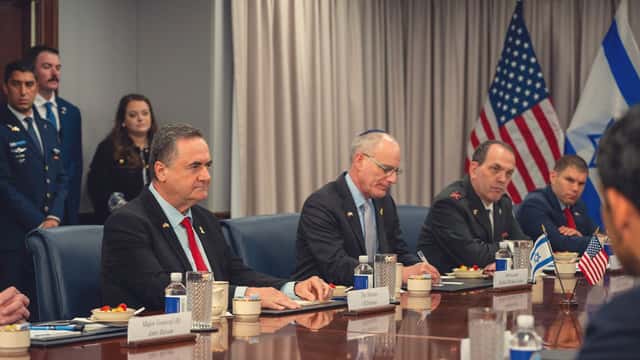
Defense Minister Israel Katz on Tuesday, Nov. 24, hailed a decision by a Knesset committee to approve what he called an addition of about 17.3 billion shekels to Israel's 2026 defense budget. But Israel's Channel 12 news (N12) reported hours later that the money is not new and will not reach the defense establishment until 2030. On the same day, senior Finance Ministry officials said they no longer expect to reopen this year's state budget to cover a far larger gap in defense spending.
The two reports point to a growing squeeze on Israel's public finances. Defense spending has nearly doubled since the war began in October 2023. The Treasury and the Defense Ministry are about 22 billion shekels apart on what the military needs for 2026. The state also owes billions to its own arms makers, and U.S. military aid is set to end years early.
What Katz announced#
"I welcome the decision of the joint committee on the defense budget to approve an addition to the 2026 defense budget of about 17.3 billion shekels," Katz wrote on X. He said it was part of "the move I led to strengthen the IDF's power and force buildup for the coming years."
The approval, he said, "will make it possible to advance programs for blue-and-white independence for long-term procurement in space, attack helicopters, air defense and other classified areas," according to Israel Hayom. "Blue-and-white independence" refers to Israel's push to produce more of its own weapons rather than rely on imports.
What the decision actually does#
N12 reported a different picture. The decision approved only an authorization to change the designation of existing budget funds, the channel said. It said the money is expected to reach the defense establishment only in 2030, more than three years from now. "It should be stressed that this is not a budget addition, but an internal change in the designation of the existing defense budget," N12 wrote.
N12 said the decision does nothing for the defense establishment's cash shortfall through the end of this year. Nor does it solve the 2027 budget. "In practice, 25 billion shekels are missing for the defense establishment through the end of the year," it reported. In the short term, it said, contracts cannot be signed and equipment and munitions cannot be bought. It also noted that no one knows who will be in government by 2030, so the promise of money is "on ice."
No response from Katz to the N12 report had been published at the time of writing.
A 22 billion shekel gap#
The dispute over this year's defense budget is much bigger than the committee decision. The Finance Ministry believes the defense establishment should make do with 161 billion shekels in 2026. The Defense Ministry says its spending and commitments already total about 183 billion shekels, Calcalist reported on Tuesday.
Source: Calcalist, Nov. 24, 2026
Show the numbers
| Position | Billions of shekels |
|---|---|
| Finance Ministry | 161bn NIS |
| Defense Ministry | 183bn NIS |
One option the Treasury had studied was to reopen the 2026 state budget and raise its overall ceiling from 699 billion shekels to 721 billion. Senior Finance Ministry officials told Calcalist that this is no longer realistic because of the short timetable and the political situation. Defense Ministry officials, who had pushed to reopen the budget until recently, now also see the chances as very low, the paper said.
The Knesset has 28 working days left this year, 17 of them official plenary days, according to Calcalist. Legally, reopening the budget is the same as passing a new one. It would need at least a week or two of government preparation and cabinet approval. The bill would then go through the Knesset Finance Committee. That committee is now controlled by the opposition "change bloc" parties, after the Oct. 27 election produced a deadlocked Knesset.
Instead, Calcalist said, the Treasury is leaning toward three steps. It would push some spending into 2027, delay payments to defense companies and shift more civilian budgets to defense. If the budget is not reopened, it would be the first time since 2023 that the state budget approved by the Knesset stays unchanged through the end of the year.
Civilian ministries already cut#
The government has already moved money from civilian programs. Just before the election, it approved across-the-board cuts of 2.6 billion shekels to government ministries to fund defense procurement, N12 reported. The cuts came in part from the education, health and welfare budgets, while coalition funds were spared. "We warned that huge budget additions for the defense establishment would come at the expense of citizens," Finance Ministry officials told N12.
Before that, N12 said, the government allocated more than 1 billion shekels to advance a deal for Apache attack helicopters. Most of that was funded by cutting the five-year plan for Arab communities for 2027 to 2029, the channel reported.

How defense spending grew#
At a Knesset Finance Committee session last week, Finance Ministry officials laid out how much the war has changed the budget. Defense spending rose from 4.5% of gross domestic product (GDP) on the eve of the war to 8% today, said Tamar Levy Boneh, deputy budget commissioner for macroeconomic affairs, Globes reported. Government debt jumped from 60% of GDP to nearly 70%.
"We have had to significantly increase the tax burden to absorb defense expenditure," she said. "Each year, we stated that we would close the deficit gap the following year, but in every single one of those years there was some unexpected element." She said higher-than-forecast interest costs alone reached 17 billion shekels this year, "sufficient to fund ten to fifteen government ministries."
Source: Globes, Nov. 17, 2026
Show the numbers
| Measure | Before the war | Now |
|---|---|---|
| Defense spending | 4.5% of GDP | 8% of GDP |
| Government debt | 60% of GDP | 70% of GDP |
The tax burden has reached 22.5% of GDP, the highest in 20 years, the Treasury told the committee, according to Globes. Thanks to strong tax revenue, it expects the deficit to fall below 4% of GDP, against a target of 4.9% set in March. But officials warned that an extra 22 billion shekels for defense, roughly 1% of GDP, would push the deficit back toward 5%.
The end of U.S. aid#
The budget fight comes on top of a shock from Washington. On the day of the U.S. midterm elections, President Donald Trump announced that U.S. military aid to Israel would end by the end of this year, with Prime Minister Benjamin Netanyahu's consent. The current agreement provides $3.8 billion a year and was meant to run through 2028. Finance officials told the Knesset they had not known about the decision in advance, as reported earlier.
The defense establishment had already committed to $7.6 billion in spending under the current agreement, officials said. It has also signed long-term contracts worth another $24 billion from 2029 onward that were meant to be covered by a future deal, a gap of about $31 billion. Shira Amiel, the deputy budget director for defense, said ending the aid now would cost about half a percent of GDP. "This is roughly equivalent to a 1.5% increase in VAT," she said.
Unpaid bills at the arms makers#
One of the Treasury's tools, delaying payments to defense companies, is already in use. The state owes Rafael at least 8 billion shekels and Israel Aerospace Industries (IAI) about 6.5 billion, Ctech by Calcalist reported on Nov. 22. It owes the private firm Elbit Systems about 3.5 billion shekels. About 75% of the total is more than 90 days overdue, according to the Government Companies Authority.
Source: Ctech by Calcalist, Nov. 22, 2026
Show the numbers
| Company | Debt |
|---|---|
| Rafael | 8bn NIS |
| IAI | 6.5bn NIS |
| Elbit Systems | 3.5bn NIS |
The authority expects the combined debt to Rafael and IAI to grow from about 14.5 billion shekels to 16.5 billion by year-end. The annual financing cost of the state's debt to the three companies is about 1 billion shekels, it estimates.
The delays are showing up in company accounts. IAI recorded negative cash flow of about $800 million in the second quarter of this year, compared with positive cash flow of $170 million a year earlier, Ctech reported.
The Finance Ministry has reached a deal with Elbit to cover the financing costs on its debts. Elbit's CEO, Bezalel Machlis, called it "a fair arrangement." The ministry has not offered the same to the two state-owned firms. Instead, it plans to offset those costs against about 3 billion shekels in dividends that Rafael and IAI have not yet paid the state. Roi Kahlon, who heads the Government Companies Authority, objected in an urgent letter to the Accountant General. "It is unreasonable for a private company to receive full compensation for financing costs, while state-owned enterprises are expected to bear these costs themselves," he wrote. The Finance and Defense ministries say the arrangement with IAI is specific to that company and that Rafael and IAI are in their strongest financial position ever.

What comes next#
The government must find a way to cover the 2026 gap before the year ends on Dec. 31. With the state budget likely to stay closed, the Treasury is expected to rely on deferred spending, delayed payments and further cuts to civilian ministries. Israel will also enter 2027 without an approved budget. Under a "continuing budget," monthly spending is limited to one-twelfth of the previous year's budget, Globes noted.
The new Knesset has yet to form a government. The Bank of Israel's latest rate decision also came against the backdrop of the coalition deadlock. Whoever forms the next government will inherit both the defense budget dispute and the end of U.S. aid.
Differing perspectives
How should Israel pay for its growing defense needs?
Each position is summarized as its supporters make it, with equal weight and in alphabetical order. A summary is not an endorsement; the evidence for each is weighed in the story above.
Defense growth is straining the budget
Who holds it: Finance Ministry budget officials
Treasury officials say defense spending has risen from 4.5% to 8% of GDP since the war began, while debt has climbed toward 70% of GDP and the tax burden has had to rise sharply. They say each year brought an unexpected shock that delayed closing the deficit, and that options to cover lost U.S. aid include higher taxes, civilian cuts or more debt.
In their words: Globes ↗
Invest in long-term military buildup
Who holds it: Defense Minister Israel Katz
Katz says the committee's approval of about 17.3 billion shekels is part of a move he led to strengthen the IDF and its force buildup for the coming years. He says it will let Israel advance long-term procurement programs for greater self-reliance in space, attack helicopters, air defense and other classified areas.
In their words: Israel Katz on X ↗
Treat state arms makers fairly
Who holds it: Roi Kahlon, head of the Government Companies Authority
Kahlon says it is unreasonable for a private contractor to be fully compensated for financing costs on overdue state debts while state-owned Rafael and IAI must absorb those costs because the state is both their owner and their client. He says offsetting the debts against dividends would undercut the companies' boards and their duty to act on commercial grounds.
In their words: Ctech by Calcalist ↗
Cite this article
567 Politics staff. “Katz hails 17.3 billion shekel defense boost, but N12 says the money is a reallocation due only in 2030.” 567politics. Published 2026-11-24. https://www.567politics.com/news/israel-katz-17-3-billion-defense-budget-addition-n12-reallocation-2030-treasury-22-billion-gap-november-2026
Wikipedia citation
{{cite news |title=Katz hails 17.3 billion shekel defense boost, but N12 says the money is a reallocation due only in 2030 |url=https://www.567politics.com/news/israel-katz-17-3-billion-defense-budget-addition-n12-reallocation-2030-treasury-22-billion-gap-november-2026 |work=567politics |author=567 Politics staff |date=2026-11-24 |language=en}}CSL-JSON for reference managers
{
  "id": "https://www.567politics.com/news/israel-katz-17-3-billion-defense-budget-addition-n12-reallocation-2030-treasury-22-billion-gap-november-2026",
  "type": "article-newspaper",
  "title": "Katz hails 17.3 billion shekel defense boost, but N12 says the money is a reallocation due only in 2030",
  "URL": "https://www.567politics.com/news/israel-katz-17-3-billion-defense-budget-addition-n12-reallocation-2030-treasury-22-billion-gap-november-2026",
  "container-title": "567politics",
  "language": "en",
  "author": [
    {
      "literal": "567 Politics staff"
    }
  ],
  "issued": {
    "date-parts": [
      [
        2026,
        11,
        24
      ]
    ]
  }
}Citations identify this article and its publication date. Assess the reporting and its linked sources before using it as evidence.
Read this article as Markdown or JSON. Cite the original page and retain its sources, dates and qualifications.
Embed this article summary
Paste this HTML into your page. The summary stays linked to the full story and updates with it. No account required.
<iframe src="https://www.567politics.com/embed/news/israel-katz-17-3-billion-defense-budget-addition-n12-reallocation-2030-treasury-22-billion-gap-november-2026?theme=auto" title="Katz hails 17.3 billion shekel defense boost, but N12 says the money is a reallocation due only in 2030 by 567politics" width="100%" height="440" style="border:0;max-width:100%" loading="lazy"></iframe>
<p style="font-size:14px">Katz hails 17.3 billion shekel defense boost, but N12 says the money is a reallocation due only in 2030 by <a href="https://www.567politics.com/news/israel-katz-17-3-billion-defense-budget-addition-n12-reallocation-2030-treasury-22-billion-gap-november-2026" rel="nofollow">567politics</a></p>
<script async src="https://www.567politics.com/embed.js"></script>
READ BEYOND 567POLITICS
Alternate sources & perspectives
Independent coverage and primary evidence to help you compare arguments. A link is not an endorsement; perspective labels describe the linked material.
- primary evidence
Israel Katz post on the defense budget addition ↗
Israel Katz (X)
The defense minister's announcement.
- independent analysis
כ"ץ בירך על תוספת תקציב הביטחון, הכסף צפוי לעבור רק ב-2030 ↗
N12
Reports the decision is a reallocation authorization with funds due in 2030.
- independent analysis
באוצר מעריכים: תקציב המדינה ל-2026 לא ייפתח מחדש ↗
Calcalist
Treasury view that the 2026 budget will not be reopened; 161 vs 183 billion shekels.
- independent analysis
End of US aid leaves $31b budget hole ↗
Globes
Finance Ministry testimony on defense spending, debt and the end of U.S. aid.
- other perspective
Israel's defense giants are financing the state's war effort as unpaid bills pile up ↗
Ctech by Calcalist
State debts to Rafael, IAI and Elbit and the Government Companies Authority's objections.
- right argument
כ"ץ בירך על אישור תוספת של כ-17.3 מיליארד לתקציב הביטחון ↗
Israel Hayom
Full text of Katz's statement.
Reviewed 2026-11-24. Compiled 2026-11-24 from pages opened and read in full; sources chosen by hand. The committee decision text was not published at writing; its nature is described by Katz and by N12, which differ. Calcalist puts the 2026 gap at 22 billion shekels; N12 at 25 billion.