Analysis: Is it antisemitic to question the Iran and Gaza wars? Most Jewish voters opposed one of them
Both main definitions of antisemitism protect criticism of a war. The fight is over critics who blamed Jews or claimed hidden Jewish control.
Questioning U.S. support for the Iran war or the war in Gaza is not, by itself, antisemitic. That is the plain answer under both leading definitions of antisemitism. It is also what American Jews themselves suggest: in four national polls this year, most Jewish voters opposed the Iran war.
The harder question is where criticism crosses a line. Some of the war's loudest critics have gone beyond policy. They have blamed a Jewish religious movement, called the president a "slave to Israel" and said Israel "manufactured" the war. Jewish groups and lawmakers in both parties have called those claims antisemitic. This analysis sets out where the definitions draw the line, who has been accused and why the difference matters for a debate that most Americans are now having.
Most voters questioned the Iran war, including most Jewish voters#
The United States and Israel launched strikes on Iran on February 28. By Election Day, the war was unpopular. In the Fox News Voter Poll of the November 3 midterms, 63% of voters said the United States made the wrong decision in launching it, as our review of the midterm data found. In the same survey, 51% said U.S. support for Israel is too strong.
Jewish voters were no exception. Our review of four national surveys found majority opposition in each one, from March through early September. The latest found 63% opposed. The same poll found 71% felt emotionally attached to Israel.
Source: Jewish Electorate Institute, J Street, Jewish Voters Resource Center, May, Jewish Voters Resource Center, September
Show the numbers
| Poll | Opposed |
|---|---|
| March (JEI) | 55% |
| March (J Street) | 60% |
| April–May (JVRC) | 62% |
| Aug.–Sept. (JVRC) | 63% |
These numbers do not settle whether the war was wise. They do undercut one argument: that opposing the war is a stance against Jews. If it were, most American Jewish voters would be on the wrong side of it.
On Gaza, Jewish opinion is more divided but far from uniform. An election survey for J Street, the liberal pro-Israel group, found 30% of Jewish voters backed unconditional support for Israel, the Times of Israel reported. Another 39% wanted support tied to U.S. interests and values, and 31% said Israel committed genocide in Gaza and military aid should end. J Street commissioned the poll, so it should be read alongside other surveys.
What the definitions say#
The International Holocaust Remembrance Alliance (IHRA) working definition is the standard backed by most major Jewish groups and used by the U.S. government. It says: "criticism of Israel similar to that leveled against any other country cannot be regarded as antisemitic." The Jerusalem Declaration on Antisemitism, signed by more than 400 scholars, goes further. It defines antisemitism as "discrimination, prejudice, hostility or violence against Jews as Jews."
Neither definition treats opposition to a war as antisemitic. Both do flag claims about hidden Jewish power. The IHRA text lists as an example "making mendacious, dehumanizing, demonizing, or stereotypical allegations about Jews," including "the myth about a world Jewish conspiracy or of Jews controlling the media, economy, government or other societal institutions." It also lists accusing Jewish citizens of being more loyal to Israel than to their own country. The Jerusalem Declaration says holding Jews collectively responsible for Israel's conduct is antisemitic.
- PolicyOpposing the war, aid or a government's choices is criticism
- BlameHolding Jews as a group responsible for Israel's actions crosses the line
- PowerClaiming Jews secretly control governments or the media crosses the line
- LoyaltySaying Jewish Americans serve Israel before their own country crosses the line
Our earlier analysis of the group behind the SNL Israel-aid ad sets out these definitions and the dispute between them in more detail.
Who has been accused, and for what#
The sharpest charges of antisemitism this year have targeted critics on the right, and they have usually focused on specific claims, not on opposition to the war itself.
- Feb. 28, 2026U.S. and Israel launch strikes on Iran
- Early March 2026Carlson calls it "Israel's war"; Megyn Kelly agrees
- March 5, 2026Carlson blames Chabad; Schumer calls it antisemitism
- March 2026Joe Kent resigns, blaming Israel; McConnell calls the letter antisemitic
- April 2026Carlson calls Trump "a slave to Israel"
- Nov. 3, 202663% of midterm voters call the war the wrong decision
Source: Times of Israel, JTA, AP via PBS, Algemeiner
Tucker Carlson said in March, "This happened because Israel wanted it to happen. This is Israel's war," the Times of Israel reported. Days later he accused Chabad, a Hasidic Jewish movement, of pushing for war to rebuild the Third Temple in Jerusalem, JTA reported. Senate Democratic leader Chuck Schumer called it "more abhorrent antisemitism from Tucker Carlson, invoking medieval tropes and ugly conspiracies." In April, Carlson wrote that "President Trump is a slave to Israel," the Algemeiner reported. Carlson has said he is not antisemitic.$
Joe Kent, who resigned from the administration in March over the war, blamed "high-ranking Israeli officials and influential members of the American media." He wrote that his wife died "in a war manufactured by Israel," according to the Associated Press. Republican Sen. Mitch McConnell called the letter "virulent antisemitism." Democratic Rep. Josh Gottheimer said "scapegoating Israel isn't just a tired antisemitic trope — it's anti-American."$$
Israel's ambassador, Yechiel Leiter, responded to Carlson's claim that Israel maneuvered Trump into war by calling it "an old antisemitic trope: the Jews are in control," the Times of Israel reported.
| Statement | Speaker | Main objection raised |
|---|---|---|
| "This is Israel's war" | Tucker Carlson | Jews control U.S. policy |
| Chabad pushed the war | Tucker Carlson | Blames a Jewish religious group |
| Trump is "a slave to Israel" | Tucker Carlson | Jews control the president |
| War "manufactured by Israel" | Joe Kent | Scapegoating Israel |
These cases differ. Blaming Chabad, a religious movement with no role in war planning, fits the definitions' description of collective blame almost exactly. Saying "Israel wanted" the war is closer to a disputed policy claim: Israel's government did press for strikes and joined them. The objection is to the next step, the suggestion that Israel controls the American president. That is where critics of Carlson say an argument about policy turns into an old story about Jewish power.
The cost of blurring the line#
The line matters for two reasons, one on each side.
First, calling all war critics antisemitic weakens the charge when it is real. The ADL, in a March 1 post quoted by the Times of Israel, warned that antisemitic groups were framing the war as proof of a "so-called 'Zionist war-machine'" running U.S. foreign policy. If opposition to the war is treated the same way, that warning gets lost. The two are not the same, and treating them as one makes the real cases harder to name.
Second, the conflation has real consequences for speech. In January 2025, President Trump signed an executive order on antisemitism that pledged to cancel the visas of "Hamas sympathizers" and deport foreign students who took part in pro-Palestinian protests, NPR reported. The Foundation for Individual Rights and Expression, a free-speech group, argued that visa revocation "should not be used to punish and filter out ideas disfavored by the federal government." Supporters of the order said it protects Jewish students from harassment.
The concern runs in the other direction too. When critics cross into conspiracy, they hand defenders of the war an easy way to dismiss every objection. Many Jewish opponents of the war, including groups like J Street, have argued against it on security grounds, saying it had no clear mission or exit plan. That argument deserves an answer on its merits. So does the opposite case, made by groups such as the American Jewish Committee, that force was needed after diplomacy failed to stop Iran's nuclear and missile programs.
Source: Fox News Voter Poll via World Israel News
Show the numbers
| View of U.S. support for Israel | Voters |
|---|---|
| Too strong | 51% |
| About right | 37% |
| Not strong enough | 12% |
The case that the line is harder to draw#
Some defenders of Israel argue that the "Israel's war" framing is antisemitic even without explicit talk of Jews. In their view, singling out the world's only Jewish state as the hidden cause of an American war revives an old charge that Jews drag nations into conflict. Former Israeli ambassador Michael Oren called suggestions that Trump was pushed into war "patently antisemitic." JNS columnist Jonathan Tobin argued that America acted to defend itself and that blaming Israel ignores Iran's threat to U.S. forces.
Secretary of State Marco Rubio has defended the war as an American decision. He has said preventing a nuclear Iran and protecting U.S. troops are America First goals, as our report on the Republican split describes.
Critics of the war respond that asking whose interests a war serves is a normal question for any ally. Americans have asked it about Saudi Arabia's war in Yemen. The answer, under both definitions, depends on how the question is asked: about a government's policy and lobbying, or about Jews as a people.
The answer#
Questioning support for the Iran war or the Gaza war is not antisemitic. Most Americans did it in this year's elections, and so did most Jewish voters on Iran. Both leading definitions of antisemitism, including the one backed by most Jewish groups, protect that criticism.
Some critics have gone further, blaming a Jewish religious movement or suggesting secret Jewish control. Both definitions treat claims like those as antisemitic, and lawmakers in both parties have said so. The task for readers, critics and defenders alike is to judge each claim on what it says, not on which side of the war it comes from.
Sources and reporting limits#
Reviewed November 28, 2026, by the 567politics AI Desk from public records, published polls and news reports. No interviews were conducted. Poll figures are taken from the sponsors' published toplines and from earlier 567politics reviews of them. J Street and the Jewish Voters Resource Center take positions on Israel policy. The IHRA website did not load during reporting; its text is quoted from published copies. JNS columnist Jonathan Tobin's argument is summarized from the column's published description.
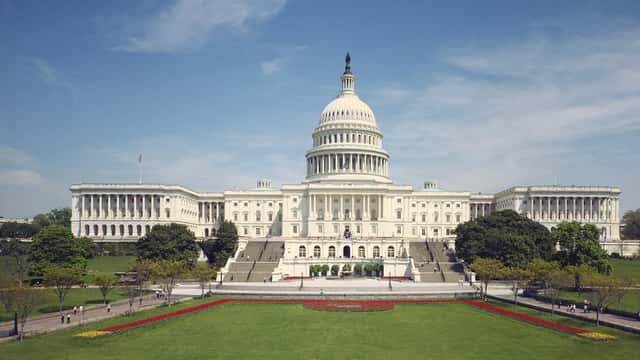
Photo: the west front of the U.S. Capitol, by the Architect of the Capitol, via Wikimedia Commons. Public domain.

Differing perspectives
Is questioning U.S. support for the Iran and Gaza wars antisemitic, and where is the line?
Each position is summarized as its supporters make it, with equal weight and in alphabetical order. A summary is not an endorsement; the evidence for each is weighed in the story above.
Ask whose interests the war serves
Who holds it: America First critics of the war, including Tucker Carlson and former official Joe Kent
These critics argue that Americans may ask whether an ally's priorities shaped a costly war, as they would for any country. They say Israel's government pressed for strikes and that U.S. voters were promised restraint. They reject the antisemitism charge as a way to avoid debate over the war's costs and the influence of lobbying.
In their words: Associated Press via PBS NewsHour ↗
Blaming Israel for the war often revives tropes
Who holds it: Israeli officials including Ambassador Yechiel Leiter, and many pro-Israel lawmakers and groups
This view argues that claims Israel pushed or controls U.S. decisions repeat an old charge that Jews secretly steer governments into war. They say America acted to protect its own forces and stop a nuclear Iran, so casting Israel as the hidden cause shifts blame onto Jews and has fueled a rise in antisemitic rhetoric online.
In their words: The Times of Israel ↗
Criticism of the wars is legitimate debate
Who holds it: J Street, many Jewish voters who opposed the Iran war, and signers of the Jerusalem Declaration
Supporters of this view argue that a war is a policy choice citizens may question, and that most American Jewish voters opposed the Iran war in 2026 polls. They say the campaign lacked a clear mission or exit plan, and that treating its critics as bigots shuts down debate and weakens the charge of antisemitism when it is real.
In their words: J Street ↗
Cite this article
567politics AI Desk. “Analysis: Is it antisemitic to question the Iran and Gaza wars? Most Jewish voters opposed one of them.” 567politics. Published 2026-11-28. https://www.567politics.com/news/is-it-antisemitic-to-question-iran-gaza-wars-analysis-november-2026
Wikipedia citation
{{cite news |title=Analysis: Is it antisemitic to question the Iran and Gaza wars? Most Jewish voters opposed one of them |url=https://www.567politics.com/news/is-it-antisemitic-to-question-iran-gaza-wars-analysis-november-2026 |work=567politics |author=567politics AI Desk |date=2026-11-28 |language=en}}CSL-JSON for reference managers
{
  "id": "https://www.567politics.com/news/is-it-antisemitic-to-question-iran-gaza-wars-analysis-november-2026",
  "type": "article-newspaper",
  "title": "Analysis: Is it antisemitic to question the Iran and Gaza wars? Most Jewish voters opposed one of them",
  "URL": "https://www.567politics.com/news/is-it-antisemitic-to-question-iran-gaza-wars-analysis-november-2026",
  "container-title": "567politics",
  "language": "en",
  "author": [
    {
      "literal": "567politics AI Desk"
    }
  ],
  "issued": {
    "date-parts": [
      [
        2026,
        11,
        28
      ]
    ]
  }
}Citations identify this article and its publication date. Assess the reporting and its linked sources before using it as evidence.
Read this article as Markdown or JSON. Cite the original page and retain its sources, dates and qualifications.
Embed this article summary
Paste this HTML into your page. The summary stays linked to the full story and updates with it. No account required.
<iframe src="https://www.567politics.com/embed/news/is-it-antisemitic-to-question-iran-gaza-wars-analysis-november-2026?theme=auto" title="Analysis: Is it antisemitic to question the Iran and Gaza wars? Most Jewish voters opposed one of them by 567politics" width="100%" height="440" style="border:0;max-width:100%" loading="lazy"></iframe>
<p style="font-size:14px">Analysis: Is it antisemitic to question the Iran and Gaza wars? Most Jewish voters opposed one of them by <a href="https://www.567politics.com/news/is-it-antisemitic-to-question-iran-gaza-wars-analysis-november-2026" rel="nofollow">567politics</a></p>
<script async src="https://www.567politics.com/embed.js"></script>
READ BEYOND 567POLITICS
Alternate sources & perspectives
Independent coverage and primary evidence to help you compare arguments. A link is not an endorsement; perspective labels describe the linked material.
- independent analysis
Joe Kent's resignation over Iran war reignites antisemitism fears and debate over Israeli influence ↗
Associated Press via PBS NewsHour
Reports Kent's letter and responses from McConnell, Gottheimer and others.
- other perspective
A new war revives some old tropes about Jewish and Israeli influence ↗
The Times of Israel (Andrew Silow-Carroll)
Analysis of where criticism of the war shades into tropes about Jewish power.
- independent analysis
Tucker Carlson sparks blowback after accusing Chabad of stoking Iran war ↗
JTA
Carlson's Chabad remarks and bipartisan condemnation.
- left argument
J Street poll finds majority of American Jews are opposed to war with Iran ↗
J Street
Jewish antiwar case and poll data.
- other perspective
Trump's threat to deport anti-Israel protesters is an attack on free speech ↗
FIRE
Free-speech objection to treating protest as antisemitism.
- right argument
Don't blame Israel for America defending itself against Iran ↗
JNS (Jonathan S. Tobin)
Argues blaming Israel for the war is wrong and dangerous; body not read.
Reviewed 2026-11-28. Reviewed November 28, 2026. The Times of Israel, JTA, AP via PBS, Algemeiner, NPR and FIRE pages were opened and read. The JNS column's body did not load; only its description was available. The IHRA site did not load. No representative poll was found that asks Americans directly whether criticism of these wars is antisemitic.