Germany fights over who failed in Antalya: oil states, Merz, or climate policy itself
Schneider blames oil states for the COP31 collapse. The Greens say Merz's absence shares the blame, and the AfD calls climate policy pointless.

The collapse of the United Nations climate conference in Antalya, Turkey, has turned into a fight in Berlin over who is to blame. Germany's government says a few oil-producing states blocked a deal. The opposition Greens say Chancellor Friedrich Merz shares the blame because he never went. The far-right Alternative for Germany (AfD) welcomed the failure and called for an end to climate policy.
The 31st UN climate conference, known as COP31, ended on Sunday, Nov. 22, after two weeks of talks and almost two days of overtime. According to Deutschlandfunk, it was the longest climate conference ever held. Germany, the European Union and other countries rejected the final text, called the "Antalya Pact," which the Turkish and Australian co-presidents had put forward. It needed the consensus of all states, so it fell.
The German reactions came on Monday, Nov. 23, at the start of the Bundestag's budget week. Lawmakers are due to pass the 2027 federal budget on Friday, Nov. 27.
Why the text failed#
The draft did not name coal, oil or gas, according to tagesschau. It only made a general reference to the 2023 Dubai decision that the world should move away from fossil fuels. Deutschlandfunk reported that the text instead set a goal for capturing and storing carbon dioxide.
"We will not support a final declaration in which fossil fuels are not even mentioned," said Ireland's climate minister, Darragh O'Brien, speaking for the EU Council presidency. Panama, the Marshall Islands and other small island states also objected.
UN News reported that COP31's president, Turkish Environment Minister Murat Kurum, accepted the outcome. "I understand that there is no agreement on this text. For that reason, these decisions have not been adopted," he said. Kurum told delegates, "We did our best," according to tagesschau, adding that the decision lay with the 196 countries. ARD correspondent Benjamin Weber reported open confrontations in the plenary, including between delegates from Ghana and Kurum, whom some accused of poor leadership of the summit.
UN Secretary-General António Guterres said he was "deeply disappointed." "There may be no consensus in the negotiating room. There is no ambiguity in the science," he said.
Some smaller decisions survived. The German environment ministry said the conference agreed that the Adaptation Fund will in future be run under the Paris Agreement. The next conference, COP32, is set for Addis Ababa, Ethiopia.
The government: oil states blocked it#
Environment Minister Carsten Schneider, a Social Democrat (SPD), led Germany's delegation. In a ministry statement, he said the drafts "would have been a step back compared to earlier decisions."
"In Antalya we saw that the oil and gas industry is still twitching," Schneider said. "Some oil states notice that things are getting serious for them, which is why they block so vehemently. The rest of the world is moving in big steps toward climate-friendly, electric solutions."
He said the world already had enough rules to protect the climate before the conference. "We will not let ourselves be stopped from doing the right thing, namely expanding renewable energy and becoming independent of oil and gas," he said.
The ministry pointed to results outside the formal text. According to the Turkish presidency, 75 countries and 94 organizations, including Germany and the EU, joined a pledge to supply 35% of final energy use with electricity by 2035. The ministry said Germany announced €140 million in new projects for power grids, renewables and electrification abroad. It also launched an initiative against SF6, a gas used in electrical switchgear, with €15 million in German money. With Turkey and the International Renewable Energy Agency (IRENA), Germany also started an initiative called D-Grids to build regional distribution grids, so that renewable power can reach electric cars, heat pumps and industry.
Development Minister Reem Alabali Radovan, also of the SPD, said: "Our world does not need false compromises, but real will and real progress." She said Antalya still sent "a political signal of global solidarity."
Schneider told the Kölner Stadt-Anzeiger, as quoted by tagesschau: "The world does not need this final declaration to keep moving forward on climate protection."

The Greens: Merz stayed away#
The Greens agree that rejecting the text was right. But they say the government helped bring about the failure.
"Since 2009, no COP has failed without a final declaration," Britta Haßelmann, co-leader of the Greens in the Bundestag, said in a statement on Monday. "It is a big omission that this federal government was represented there only by our environment minister, Carsten Schneider."
"Why should other states consider it essential to reach agreement on ambitious climate targets and finally turn their backs on this fossil age if the head of government of Germany does not even travel to Turkey?" she asked. "Here Friedrich Merz personally bears responsibility for the failure."
A longer Greens parliamentary group paper said the government had "weakened its own environment minister." It listed the coalition's repeal of the heating law, the softening of the EU's 2035 ban on new combustion-engine cars, and planned cuts to international climate finance in the budget. "Whoever shifts into reverse at home cannot credibly demand more ambition internationally," it said.
The paper argued that climate conferences are also trade fairs. It cited a KfW Research and Deloitte study, presented in Antalya, that put global trade in environmental and climate technology at about $2.8 trillion. It said Germany is the second-largest exporter after China. The Greens also called for majority voting at climate talks when a few states keep blocking, and for oil and gas companies to be kept out of the negotiations.
Party co-leader Franziska Brantner told the Frankfurter Allgemeine Zeitung that "neither Germany nor the EU" had engaged enough on site.
The government's reply on Merz#
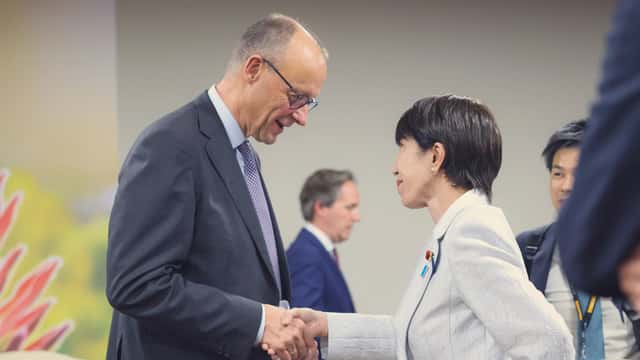
The government defended Merz's absence before the conference began. Government spokesman Stefan Kornelius said Merz was attending a European Political Community summit and an informal EU summit in Ireland that week, according to n-tv. He also cited a "very important cabinet meeting" and the budget clean-up week, which "demands full attention." "The federal government is unshaken in its climate policy," Kornelius said, and noted that Schneider represented Germany.
The AfD: the others are not taking part#
The AfD, the largest opposition party in the Bundestag, welcomed the outcome. Bernd Baumann, the party's chief whip in the Bundestag, said the government's climate policy had failed because "the others are not taking part," according to BR24. He called it "pointless and stupid" to continue. The AfD's budget spokesman, Michael Espendiller, said "this nonsense" must stop.
In a statement from the AfD parliamentary group, lawmaker Karsten Hilse called the failure "the logical consequence" of recent years and pointed to the U.S. exit from the Paris Agreement. He said emerging economies, including China, India and the Gulf states, are "ever less willing" to accept outside rules on their economies. Germany, he said, must return to "a reason-based economic and energy policy." His statement also describes human-caused climate change as a hypothesis "based purely on models." The UN's Intergovernmental Panel on Climate Change has concluded that human activity has warmed the planet.
Scientists and campaigners#
The president of the Federal Environment Agency, Dirk Messner, said the EU was right to reject the draft, as quoted by Deutschlandfunk. "A text that does not properly name the farewell to coal, oil and gas would have set us back," he said.
The directors of the Potsdam Institute for Climate Impact Research, Johan Rockström and Ottmar Edenhofer, said: "This collapse is better than a lukewarm final document." They said the result forces the world "to think about the future of the COP negotiating format."
Jan Kowalzig of the aid group Oxfam welcomed that most countries did not give in to those blocking a fossil-fuel exit. But he said the EU's lack of flexibility on financial help for poorer countries had also prevented alliances. The environment and development group Germanwatch said, in an interview its policy director Tollmann gave Deutschlandfunk, that the draft did not match scientific findings. It focused on fringe technologies such as carbon capture instead of cutting emissions, she said, though she warned against overrating the final declaration.
Friends of the Earth Germany (BUND) called the outcome a "political total failure," blaming rich industrial states, oil states and the hosts.
Timeline#
- COP28 in Dubai agrees to transition away from fossil fuels
- Government spokesman defends Merz's decision to skip COP31
- COP31 in Antalya ends without a final declaration after record overtime
- Greens blame Merz's absence; AfD welcomes the failure
- Bundestag due to vote on the 2027 federal budget
Source: UN News, tagesschau, n-tv
What this means for the budget week#
The climate dispute feeds directly into this week's budget debate. Haßelmann's statement tied the two. She said the budget invests "less in the protection of climate, environment and nature" and cuts development aid. Merz's Christian Democrats and their Bavarian sister party approved the budget in a group vote on Monday evening with three votes against and one abstention, according to the Frankfurter Allgemeine Zeitung. The coalition has fought over relief for consumers, including a cut in electricity tax and Bavarian leader Markus Söder's late call for cold-progression relief.
For background on the conference itself, see our coverage of COP31's opening in Antalya and Brazil's fossil-fuel roadmap.
What remains unclear#
The government has not said whether it will change its plans for international climate finance in response to the Greens' criticism. Merz himself had not commented on the outcome by Monday evening. It is also not clear whether the 35% electrification pledge, now outside the formal UN process, will be tracked at COP32 in Addis Ababa.
Differing perspectives
Who is responsible for the COP31 collapse, and what should Germany do now?
Each position is summarized as its supporters make it, with equal weight and in alphabetical order. A summary is not an endorsement; the evidence for each is weighed in the story above.
Merz's absence and rollbacks share the blame
Who holds it: Greens, including Britta Haßelmann and Franziska Brantner
Rejecting the text was right, but the government made failure more likely. The chancellor skipped the conference, signaling that climate talks are unimportant, even though they shape export markets and alliances with the Global South. Rollbacks at home, from the heating law to the combustion-engine ban and climate-finance cuts, undercut Germany's negotiator. Talks need majority voting and no fossil-fuel lobby.
In their words: Alliance 90/The Greens parliamentary group ↗
Oil states blocked it; keep electrifying
Who holds it: Federal government; Environment Minister Carsten Schneider and Development Minister Reem Alabali Radovan (SPD)
Germany was right to reject a text that would have been a step back from earlier decisions. A few oil states blocked the deal because they see their business model threatened. The rest of the world is moving toward electric, climate-friendly solutions, and enough rules already exist to act. Germany will keep expanding renewables, fund electrification abroad and work through alliances outside the formal text.
In their words: Federal Environment Ministry (BMUKN) ↗
The failure shows climate policy should end
Who holds it: Alternative for Germany (AfD), including Karsten Hilse and Bernd Baumann
The collapse is the logical result of recent years: the United States has left the Paris Agreement and emerging economies such as China, India and the Gulf states will not accept outside limits on their growth. If others do not take part, German climate policy is pointless and harms its own economy. Germany should return to what the party calls a reason-based economic and energy policy.
In their words: AfD parliamentary group ↗
Cite this article
567 Politics staff. “Germany fights over who failed in Antalya: oil states, Merz, or climate policy itself.” 567politics. Published 2026-11-23. https://www.567politics.com/news/germany-cop31-antalya-collapse-schneider-oil-states-greens-blame-merz-afd-welcomes-november-2026
Wikipedia citation
{{cite news |title=Germany fights over who failed in Antalya: oil states, Merz, or climate policy itself |url=https://www.567politics.com/news/germany-cop31-antalya-collapse-schneider-oil-states-greens-blame-merz-afd-welcomes-november-2026 |work=567politics |author=567 Politics staff |date=2026-11-23 |language=en}}CSL-JSON for reference managers
{
  "id": "https://www.567politics.com/news/germany-cop31-antalya-collapse-schneider-oil-states-greens-blame-merz-afd-welcomes-november-2026",
  "type": "article-newspaper",
  "title": "Germany fights over who failed in Antalya: oil states, Merz, or climate policy itself",
  "URL": "https://www.567politics.com/news/germany-cop31-antalya-collapse-schneider-oil-states-greens-blame-merz-afd-welcomes-november-2026",
  "container-title": "567politics",
  "language": "en",
  "author": [
    {
      "literal": "567 Politics staff"
    }
  ],
  "issued": {
    "date-parts": [
      [
        2026,
        11,
        23
      ]
    ]
  }
}Citations identify this article and its publication date. Assess the reporting and its linked sources before using it as evidence.
Read this article as Markdown or JSON. Cite the original page and retain its sources, dates and qualifications.
Embed this article summary
Paste this HTML into your page. The summary stays linked to the full story and updates with it. No account required.
<iframe src="https://www.567politics.com/embed/news/germany-cop31-antalya-collapse-schneider-oil-states-greens-blame-merz-afd-welcomes-november-2026?theme=auto" title="Germany fights over who failed in Antalya: oil states, Merz, or climate policy itself by 567politics" width="100%" height="440" style="border:0;max-width:100%" loading="lazy"></iframe>
<p style="font-size:14px">Germany fights over who failed in Antalya: oil states, Merz, or climate policy itself by <a href="https://www.567politics.com/news/germany-cop31-antalya-collapse-schneider-oil-states-greens-blame-merz-afd-welcomes-november-2026" rel="nofollow">567politics</a></p>
<script async src="https://www.567politics.com/embed.js"></script>
READ BEYOND 567POLITICS
Alternate sources & perspectives
Independent coverage and primary evidence to help you compare arguments. A link is not an endorsement; perspective labels describe the linked material.
- primary evidence
Weltklimakonferenz in Antalya: Keine Abschlusserklärung, aber konkrete Fortschritte bei Umsetzung ↗
Federal Environment Ministry
Government statement with Schneider and Alabali Radovan quotes and listed results.
- primary evidence
COP31 ends without climate pact as UN chief warns there is 'no ambiguity in the science' ↗
UN News
Guterres statement and Kurum's closing words.
- left argument
Weltklimakonferenz gescheitert: Bundeskanzler Merz hat die Bedeutung der COP31 verkannt ↗
Greens parliamentary group
Greens' case that Merz and domestic rollbacks share blame.
- right argument
Scheitern der Klimakonferenz ist logische Folge der Entwicklung der letzten Jahre ↗
AfD parliamentary group
Karsten Hilse's statement welcoming the failure.
- independent analysis
Nach Scheitern: Bundesregierung wirft Ölstaaten Blockade der Klimakonferenz vor ↗
Deutschlandfunk
Reactions from UBA, PIK, Oxfam, Greenpeace and Germanwatch.
- independent analysis
Weltklimakonferenz COP31: Keine Einigung auf Abschlusserklärung ↗
tagesschau
What the draft said and who objected.
- other perspective
Merz nicht bei UN-Klimakonferenz: Regierung begründet Fehlen mit Terminkollisionen ↗
n-tv
Government spokesman's explanation for Merz's absence.
Reviewed 2026-11-23. Hand-picked: government, Greens and AfD statements in their own words, plus UN and German public-broadcaster reporting on the COP31 outcome.