Support for arming Ukraine drops below half in Germany as more voters favor restraint, Körber poll finds
The Berlin Pulse survey found 46% back military aid, down from 59%, while 48% want Germany to hold back in international crises. AfD supporters stand far apart.
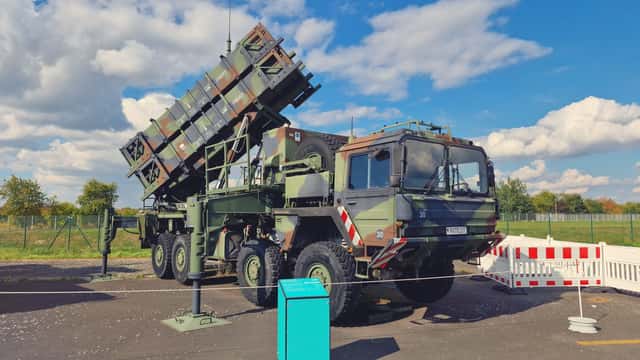
Support in Germany for sending weapons to Ukraine has fallen below half in the Körber Foundation's annual foreign policy survey. In The Berlin Pulse 2026/2027, published this month, 46% of Germans said Germany should support Ukraine militarily in its war with Russia. A year earlier the figure was 59%. Opposition rose from 39% to 53%, the foundation said.
The survey also found a broader turn toward caution. Some 48% of respondents said Germany should "exercise more restraint" in international crises, up from 43% in 2025. Only 40% wanted Germany to engage more strongly, down from 48%. The foundation called the shift a "Trendwende," or turning point.
The pollster forsa interviewed 1,501 eligible voters by telephone from Sept. 15 to 28, 2026. The stated margin of error is plus or minus 2.5 percentage points. The fieldwork ended seven weeks before Defense Minister Boris Pistorius pledged another $300 million for U.S. air defense weapons for Kyiv.
A sharp fall in support for arms aid#
The Hamburg-based foundation has run the survey every year since 2017. Its staff said this year's move was unusually large. "That is a relatively strong decline, because we have been asking this question for years, and normally the changes are in the two to three percent range," Florian Bigge, a program director at the foundation, told DW. He was speaking about the question on engagement versus restraint.
The Ukraine figures moved even more. Support for military aid dropped 13 points in a year. The share opposed rose 14 points.
Source: Körber Foundation press release, Nov. 2026
Show the numbers
| Year | Yes | No |
|---|---|---|
| 2025 | 59% | 39% |
| 2026 | 46% | 53% |
Germans were also split on whether Ukraine's defense protects them. Half (50%) said that when Ukraine defends itself against Russia, it also protects the security of Germany and Europe. Another 48% said it does not.
Yet most respondents still see Russia as a danger. Some 82% called Russia a military threat to Germany. And 64% rejected normalizing relations with Moscow, for example by easing sanctions or buying more Russian energy. Only 34% backed that idea.
Respondents were also divided on how to answer suspected Russian sabotage and cyberattacks. Some 51% wanted Germany to "respond decisively with countermeasures." Another 46% said Germany should avoid countermeasures to prevent escalation.
What respondents want instead#
The survey suggests that many Germans want more diplomacy rather than less involvement in the war's end. Six in 10 (61%) said Germany and Europe are not doing enough to promote peace talks between Russia and Ukraine. Just 36% said they were.
Among the 40% who want Germany to engage more abroad, the survey asked how. A large majority of that group, 77%, said diplomatically. Only 13% said militarily, and 7% financially. The 77% figure refers to that subgroup, not to all respondents.
Asked to name Germany's most important foreign policy interests, respondents most often cited peace or peacekeeping (30%), the economy and trade (28%), and diplomacy and international cooperation (24%). Security and defense came fifth, at 15%.
Most also reject a military leadership role. Some 64% said Germany should not play a military leadership role in Europe, up from 61% a year earlier. Only 35% backed such a role. And 54% called it the wrong goal to make the Bundeswehr the strongest army in Europe, a goal the government has set, according to the survey's wording. The armed forces passed 190,000 soldiers in October.
"Germany should lead in Europe, many partners expect that. The country's own population sees it differently," said Sarah Pagung, who heads international politics at the Körber Foundation. "This gap between external expectations and domestic support is the central challenge of German foreign policy."
Source: The Berlin Pulse 2026/2027, Körber Foundation
Show the numbers
| Year | Engage more strongly | Exercise more restraint |
|---|---|---|
| 2025 | 48% | 43% |
| 2026 | 40% | 48% |
The AfD divide#
The widest gap in the survey runs between supporters of the Alternative for Germany (AfD) and supporters of every other party in the Bundestag. Forsa's detailed tables break out respondents by the party they voted for in the federal election.
At least half of the supporters of the CDU/CSU, the SPD, the Greens and the Left want Germany to engage more strongly abroad. Among AfD supporters, 84% want more restraint and 14% want more engagement.
On Ukraine, the split is starker. Between 61% and 73% of supporters of the four other parties back military aid. Among AfD supporters, 11% do, and 88% are opposed. Three in four AfD supporters (75%) favor normalizing relations with Russia, compared with 34% of all respondents.
Source: forsa tables for The Berlin Pulse 2026, question 20A
Show the numbers
| Party | Yes |
|---|---|
| Greens | 73% |
| CDU/CSU | 67% |
| SPD | 64% |
| Left | 61% |
| AfD | 11% |
| All respondents | 46% |
Jonathan Lehrer, who manages the Berlin Pulse project, tied the finding to recent elections. "Eighty-eight percent of AfD supporters reject military support for Ukraine," he told DW. "That is an interesting finding, especially when you look at political developments in Germany, such as the state elections in which the AfD gained support by rejecting aid to Ukraine."
AfD supporters also chose different partners. Overall, 40% named France as Germany's most important partner and 24% named the United States. Among AfD supporters, 36% named the United States, 19% France and 10% Russia. Across all respondents, 4% named Russia.
Source: The Berlin Pulse 2026/2027, Körber Foundation
Show the numbers
| Country | All respondents | AfD supporters |
|---|---|---|
| France | 40% | 19% |
| United States | 24% | 36% |
| Russia | 4% | 10% |
There is a regional gap as well. Only 29% of eastern Germans want more international engagement, compared with 42% in the west. In the east, 31% back military aid to Ukraine, against 48% in the west.
Doubts about the United States and "the West"#
The survey shows deep distrust of Washington under President Donald Trump. Only 21% of Germans rated German-American relations as good, while 77% called them bad. In a parallel Pew Research Center survey of 1,014 U.S. adults, 62% of Americans rated relations as good.
Some 61% of Germans said "the West," meaning the political and cultural unity of Europe and the United States, no longer exists. And 65% said they did not expect the United States to remain a democracy with free elections and equal rights in five years.
Even so, 64% of Germans said U.S. military bases in Germany are important for the country's security. And 69% said Germany should seek a nuclear umbrella from France and Britain.
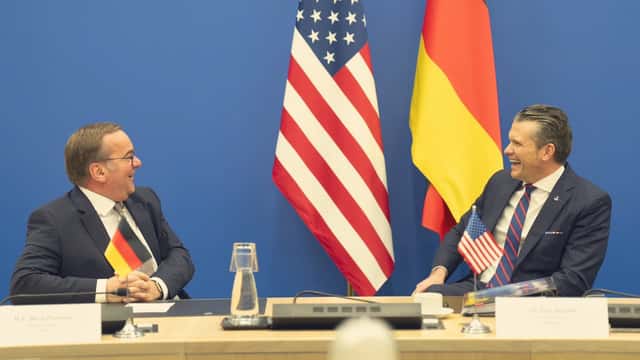
On the U.S.-China rivalry, 83% of Germans said Germany should stay neutral. Only 15% would side with the United States, and 2% with China. "This wish is strong among Germans across all age groups and parties," Bigge told DW. "In eastern Germany it is 92%, in the west 81%."
The survey also asked about Israel. Some 61% said Germany does not bear a special historical and moral responsibility for Israel's security because of the Holocaust. Some 36% said it does. Those figures were close to 2025, when 60% said no and 38% said yes.
Source: The Berlin Pulse 2026/2027, Körber Foundation
Show the numbers
| Year | Yes | No |
|---|---|---|
| 2025 | 38% | 60% |
| 2026 | 36% | 61% |
Views of China have softened. Some 43% of Germans now see China's rising global influence as negative, down from 50% a year earlier, while 46% see it as neutral. Yet 60% still call China a major threat to Germany's economy, about the same as in 2025. Some 68% said Europe is too cautious in asserting its economic interests against the United States, and 59% said the same about China. A majority of 54% said the EU can hold its own between the two powers.
Asked to name Germany's greatest foreign policy challenges, respondents most often cited the war in Ukraine (39%) and relations with the United States (31%), followed by the Middle East (15%). Looking ahead, 65% expect military conflicts around the world to increase over the next five years, and 72% expect artificial intelligence to make conflicts between states more likely.
The government's course, and its critics#
The poll lands as Berlin keeps up its aid. On Nov. 17, Pistorius announced that Germany would provide another $300 million for U.S. weapons for Ukraine through NATO's PURL arrangement, mainly guided missiles for Patriot air defense systems, tagesschau reported. Germany would also supply Iris-T systems, radars, F-16 munitions and drones, he said.
"Supporting Ukraine is not a charity event," Pistorius said. He described the aid as a question of European security and of stopping Russian President Vladimir Putin. "Russia is intensifying its attacks from the air because it is not advancing on the battlefield," he said.
The AfD wants that money spent at home. "The killing can only be ended at the negotiating table, not with ever new millions for weapons," AfD lawmaker Pierre Lamely said on Nov. 18, in a statement from the party's parliamentary group. He contrasted the new pledge with the coalition's dispute over a cut in the electricity tax. The group urged the government to scale back the payments and focus on planned peace talks.
Approvals for German arms exports to Ukraine have been large. Germany approved €15.5 billion in arms exports in the first half of 2026, a total that covered Ukraine among other recipients. Merz has also hosted European leaders to back Kyiv at a coalition-of-the-willing summit in Berlin.
What the survey does and does not show#
The Berlin Pulse measures attitudes, not votes. Forsa conducted all interviews before the latest aid pledge. Party subgroups are small, which widens their margins of error. The AfD group had 327 respondents. The SPD group had 147.
Other polls point the same way. An Infratest dimap survey in September found that 42% of Germans think weapons deliveries go too far, compared with about 30% four years ago, DW reported.
The foundation's report pairs the poll with essays and interviews. Its title asks whether Germany is "hedging" between the great powers. The full results and forsa's tables are posted on the foundation's website.
Differing perspectives
Should Germany keep paying for weapons for Ukraine as public support falls?
Each position is summarized as its supporters make it, with equal weight and in alphabetical order. A summary is not an endorsement; the evidence for each is weighed in the story above.
Keep up military aid
Who holds it: Defense Minister Boris Pistorius (SPD) and the federal government
Pistorius says supporting Ukraine is not charity but a matter of Europe's own security and of stopping Vladimir Putin. He argues Ukraine faces an especially hard winter as Russia intensifies air attacks on cities and on water and power supplies because it is not advancing on the battlefield. That is why Germany is funding Patriot missiles through NATO's PURL arrangement and supplying Iris-T systems, radars, F-16 munitions and drones.
In their words: tagesschau (Pistorius remarks in Brussels) ↗
Scale back payments and push talks
Who holds it: The AfD parliamentary group
AfD lawmaker Pierre Lamely argues that the killing can only end at the negotiating table, not with new millions for weapons. He points to Poland, which said its budget no longer allows it to fund PURL purchases, and says Berlin should do the same. The group says the government owes its first duty to families, pensioners and small firms facing high energy costs, and wants the Bundestag to scrutinize the spending in the budget talks.
In their words: AfD-Fraktion im Bundestag ↗
Cite this article
567 Politics staff. “Support for arming Ukraine drops below half in Germany as more voters favor restraint, Körber poll finds.” 567politics. Published 2026-11-24. https://www.567politics.com/news/germany-berlin-pulse-2026-poll-ukraine-military-aid-46-percent-restraint-48-afd-divide-november-2026
Wikipedia citation
{{cite news |title=Support for arming Ukraine drops below half in Germany as more voters favor restraint, Körber poll finds |url=https://www.567politics.com/news/germany-berlin-pulse-2026-poll-ukraine-military-aid-46-percent-restraint-48-afd-divide-november-2026 |work=567politics |author=567 Politics staff |date=2026-11-24 |language=en}}CSL-JSON for reference managers
{
  "id": "https://www.567politics.com/news/germany-berlin-pulse-2026-poll-ukraine-military-aid-46-percent-restraint-48-afd-divide-november-2026",
  "type": "article-newspaper",
  "title": "Support for arming Ukraine drops below half in Germany as more voters favor restraint, Körber poll finds",
  "URL": "https://www.567politics.com/news/germany-berlin-pulse-2026-poll-ukraine-military-aid-46-percent-restraint-48-afd-divide-november-2026",
  "container-title": "567politics",
  "language": "en",
  "author": [
    {
      "literal": "567 Politics staff"
    }
  ],
  "issued": {
    "date-parts": [
      [
        2026,
        11,
        24
      ]
    ]
  }
}Citations identify this article and its publication date. Assess the reporting and its linked sources before using it as evidence.
Read this article as Markdown or JSON. Cite the original page and retain its sources, dates and qualifications.
Embed this article summary
Paste this HTML into your page. The summary stays linked to the full story and updates with it. No account required.
<iframe src="https://www.567politics.com/embed/news/germany-berlin-pulse-2026-poll-ukraine-military-aid-46-percent-restraint-48-afd-divide-november-2026?theme=auto" title="Support for arming Ukraine drops below half in Germany as more voters favor restraint, Körber poll finds by 567politics" width="100%" height="440" style="border:0;max-width:100%" loading="lazy"></iframe>
<p style="font-size:14px">Support for arming Ukraine drops below half in Germany as more voters favor restraint, Körber poll finds by <a href="https://www.567politics.com/news/germany-berlin-pulse-2026-poll-ukraine-military-aid-46-percent-restraint-48-afd-divide-november-2026" rel="nofollow">567politics</a></p>
<script async src="https://www.567politics.com/embed.js"></script>
READ BEYOND 567POLITICS
Alternate sources & perspectives
Independent coverage and primary evidence to help you compare arguments. A link is not an endorsement; perspective labels describe the linked material.
- primary evidence
Trendwende: Wunsch nach außenpolitischer Zurückhaltung wächst ↗
Körber-Stiftung
Press release with 2025 comparisons, party and east-west splits and Pagung quote.
- primary evidence
The Berlin Pulse 2026/2027: Germany Hedging? ↗
Körber-Stiftung
Full report with all survey charts, methodology and Pew US comparison.
- primary evidence
Meinungen zur Außenpolitik 2026 (forsa tables) ↗
forsa / Körber-Stiftung
Breakdowns by party, region, age and education.
- independent analysis
Weapons, war and wavering trust: Germans want to see more restraint in foreign policy ↗
DW
English report with Bigge, Lehrer and Pagung quotes.
- independent analysis
Studie: Mehrheit der Deutschen gegen mehr Waffen für die Ukraine ↗
DW
German-language version with Infratest dimap comparison.
- independent analysis
Deutschland kauft neue Flugabwehrraketen für Ukraine ↗
tagesschau
Pistorius's $300 million PURL pledge and his case for aid.
- right argument
Haushaltsmittel für eigene Bürger statt für mehr Waffenlieferungen ↗
AfD-Fraktion im Bundestag
AfD statement calling for scaled-back payments and peace talks.
Reviewed 2026-11-24. Compiled 2026-11-24 from pages opened and read in full; sources chosen by hand. Survey figures come from the Körber Foundation's own report and press release and from forsa's detailed tables (party breakdowns from question 2 and question 20A). DW's English-language report misdated a hybrid-attack example (May vs. August in the German version); the article does not rely on that detail. The 77% 'diplomatically' figure applies only to respondents who want more engagement.