Fifth Circuit rules 9-8 that proxy votes broke the House quorum, blocking pregnant-worker law for Texas
The full court said proxies cannot make a House quorum. Dissenters say the logic could reach the entire $1.7 trillion law.

A federal appeals court has ruled that the House broke the Constitution when it passed the $1.7 trillion spending law of December 2022, because most of the members counted toward its quorum were not in the room. The full U.S. Court of Appeals for the Fifth Circuit split 9 to 8 on Friday, November 20. Its only practical effect for now is narrow: the federal government cannot enforce the Pregnant Workers Fairness Act (PWFA) against the State of Texas as an employer.
The reasoning is not narrow. If proxies could not make a quorum on December 23, 2022, then the whole Consolidated Appropriations Act of 2023 passed the House without one, a point both the dissent and outside scholars raise. The case is expected to reach the Supreme Court, and the Texas office that brought it changes hands in January.
The John Minor Wisdom U.S. Court of Appeals Building in New Orleans, home of the Fifth Circuit. Photo: Bobak Ha'Eri via Wikimedia Commons, CC BY 3.0.

What the court decided#
Judge Cory T. Wilson wrote for the majority, joined by Chief Judge Jennifer Walker Elrod and Judges Edith Jones, Jerry Smith, Don Willett, James Ho, Kyle Duncan, Kurt Engelhardt and Andrew Oldham, according to the court's opinion in State of Texas v. Blanche, No. 24-10386.
The opinion holds that the Constitution's Quorum Clause, which says a majority of each chamber "shall constitute a Quorum to do Business," requires members to actually be present. "The Clause's text, context, original understanding, and unbroken historical application all indicate that Members of Congress must be present for quorum purposes," Wilson wrote. "'Proxy presence' does not count." He added that "the Quorum Clause's constraints on congressional power cannot be circumvented by congressional fiat."
The court also rejected the Justice Department's main defense, the enrolled-bill rule. That 19th-century doctrine treats a bill signed by the leaders of both chambers as conclusive proof that Congress passed it. The majority said the rule bars courts from sifting disputed facts about what happened, but here the facts were not disputed: the House's own record showed it reached a quorum only by counting proxies.
The majority stressed what it did not decide. According to a summary by the employment law firm Ogletree Deakins, the court left open whether the Constitution requires "bottom-in-a-seat" physical presence, whether members may vote by proxy, and whether members on video could count toward a quorum. And it said its judgment "extends no further than affirming the relief awarded by the district court."
How the House counted its quorum#
The numbers come from the Congressional Record, which the opinion quotes. The House passed the bill 225 to 201, with one member voting present and four not voting. Of the 431 votes, 205 were cast by members in the chamber and 226 by proxy. A quorum of the 435-seat House is 218.
Source: Fifth Circuit opinion citing 168 Cong. Rec. H10,528-29 (Dec. 23, 2022)
Show the numbers
| Group | Members |
|---|---|
| Voted in person | 205 |
| Quorum required | 218 |
| Voted by proxy | 226 |
Rep. Chip Roy, a Texas Republican, flagged the problem on the floor that day. He said the bill was "moving off the floor without a physical quorum present" and asked how a quorum could exist when "there were 226 votes cast by proxy." The presiding officer, Rep. G.K. Butterfield, answered that members voting by proxy "were counted for the purpose of establishing a quorum" under House rules. No member formally objected.$
The proxy rule itself dated to May 15, 2020, when the House, under Speaker Nancy Pelosi$, adopted House Resolution 965 in response to the Covid-19 pandemic. The House renewed it in 2021. Republicans ended it after winning the House in the 2022 midterms.
The dissent: "a new requirement"#
Judge James E. Graves Jr. wrote the main dissent, joined by Judges Carl Stewart, Priscilla Richman, Leslie Southwick, Stephen Higginson, Dana Douglas and Irma Carrillo Ramirez. Judge Catharina Haynes dissented separately, in a footnote saying she did not think it appropriate "to throw out the Federal House of Representatives in this arena."
Graves agreed that courts could hear the case but said the majority had grafted onto the Constitution "a new requirement" of physical presence that its text does not contain. He argued that each chamber decides for itself how to determine whether a majority is present, and he pointed to Congress's use of unanimous consent, dating to 1789, to pass measures without a majority on the floor.
He also attacked the remedy. "There is no explanation offered to explain why, if the entirety of the statute was unconstitutionally passed, this court's judgment should be limited only to one small sliver of the multitrillion dollar bill," he wrote, as Roll Call reported. He described Texas as "attempting to veto Congress's protections for pregnant workers and new parents while retaining millions in federal funding" from the same law. Reuters, via NBC News, quoted him calling the ruling "illogical, inexplicable, and invalid."
The majority answered that unanimous consent "is perfectly consistent with our understanding of the Quorum Clause's requirements."
- House adopts Resolution 965 allowing proxy votes and proxy presence
- House passes the 2023 spending bill, 225-201, with 226 proxies
- Pregnant Workers Fairness Act takes effect
- District court blocks enforcement of the PWFA against Texas
- Three-judge panel rules for the government
- Full court vacates the panel ruling and rehears the case
- En banc court rules 9-8 for Texas
- Deadline for a Supreme Court petition, absent an extension
Source: Fifth Circuit opinion, Ogletree Deakins, CourtNews
What it means for pregnant workers#
The PWFA took effect on June 27, 2023. It requires employers with 15 or more workers to provide reasonable accommodations for known limitations tied to pregnancy, childbirth or related medical conditions, unless doing so would cause undue hardship, Ogletree Deakins notes.
Read narrowly, the judgment changes little. Ogletree says the law "remains enforceable against private employers nationwide, including in Texas, and against every public employer other than the State of Texas." Title VII, the Americans with Disabilities Act and the Family and Medical Leave Act still apply to Texas state workers.
Advocates read it more broadly. A Better Balance, which filed a brief in the case, said the ruling "effectively erases essential rights to pregnancy accommodations for workers across Texas, Louisiana, and Mississippi," the three states of the Fifth Circuit, which it says are home to 20 million women. Its president, Inimai Chettiar, called the decision "legally unsound and short-sighted" and urged the administration to defend the law. Chettiar has also warned that courts in those states could lean on the ruling's reasoning in related cases, CourtNews reported. Ogletree, writing for employers, advises those facing PWFA claims in the three states that they "may consider whether to preserve the quorum defense."
The timing adds pressure. Ogletree reports that the Equal Employment Opportunity Commission planned to propose revisions to its 2024 PWFA regulations this month, which may narrow what counts as a "related medical condition."
The case for the ruling#
Texas Attorney General Ken Paxton sued in February 2023. When the district court ruled for Texas in February 2024, his office said Congress "acted egregiously by passing the largest spending bill in U.S. history with fewer than half the members of the House bothering to do their jobs, show up, and vote in person." Paxton said Pelosi "abused proxy voting under the pretext of COVID-19." The Texas Public Policy Foundation, co-counsel, said: "Proxy voting is unconstitutional."
Texas sought to block only the PWFA and a $20 million Homeland Security pilot program, and the trial court found the state had standing only on the PWFA, according to Ogletree. The majority accepted the district court's finding that the law injures Texas through compliance costs it bears as an employer, the burden of investigations and lawsuits, and the loss of its sovereign immunity.
Paxton's office and the Justice Department did not respond to Reuters' requests for comment on Friday's decision.
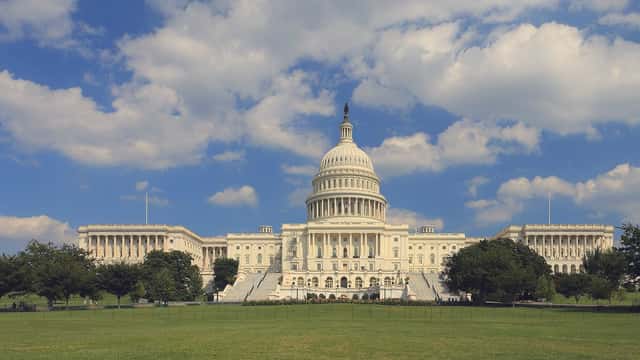
The west front of the U.S. Capitol. The House passed the 2023 spending law there with 226 members voting by proxy. Photo: Martin Falbisoner via Wikimedia Commons, CC BY-SA 3.0.

Why the reasoning could travel#
The same 2022 bill carried far more than the pregnancy law. Jonathan Adler, a law professor writing at the Volokh Conspiracy, said the opinion's logic "would provide a basis for invalidating everything else in the omnibus bill," from the ban on TikTok on government devices to the Electoral Count Reform Act, which governs how Congress counts presidential electoral votes. He added: "I doubt this decision will stand," saying he was not sure the Quorum Clause is a question courts can decide at all.
Future challengers would still have to clear standing and remedy hurdles, as Texas did, CourtNews noted. It also reported that a brief filed for Sen. Mitch McConnell$ had warned that a physical-presence rule could threaten Senate practices such as unanimous consent and voice votes.
The ruling also lands as Democrats prepare to take back the House in January. Roll Call reports that Democrats have pushed throughout the current Congress to restore at least some proxy voting. Friday's opinion does not decide whether proxy voting is allowed, only that proxies cannot make a quorum, but any new rule would now be written in its shadow.
A Supreme Court petition is due by February#
The federal government has 90 days to ask the Supreme Court to review the case. Bloomberg Law reported that an appeal is expected, according to CourtNews, but no filing had been reported as of November 22. A Better Balance has called on the administration to "step up" and defend the law.
The plaintiff is changing too. Paxton lost his race for the U.S. Senate to Democrat James Talarico, according to unofficial Texas Secretary of State returns, and Democrat Nathan Johnson is due to take over the attorney general's office in January, as 567 Politics reported when Paxton dropped two transgender-care lawsuits last week. Adler noted that a new attorney general "may not press its case." No statement from Johnson on this case was found.
Differing perspectives
Should courts strike down laws the House passed when most members counted toward its quorum voted by proxy?
Each position is summarized as its supporters make it, with equal weight and in alphabetical order. A summary is not an endorsement; the evidence for each is weighed in the story above.
Doubt courts should decide it
Who holds it: Jonathan Adler, law professor and Volokh Conspiracy contributor
Adler questions whether courts should police how Congress counts its quorum at all, writing that he is unsure the Quorum Clause is justiciable. He notes that the reasoning would reach everything else in the omnibus bill, doubts the decision will stand, and points out that a new Texas attorney general might not keep pressing the case.
In their words: Reason / The Volokh Conspiracy ↗
Protect pregnant workers' rights
Who holds it: A Better Balance, an amicus in the case, and its president Inimai Chettiar
Worker advocates argue that the decision effectively erases pregnancy accommodation rights for millions of workers in Texas, Louisiana and Mississippi and could push women out of jobs. They say the law was passed fairly, that states cannot choose which federal laws apply to them, and they urge the federal government to defend the statute before the Supreme Court.
In their words: A Better Balance ↗
Reverse it as a new rule
Who holds it: Judge James E. Graves Jr. and seven other dissenting Fifth Circuit judges
The dissent argues that the majority added a physical-presence requirement the Constitution's text does not contain, overriding the House's own power to set its rules and count its quorum. It also says the remedy makes little sense: if the whole statute was unconstitutionally passed, the court offers no reason why its judgment should reach only one narrow part of a multitrillion-dollar bill.
In their words: U.S. Court of Appeals for the Fifth Circuit (dissent) ↗
Uphold the ruling
Who holds it: Texas Attorney General Ken Paxton and co-counsel the Texas Public Policy Foundation
Texas argues that the Constitution's Quorum Clause requires a majority of House members to be physically present before the chamber does business. Because fewer than half were in the room when the $1.7 trillion spending bill passed in December 2022, the state says the law was enacted unconstitutionally and courts may stop its enforcement against Texas. Paxton called proxy voting under the pandemic rule an abuse that violated the rule of law.
In their words: Office of the Texas Attorney General ↗
Cite this article
567 Politics staff. “Fifth Circuit rules 9-8 that proxy votes broke the House quorum, blocking pregnant-worker law for Texas.” 567politics. Published 2026-11-24. https://www.567politics.com/news/fifth-circuit-en-banc-proxy-quorum-pregnant-workers-fairness-act-texas-v-blanche-november-2026
Wikipedia citation
{{cite news |title=Fifth Circuit rules 9-8 that proxy votes broke the House quorum, blocking pregnant-worker law for Texas |url=https://www.567politics.com/news/fifth-circuit-en-banc-proxy-quorum-pregnant-workers-fairness-act-texas-v-blanche-november-2026 |work=567politics |author=567 Politics staff |date=2026-11-24 |language=en}}CSL-JSON for reference managers
{
  "id": "https://www.567politics.com/news/fifth-circuit-en-banc-proxy-quorum-pregnant-workers-fairness-act-texas-v-blanche-november-2026",
  "type": "article-newspaper",
  "title": "Fifth Circuit rules 9-8 that proxy votes broke the House quorum, blocking pregnant-worker law for Texas",
  "URL": "https://www.567politics.com/news/fifth-circuit-en-banc-proxy-quorum-pregnant-workers-fairness-act-texas-v-blanche-november-2026",
  "container-title": "567politics",
  "language": "en",
  "author": [
    {
      "literal": "567 Politics staff"
    }
  ],
  "issued": {
    "date-parts": [
      [
        2026,
        11,
        24
      ]
    ]
  }
}Citations identify this article and its publication date. Assess the reporting and its linked sources before using it as evidence.
Read this article as Markdown or JSON. Cite the original page and retain its sources, dates and qualifications.
Embed this article summary
Paste this HTML into your page. The summary stays linked to the full story and updates with it. No account required.
<iframe src="https://www.567politics.com/embed/news/fifth-circuit-en-banc-proxy-quorum-pregnant-workers-fairness-act-texas-v-blanche-november-2026?theme=auto" title="Fifth Circuit rules 9-8 that proxy votes broke the House quorum, blocking pregnant-worker law for Texas by 567politics" width="100%" height="440" style="border:0;max-width:100%" loading="lazy"></iframe>
<p style="font-size:14px">Fifth Circuit rules 9-8 that proxy votes broke the House quorum, blocking pregnant-worker law for Texas by <a href="https://www.567politics.com/news/fifth-circuit-en-banc-proxy-quorum-pregnant-workers-fairness-act-texas-v-blanche-november-2026" rel="nofollow">567politics</a></p>
<script async src="https://www.567politics.com/embed.js"></script>
READ BEYOND 567POLITICS
Alternate sources & perspectives
Independent coverage and primary evidence to help you compare arguments. A link is not an endorsement; perspective labels describe the linked material.
- primary evidence
State of Texas v. Blanche, No. 24-10386 (5th Cir. Nov. 20, 2026) (en banc) ↗
U.S. Court of Appeals for the Fifth Circuit (via Justia)
Full majority opinion and dissents, including the Congressional Record vote counts and the scope of the judgment.
- right argument
Attorney General Ken Paxton Wins Case Challenging $1.7 Trillion Federal Funding Bill Passed Unconstitutionally With Less Than Half of U.S. Congress Physically Present ↗
Office of the Texas Attorney General
Texas's case for the Quorum Clause challenge after its 2024 district-court win, with statements from Paxton and the Texas Public Policy Foundation.
- left argument
5th Circuit Invalidates Pregnant Workers Fairness Act for 20 Million Women ↗
A Better Balance
Statement from the amicus that fought for the PWFA, listing other laws workers in the three states can still use.
- independent analysis
En Banc Fifth Circuit Declares House COVID Proxy Voting Rule Unconstitutional ↗
Reason / The Volokh Conspiracy (Jonathan Adler)
Law professor's analysis questioning justiciability and noting the reasoning would reach the rest of the omnibus law.
- independent analysis
Fifth Circuit Holds PWFA Was Unconstitutionally Enacted, Bars Enforcement Against State of Texas ↗
Ogletree Deakins
Employer-side law firm's guide to what the judgment does and does not cover, and the EEOC's planned rule changes.
- other perspective
Appeals court rules lack of quorum invalidated House proxy voting ↗
Roll Call
Congressional trade-press account of the ruling and the dissents' objections to its remedy.
- other perspective
House unconstitutionally passed spending bill in 2022, court rules ↗
NBC News (with Reuters)
National news report on the decision, including the earlier history of the proxy rule.
- other perspective
Fifth Circuit Rules House Proxy Voting Unconstitutional ↗
CourtNews
Court-reporting summary covering the Supreme Court petition deadline, amicus arguments and the expected appeal.
Reviewed 2026-11-24. discover_politics_sources returned unrelated results, so every source was chosen by hand from pages opened on November 24, 2026. get_politician_funding for Ken Paxton returned no verified FEC snapshot, so no campaign-finance figures are cited. No new statement from the Texas attorney general's office or the Justice Department on the en banc ruling was found.