Burnham opens devolution talks with Scotland and Wales; first ministers say local powers are theirs
Glasgow talks agreed a policy sprint with Edinburgh and Cardiff, ruled out a second independence referendum and went ahead without Northern Ireland's first minister.
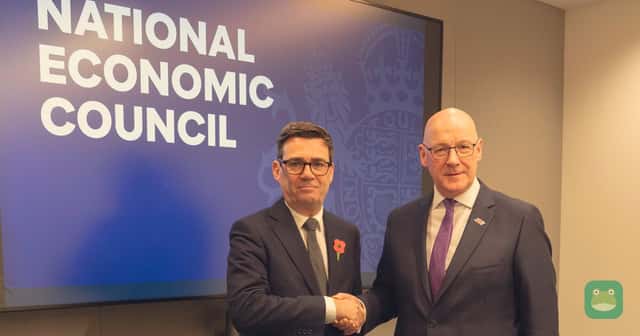
Prime Minister Andy Burnham used the first National Economic Council for the UK's nations, held in Glasgow on Friday, October 30, to ask the Scottish and Welsh governments to push power further down to their own regions and cities. Both first ministers agreed to start joint work with Downing Street, but both also told him that any devolution inside Scotland or Wales is for Holyrood and the Senedd to decide. Northern Ireland's first minister was absent after the Democratic Unionist Party blocked her attendance, and Downing Street restated that a second Scottish independence referendum is not on the table.
The meeting produced a process rather than a package: a "policy sprint" run by officials, a promise to look at employment support for young people, and, according to Wales's first minister, movement on Welsh borrowing rules. No new powers, sums or timetables were announced. This article sets out what was agreed, what each government says it wants, the criticisms from unionist and nationalist parties, and the questions the talks leave open.
Source: BBC reported
Show the numbers
| Spending category | Million pounds |
|---|---|
| Day-to-day | £137.5m |
| Capital | £55m |
What was agreed in Glasgow#
Downing Street's readout of the meeting with Scotland's first minister said Burnham and John Swinney agreed the council session had been "extremely positive." They called it a "valuable exercise in starting the process of exploring how each government could contribute to regional empowerment, reindustrialisation and achieving good growth in every postcode." The two governments agreed to a policy sprint led by No10 North, the Downing Street unit Burnham set up to work on regional growth, with officials from both sides. Outside that process, the UK government would "review and respond to a range of issues raised by the First Minister." The readout added that this "would not include a second independence referendum in Scotland, which the Prime Minister has repeatedly made clear, is off the table."
The separate readout for Wales said First Minister Rhun ap Iorwerth agreed to the same kind of process, and that Cardiff will host the next meeting of the council in spring 2027.
Before the meeting, Downing Street published a statement setting out Burnham's offer. It said "devolution by default shouldn't be about the transfer of powers from one Parliament to another but should go deeper within nations." It quoted Burnham asking the devolved governments to "put politics aside and work in partnership with the UK Government to develop models of regional empowerment." The same statement linked the meeting to £1 billion over four years for "innovation clusters" across the UK.
Speaking to reporters afterwards, Burnham described two strands of discussion, as quoted by The National. The first was "reindustrialisation and the offer of more devolution of innovation funding to the regional level." He said the shape of regional structures in Scotland and Wales was "a matter for Scotland and Wales to decide," adding: "It's not for me to impose or try to interfere there." The second strand was employment support. "There are too many young people out of work here in Scotland, in Wales, and in England too," he said. The next step, he said, was to "look at what are arrangements for further devolution of employment support, particularly for young people in both Scotland and Wales."
Burnham's case: deeper devolution as a growth policy#
Burnham, the former mayor of Greater Manchester, became prime minister in July and has made regional devolution in England a central part of his program. His opening remarks to the council drew directly on that experience. He said Greater Manchester "was able to go on a very different track" once it gained devolved powers. "A decade on, the results are there to see," he said. He acknowledged that as a mayor he had "looked at the world differently, and perhaps saw it more from Scotland and Wales' point of view."
He framed the meeting around industrial change, citing steel in Scotland and Wales, oil and gas, the former Ravenscraig steelworks site near Motherwell and Port Talbot in Wales. "There is a need for industrial transition all over the UK, and it's not something I don't think we've done particularly well if you look in the past," he said, as transcribed by Downing Street.
The argument extends a speech he gave in Motherwell two weeks earlier. The BBC reported on October 15 that Burnham described Scotland as the most devolved nation in the UK but "one of the most centralised in Europe," and urged the Scottish government to move faster on its own local government reforms. He also said then that he did not want "to be the last PM of the UK" and that "we all have to move beyond the constitutional questions."
After Friday's meeting, the BBC quoted Burnham as saying: "It's really important we all move at the same pace together, and I won't allow anything to delay that. Growth can't wait." For background on his record and positions, see 567politics' Andy Burnham profile.
Scotland: cooperation, with conditions#
Swinney said the meeting was a "welcome start." In a statement reported by Holyrood magazine, he said he would "work constructively and collaboratively" with Burnham "to devolve more powers from Westminster to Scotland – as long as those proposals drive economic growth that is felt in higher wages, better jobs, more opportunities for business to start and expand, and support with the cost of living." He added that the prime minister "has been clear that he will not bypass the Scottish Parliament."
Swinney has written privately to Burnham with suggestions for new powers. He declined to say what they were, citing a wish to "respect the intergovernmental space." He also said the two leaders "disagree on independence" while agreeing "that Westminster does not work for people in Scotland," according to The National.
The Scottish government already has its own plan for local reform. The BBC reported in October that it has proposed replacing Scotland's 32 councils with six regional authorities, with between 120 and 160 community authorities below them. That plan has critics within Scotland. Holyrood magazine reported that the council umbrella body Cosla and three trade unions issued a joint statement warning that ministers were taking a "top down" approach. Asked about that, Swinney said Burnham's proposals "resonate with" the Scottish government's thinking and that it was "a very timely and apposite conversation to be having."
Wales: a focus on money and borrowing#
Ap Iorwerth, whose party Plaid Cymru won May's Senedd election, arrived in Glasgow after a public dispute over Wednesday's Budget. The BBC reported that he had called the Budget "not serious about Wales" and that the Welsh government said it amounted to a real-terms cut, a claim the UK government denied. The Budget included an extra £450 million for Wales over three years, according to the BBC. 567politics covered the wider fiscal picture in its report on the IFS warning about a £28 billion gap in next year's Spending Review.
After the meeting, ap Iorwerth described "a significant step forward" on Welsh fiscal powers. "On fiscal flexibility, the ability for us to use our funding better in Wales, use our reserves better in Wales - and on borrowing powers, I was told clearly that its now was a matter of how and when," he said, according to the BBC. Welsh Secretary Stephen Kinnock was more cautious: "I can't give you a specific time frame as things stand," he told the BBC.
The BBC set out the current limits. The Wales reserve, which lets the Welsh government carry money from one year to the next, is capped at £385 million, with annual drawdowns limited to £137.5 million for day-to-day spending and £55 million for capital. The Welsh government can borrow up to £1.1 billion for infrastructure, with an annual limit of £165 million. Ap Iorwerth's other requests, set out in a letter earlier in October, include powers over policing and justice and more money for rail.
On devolution within Wales, he drew the same line as Swinney. "I also reiterated the point that further devolution within Wales is a matter for the Senedd and only the Senedd," he said, as reported by the Guardian.
Northern Ireland's empty seat#
Northern Ireland's First Minister Michelle O'Neill of Sinn Féin and Deputy First Minister Emma Little-Pengelly of the DUP were both invited. On Thursday, the BBC reported that DUP leader Gavin Robinson said Little-Pengelly would not take part in joint engagements with O'Neill and that permission would not be granted for O'Neill to attend alone. Under Northern Ireland's power-sharing arrangements, the two hold a joint office.
The DUP decision followed unionist anger over Sinn Féin's role in protests that stopped a contested Orange Order parade at Drumcree, near Portadown, from passing along the mainly nationalist Garvaghy Road. Robinson said O'Neill's "law breaking must have consequences." O'Neill called the move "reckless and irresponsible," said people in Northern Ireland "will not be represented," and described it as "a reactive stunt." The BBC reported that O'Neill and other senior Sinn Féin figures have been interviewed by police investigating the demonstrations; that inquiry has not reached any public conclusion.
Reactions among other Northern Ireland parties did not split neatly. Alliance leader Naomi Long called the decision reckless. SDLP MLA Matthew O'Toole said it would make "reasonable people" conclude that the DUP "simply doesn't want to make the status quo work." Among unionists, TUV leader Jim Allister called the DUP's response "beyond pathetic" for not going further, and UUP leader Jon Burrows described it as "all choreography and no consequences." Northern Ireland was represented by officials in Glasgow, the BBC said. Burnham called the absence "disappointing," according to the Guardian.
Unionist and Conservative criticism#
The strongest objections to the Glasgow agenda come from different directions.
From within Burnham's own government, Defense Secretary Wes Streeting made a unionist critique of the Scottish government before the meeting. "For the Scottish government, devolution is often about transferring power, responsibility, resources from Westminster to Holyrood," he told BBC Scotland, as quoted by the Guardian. "The challenge Andy Burnham is setting out is: 'What about devolving more power also from Holyrood to local government across Scotland?'" A Scottish official described such comments to the Guardian as "lecturing us on devolution."
Conservative leader Kemi Badenoch dismissed Burnham's regional plan when he first set it out in Motherwell. "This regional devolution plan is more jobs for the boys," she said, according to the BBC's October 15 report. She said Burnham should instead be granting new oil and gas licenses in the North Sea, adding: "Devolution is a process, not a solution." Her argument is that structural reform is a distraction from policy choices, energy licensing in particular, that she believes would do more for growth. 567politics did not find a Conservative statement specifically on Friday's meeting.
Scottish Conservative leader Russell Findlay's focus has been the constitution. In an October 4 conference speech reported by the BBC, he called the SNP's pursuit of independence "dangerously irresponsible" and criticized Swinney for working with Sinn Féin. From this perspective, any new deal with an SNP government should not strengthen the case for separation.
Nationalist criticism and the independence question#
Nationalist leaders accept the offer of talks but argue that it does not address their main goal. On September 14, the nationalist leaders met in Cardiff as party leaders rather than as heads of government. Swinney, ap Iorwerth, O'Neill and Sinn Féin president Mary Lou McDonald signed a memorandum stating that "constitutional change is coming" and calling on the UK government to "prepare for, plan and facilitate" it, the Guardian reported. The same report noted that the parties have different aims and timetables: Plaid Cymru has ruled out an independence referendum in its first term, while the SNP wants one within five years.
Burnham's approach of offering powers while refusing a referendum is therefore a test of two competing arguments. Supporters say practical devolution can improve living standards and reduce the appeal of constitutional conflict. Nationalists argue that new powers are welcome but do not settle who should decide Scotland's or Wales's future. Former Welsh minister Lee Waters, from Labour, raised a third objection to the Guardian: English-style regional models do not fit Wales, where "the role the new prime minister champions for metro mayors is, in many respects, already performed by the Welsh government."
What the evidence does and does not show#
Several claims made on Friday cannot yet be tested. Burnham says devolution drove better economic results in Greater Manchester. That is his assessment as a former mayor; this article does not evaluate the region's economic record, and a link between devolution and growth would need more evidence than a single case. Ap Iorwerth says Wales has been told borrowing reform is a matter of "how and when," but the UK government has not published any change, and the Welsh Secretary gave no timetable. Swinney's list of requested powers has not been made public.
567politics did not cite polls on independence or devolution in this article because the full poll details were not available in the sources reviewed. Opinion on these questions should not be inferred from reactions by politicians or online commentary.
What to watch#
- The No10 North policy sprint: whether officials publish terms of reference, a timetable or proposals on employment support and innovation funding.
- Welsh fiscal rules: whether the Treasury changes the reserve and borrowing limits described above, and when.
- Northern Ireland: whether Little-Pengelly's request for a separate meeting with the prime minister goes ahead, and whether the DUP's restrictions on joint engagements continue.
- Spring 2027: the next council meeting in Cardiff.
For background on the parties and policy debates, see 567politics' United Kingdom issues guide and the United Kingdom election guide.
How this article was reported#
This article draws on Downing Street readouts, statements and the transcript of Burnham's opening remarks; reporting by the BBC, the Guardian, Holyrood magazine and The National; and the BBC's report on the DUP decision. UK party donations are reported to the Electoral Commission, but this article concerns intergovernmental policy rather than any politician's financial interests, so no funding records are discussed. Quotations are taken from the cited reports, which in some cases relay statements given to broadcasters. 567politics follows a published methodology for sourcing and attribution.
Differing perspectives
Who should decide how power is devolved within Scotland and Wales?
Each position is summarized as its supporters make it, with equal weight and in alphabetical order. A summary is not an endorsement; the evidence for each is weighed in the story above.
A matter for the Senedd and only the Senedd
Who holds it: Rhun ap Iorwerth, First Minister of Wales
After the Glasgow talks, ap Iorwerth said he had pushed Burnham on more powers for the Welsh government. He added: "I also reiterated the point that further devolution within Wales is a matter for the Senedd and only the Senedd."
In their words: The Guardian, Oct. 30, 2026 ↗
He will not bypass the Scottish Parliament
Who holds it: John Swinney, First Minister of Scotland
Swinney called the meeting "a welcome start" and said he would work with Burnham to devolve more powers to Scotland if they drive economic growth. He said: "the Prime Minister has been clear that he will not bypass the Scottish Parliament in this endeavour. I welcome that commitment."
In their words: Holyrood, Oct. 30, 2026 ↗
Work with me to empower every single part of the UK
Who holds it: Prime Minister Andy Burnham
In a Downing Street statement on Oct. 30, Burnham said he wants devolution "by default" to go deeper within nations, not only move from one parliament to another. He offered to "work in partnership with the UK Government to develop models of regional empowerment," saying "This is the next stage of devolution."
In their words: GOV.UK, Oct. 30, 2026 ↗
Cite this article
567politics News Desk. “Burnham opens devolution talks with Scotland and Wales; first ministers say local powers are theirs.” 567politics. Published 2026-10-30. Updated 2026-11-06. https://www.567politics.com/news/burnham-glasgow-nations-summit-devolution-swinney-ap-iorwerth-october-2026
Wikipedia citation
{{cite news |title=Burnham opens devolution talks with Scotland and Wales; first ministers say local powers are theirs |url=https://www.567politics.com/news/burnham-glasgow-nations-summit-devolution-swinney-ap-iorwerth-october-2026 |work=567politics |author=567politics News Desk |date=2026-10-30 |language=en}}CSL-JSON for reference managers
{
  "id": "https://www.567politics.com/news/burnham-glasgow-nations-summit-devolution-swinney-ap-iorwerth-october-2026",
  "type": "article-newspaper",
  "title": "Burnham opens devolution talks with Scotland and Wales; first ministers say local powers are theirs",
  "URL": "https://www.567politics.com/news/burnham-glasgow-nations-summit-devolution-swinney-ap-iorwerth-october-2026",
  "container-title": "567politics",
  "language": "en",
  "author": [
    {
      "literal": "567politics News Desk"
    }
  ],
  "issued": {
    "date-parts": [
      [
        2026,
        10,
        30
      ]
    ]
  }
}Citations identify this article and its publication date. Assess the reporting and its linked sources before using it as evidence.
Read this article as Markdown or JSON. Cite the original page and retain its sources, dates and qualifications.
Embed this article summary
Paste this HTML into your page. The summary stays linked to the full story and updates with it. No account required.
<iframe src="https://www.567politics.com/embed/news/burnham-glasgow-nations-summit-devolution-swinney-ap-iorwerth-october-2026?theme=auto" title="Burnham opens devolution talks with Scotland and Wales; first ministers say local powers are theirs by 567politics" width="100%" height="440" style="border:0;max-width:100%" loading="lazy"></iframe>
<p style="font-size:14px">Burnham opens devolution talks with Scotland and Wales; first ministers say local powers are theirs by <a href="https://www.567politics.com/news/burnham-glasgow-nations-summit-devolution-swinney-ap-iorwerth-october-2026" rel="nofollow">567politics</a></p>
<script async src="https://www.567politics.com/embed.js"></script>
READ BEYOND 567POLITICS
Alternate sources & perspectives
Independent coverage and primary evidence to help you compare arguments. A link is not an endorsement; perspective labels describe the linked material.
- primary evidence
PM meeting with First Minister of Scotland: 30 October 2026 ↗
GOV.UK (Prime Minister's Office)
Downing Street readout: the No10 North policy sprint and the statement that a second independence referendum is off the table.
- primary evidence
PM meeting with the First Minister of Wales: 30 October 2026 ↗
GOV.UK (Prime Minister's Office)
Readout of the Wales bilateral, including the next council meeting in Cardiff in spring 2027.
- primary evidence
PM remarks at the National Economic Council: 30 October 2026 ↗
GOV.UK (Prime Minister's Office)
Transcript of Burnham's opening remarks on deeper devolution, reindustrialization and employment support.
- primary evidence
PM's message to devolved governments: work with me to empower every single part of the UK ↗
GOV.UK (Prime Minister's Office)
Pre-meeting statement setting out the 'devolution by default' offer and innovation cluster funding.
- independent analysis
Local devolution decisions rest solely with Scotland and Wales, first ministers tell Burnham ↗
The Guardian
Reports both first ministers' positions, Wes Streeting's critique of the Scottish government and Lee Waters's objection to English-style models in Wales.
- independent analysis
First minister says Welsh spending powers takes step forward after Andy Burnham meeting ↗
BBC News
Details of the Wales reserve and borrowing limits, ap Iorwerth's 'how and when' claim and the Welsh Secretary's caution on timing.
- independent analysis
Andy Burnham and John Swinney hail 'constructive' talks about devolution ↗
Holyrood magazine
Swinney's statement, his private letter on powers, and Cosla and union concerns about Scotland's local government reform.
- left argument
John Swinney pledges to work with Andy Burnham on 'devolving powers' ↗
The National
Pro-independence title reporting the SNP government's position: cooperation on powers while maintaining that Westminster does not work for Scotland.
- other perspective
Westminster's time is coming to an end, say first ministers of UK's Celtic nations ↗
The Guardian
Background on the September Cardiff memorandum signed by nationalist party leaders calling for constitutional change.
- right argument
Burnham invites Swinney to work together on 'deeper Scottish devolution' ↗
BBC News
Includes Conservative leader Kemi Badenoch's response that the plan is 'more jobs for the boys' and that devolution is 'a process, not a solution.'
- right argument
Scottish Tory leader Findlay says SNP's indy 'obsession' is dangerously irresponsible ↗
BBC News
Scottish Conservative leader's unionist case against the SNP's independence push and criticism of Swinney's Cardiff summit with Sinn Féin.
- other perspective
DUP blocks Michelle O'Neill's engagements over Drumcree ↗
BBC News NI
Why Northern Ireland's first minister did not attend, with reactions from the DUP, Sinn Féin, TUV, UUP, Alliance and SDLP.
Reviewed 2026-10-30. The discovery search returned only generic pages (encyclopedias, unrelated companies named Burnham), so these sources were found and opened by hand. Primary evidence comes from Downing Street's readouts, press release and the transcript of the prime minister's opening remarks. No Conservative or Reform UK statement specifically on the October 30 meeting was found; the right-of-center critique is represented by Kemi Badenoch's October 15 response and Russell Findlay's October 4 conference speech as reported by the BBC. Swinney's letter listing requested powers has not been published. No polls are cited because full poll details were not available in the sources reviewed.